Diverse Competition Mechanisms: The Deep Principles Behind Training Fun
Diverse competition mechanisms refer to designing more match segments with different rules for players during training, creating more ways and opportunities for competition. This article breaks down the design and application of competition mechanisms through two classic sessions, "Tower Strike" and "Double Shot", and explores the design principles behind offensive and defensive goals.
Introduction
You've surely seen this scene before: a group of kids lazily standing in line during training, taking one kick when it's their turn, then going back to waiting in line. The passing drills the coach carefully designed? The kids are completely unfocused.
But these very same kids transform the moment it's time for a match, fully engaged, fighting for every inch, eyes lit up.
Is it that the kids don't want to train? No. The training is missing one thing, a game format.
The same training content, with different game formats added, produces dramatically different results. It's like the same field and the same number of players, 4v4 and King of the Ball are two completely different experiences. Change the rules, and everything changes.
This is the core of what we're going to discuss today: How to make training different through the design of game formats.
Diverse Competition Mechanisms
The "game formats" mentioned here are exactly what we want to introduce today, a critically important coaching tool: diverse competition mechanisms.
Diverse competition mechanisms refer to designing more match segments with different rules for players during training, creating more ways and opportunities for competition.
A long time ago, Coach A asked in our group chat: what should I do when players are always unmotivated during juggling practice? Some people said to change the training content, others said to reduce juggling time...
In the end, Coach A adopted the following answer: whoever juggles the most each time gets to be captain. A week later, Coach A's feedback in the group was: "It's magical, now everyone practices juggling on their own, and the captaincy hasn't stayed with the same person for more than two days."
A dad with a professional football background arrived early with his child for extra practice, methodically helping the child practice "figure-8s."
Accurate instructions like "Go go go, speed up, lighter touches on the ball" gradually gave way to slightly reproachful comments like "Why are you slowing down again, you've only done a few and you're tired already, you hit the cone again."
The parent asked Coach B for help. Coach B set up a larger figure-8 course with cones for the dad and said: you two start at the same time and see who finishes five laps faster. Then the father and son played joyfully with laughter until training started.
These two examples represent the simplest application of competition mechanisms. Training with competition mechanisms added is like a game with game formats added, it increases the reward factor and replayability, turning a player from a "worker" into a "gamer."
A "worker" follows orders, rigidly repeats mechanical operations, and the ultimate goal is to complete the task; a "gamer" actively seeks solutions and creatively defeats opponents.
So what changes can the use of diverse competition mechanisms actually bring to our training? Next, I will explain in detail through two classic training sessions that Hobbit Academy students are all familiar with.
Tower Strike
In static training, sessions focused on the theme of "passing accuracy" often involve simple repetitive back-and-forth passing.
The "Tower Strike" session, by placing a "tower" in the middle and seeing who can hit it more times, introduces a head-to-head scoring format between two players. This instantly makes it one of the classic training exercises.
But an outstanding coach can bring more advanced game formats to this session, delivering even better training results.
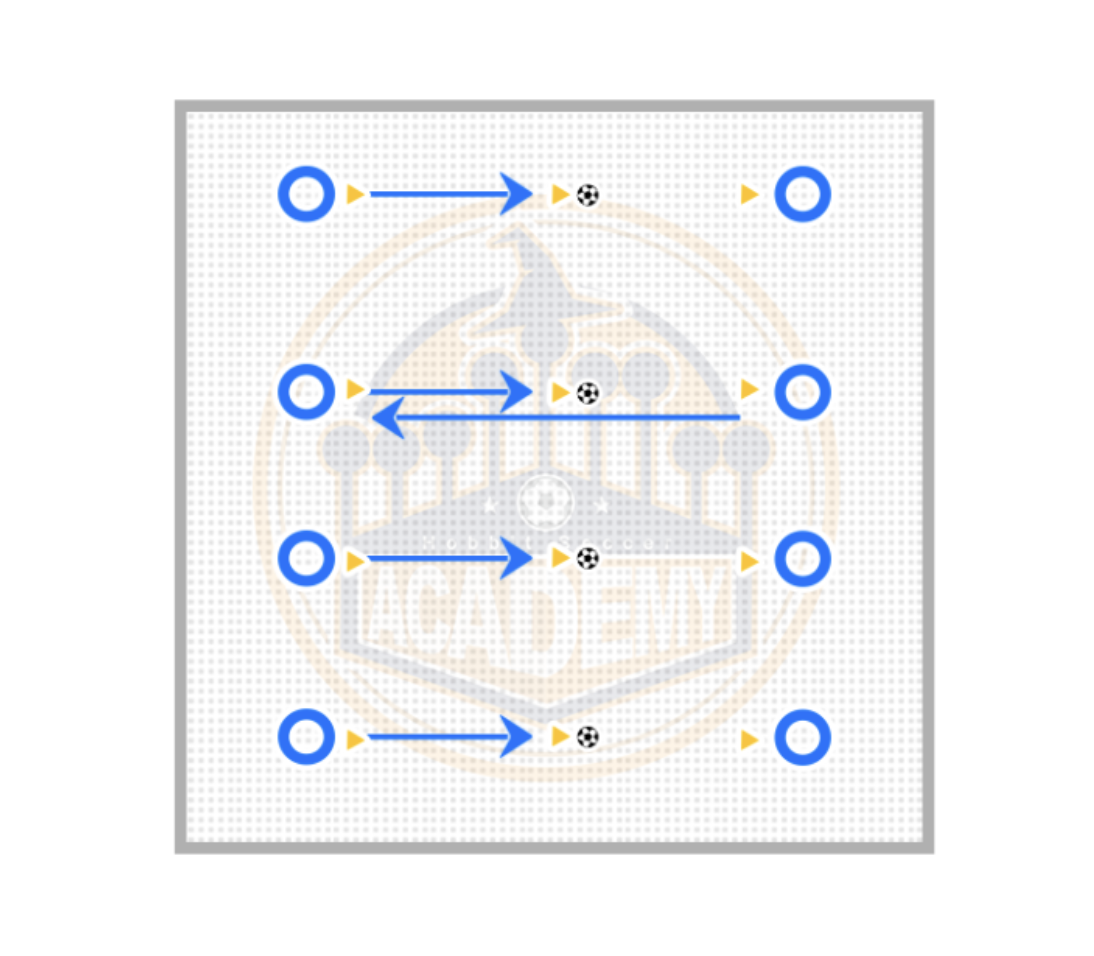
Training theme: Passing accuracy
Applicability: All age groups / All skill levels / Any number of players
Training outcomes: Higher inside-of-the-foot accuracy / Improved confidence in passing with other parts of the foot
Steps (Competition Mechanisms):
-
Pairs go head-to-head: a successful inside-of-the-foot Tower Strike scores 1 point; highest score within two minutes wins. Play one round.
-
Divide the four groups into four tiers: "Ligue 1 / La Liga / Premier League / Champions League." Each round's winner gets promoted, the loser gets relegated. Play several rounds.
-
Time: two minutes, see who scores the most among all players. Play one round.
-
Pairs go head-to-head: a successful outside-of-the-foot Tower Strike scores 1 point; highest score within two minutes wins. Play one round.
-
Four tiers: each round's winner gets promoted, the loser gets relegated. Play several rounds.
-
Time: two minutes, see which pair has the highest combined score. That pair swaps positions directly with the Champions League pair. Play one round.
-
Pairs go head-to-head: a successful instep Tower Strike scores 1 point; highest score within two minutes wins. Play one round.
-
Four tiers: each round's winner gets promoted, the loser gets relegated. Play several rounds.
-
Time: two minutes, see which pair has the lowest combined score. That pair swaps positions directly with the Ligue 1 pair. Play one round.
-
Pairs go head-to-head: inside of the foot = 1 point, weaker foot inside = 2 points, outside of the foot = 3 points, instep = 5 points; highest score within two minutes wins. Play one round.
-
Time: two minutes, see who scores the most among all players. Play one round.
-
See who is the fastest to reach 16 points among all players.
I'm sure you've noticed that every step within this session is a different type of competition, the entire session is composed entirely of competition mechanisms.
Whether for youth or adults, everyone thoroughly enjoys this session every time they play it.
While efficiently improving passing accuracy, everyone also starts to feel a surprising confidence in their non-dominant passing techniques! So how does this session achieve this effect? (Please refer back to the 12 steps above.)
-
First, it's a one-on-one head-to-head within your pair. All segments remain in a head-to-head format, ensuring everyone's high concentration.
-
Then we enter the Promotion/Relegation head-to-head. Every player not only wants to beat their pair opponent but also wonders if they can step by step defeat everyone. And even if you lose this round and get relegated, you still have the chance to start over and climb back up, so intrinsic motivation drives everyone to keep competing.
-
If you performed poorly in the Promotion/Relegation rounds, there's still a challenge-everyone head-to-head. Even if I'm in the "Ligue 1" tier, within two timed minutes I can still defeat a player way up in the "Champions League" tier.
-
Same as 1.
-
Same as 2.
-
Competition mechanism 3 at the end of the inside-of-the-foot segment is one-vs-everyone, giving each person a chance to come from behind. But at the end of the outside-of-the-foot segment, what's introduced is a pair-vs-pair competition to see which pair has the highest combined score. This in turn motivates two people who were opponents to work together to defeat other pairs, every pair wants to see if they can beat the "Champions League" pair.
-
Same as 1.
-
Same as 2.
-
At the end of the instep segment, yet another competition mechanism is introduced. The previous two techniques ended with comeback opportunities, but this time it's about seeing which pair will "collapse." Everyone will focus intently on holding their position to avoid being directly relegated to "Ligue 1."
-
The practice, or rather "groundwork", of the previous three different techniques finally leads to a format with differentiated point values. The less conventional the passing technique, the higher the score, so to win the match, everyone will voluntarily try the non-dominant techniques they practiced earlier. But this also starts with Promotion/Relegation.
-
Then every individual can challenge everyone else to see who scores the highest overall, concentration and intrinsic motivation surge once again.
-
Perhaps in competition mechanisms 10 and 11, most people will try more of the highest-scoring instep and outside-of-the-foot techniques. Competition mechanism 12 then uses the power of rules to make everyone combine various passing techniques, because you must use them this way for your score to reach exactly the target without "going bust."
So in these 12 tightly combined rounds of competition, all players performed high-frequency passing practice. To compete for victory, everyone also took every single pass very seriously. Everyone alternated between the disappointment of missing the tower and the joy of hitting it. Nearly every player competed head-to-head against one another. About a third of the players won at least one competition. Accuracy and confidence in non-dominant passing techniques undoubtedly improved dramatically, there were even cases where outside-of-the-foot or instep hit rates exceeded inside-of-the-foot rates. And in the final two "big matches," the luck factor is actually quite significant, so an unexpected champion is likely to emerge...
All kinds of wonderful experiences are woven into what could have been a very boring "passing accuracy" training theme. Through the relentless hammering of competition mechanisms, this session has become a classic demonstration lesson.
Improving passing accuracy as a teaching outcome may not be that hard, but improving confidence in weaker foot passing truly requires letting players experience success through repeated competition.
Double Shot
As one of the most frequently mentioned practical sessions in L1 coach training, what leaves the deepest impression about the Double Shot game, besides the precise coaching points, is definitely that elimination format.
It is precisely because of the clever use of this format that this simple little game achieves remarkably advanced training outcomes.
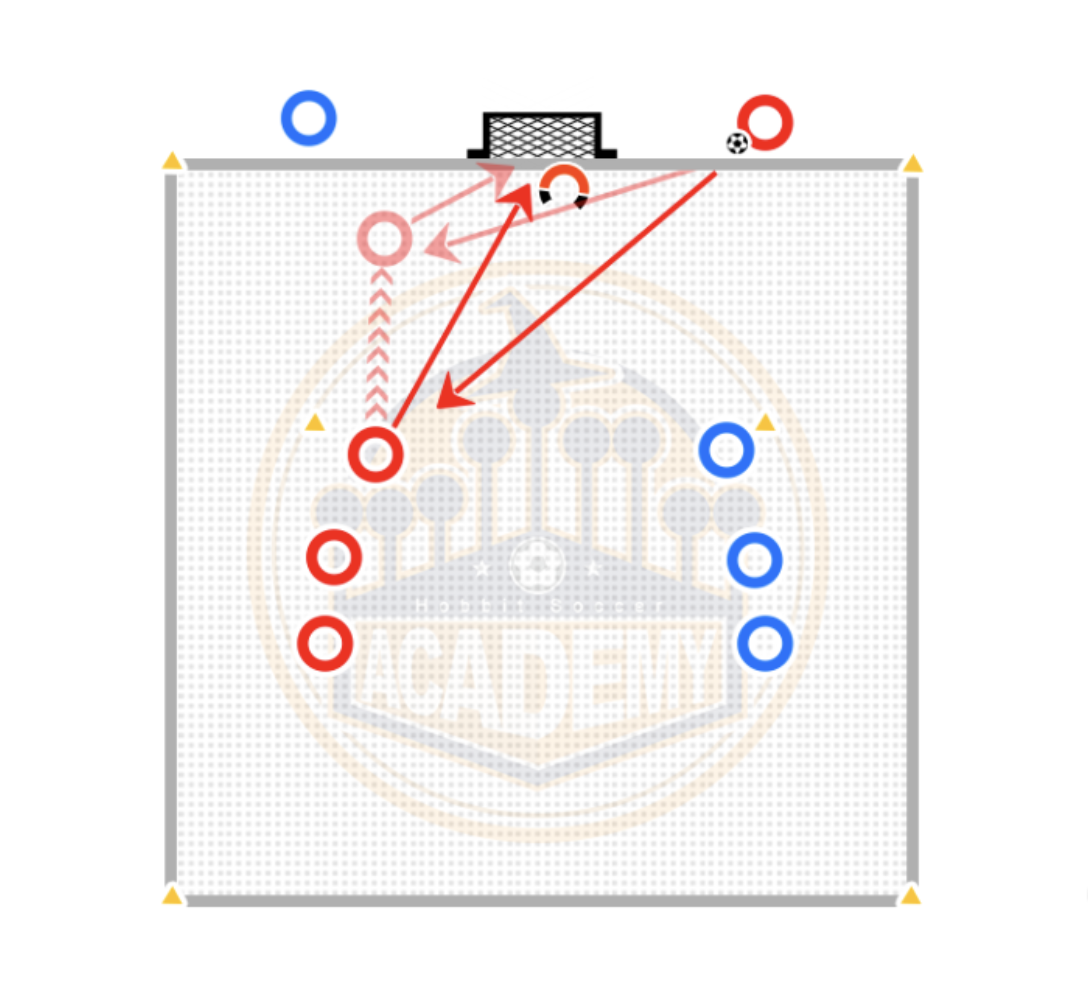
Training theme: Clinical finishing
Applicability: All age groups / All skill levels / Any number of players
Training outcomes: Higher quality inside-of-the-foot shooting / Awareness of follow-up shots / Stronger desire to score
Setup: All players except the goalkeeper are divided into two teams, each sending out one feeder. The feeder gives each shooter two consecutive balls. The first feed is a ground pass, and the shooter moves forward to complete a one-touch inside-of-the-foot shot. The second feed is a hand-thrown half-height ball, and the shooter, after completing the first shot, continues forward to complete a header. After one Red Team player finishes both shots, a Blue Team player goes, alternating in sequence.
Steps (Competition Mechanisms):
-
Each goal scores 1 point, see who scores the most overall.
-
Each goal scores 1 point, see which team scores more.
-
An inside-of-the-foot goal scores 1 point, a header goal scores 5 points, see which team scores more.
-
Scoring only one goal earns 1 point; scoring both goals earns 10 points, see which team scores more.
-
If you score one of two shots, you stay alive in the game. If you miss both shots, you're eliminated. If you score both, you choose to either challenge a designated opponent, or revive a teammate (the challenged player must score both or they're eliminated too). Whichever team has players remaining at the end wins.
Just like "Tower Strike," "Double Shot" is a training game that never gets old no matter when you play it, and it's an activity that both youth and adult players never tire of.
The reason for this is the unique use of competition mechanisms.
Having seen the first session example, I'm sure everyone can identify that competition mechanisms 1 and 2 are individual and team competitions respectively. The integration of competition mechanisms with the training theme begins with competition mechanism 3.
-
During steps 1 and 2, what's most likely to happen is: lots of inside-of-the-foot goals but few header goals; players are very focused on the foot shot but keep losing concentration on the header. And after each round, whether as a team or individually, scores are probably quite low. So the high bonus for header goals gives everyone a shot of adrenaline and also helps us better introduce the concept of "follow-up shot awareness."
-
When the high reward is given to headers and everyone becomes more focused on the second shot, we then need everyone to aim for scoring both goals. Therefore, scoring both goals for 10 points means that if even one person achieves it, it's practically enough to crush the other team. Concentration and intrinsic motivation surge dramatically.
-
The climax of the training is Double Shot's signature format, step 5! The ultimate training objective of "desire to score" is fully activated! If you score at least one goal you stay alive; if you miss both you're eliminated; if you score both you gain the power to influence the outcome.
So when you miss your first shot, to avoid elimination you won't lose focus, instead you need to finish the second goal even more calmly and with greater concentration. Isn't this exactly what a follow-up shot is in a real match!
If you scored the first goal, you'll want to score the second to change the game and become the hero! Or maybe some players could always manage to score at least one early on and didn't have a strong enough desire to score, but toward the end, maybe your team is down to just one or two players including yourself, the team competition mechanism will also force you to give everything you've got to turn the tide!
Cheers and gasps of surprise echo across the training ground. Everyone's performance becomes the talk of the session. During eliminations and challenges, everyone holds their breath. When a hero emerges, the whole field erupts...
Without even realizing it, everyone's shooting quality has improved significantly. But even more importantly, the training outcomes help everyone develop a stronger desire to score and better awareness of follow-up shots!
This is what we mean by the magical effects that diverse competition mechanisms can achieve when integrated into training.
More Application Scenarios
The previous sections presented two fairly complete examples of various competition mechanisms used in combination to achieve clear training objectives. Now let me share a few more competition mechanisms that I personally love, along with their application scenarios.
1. The "Cash Out" Format
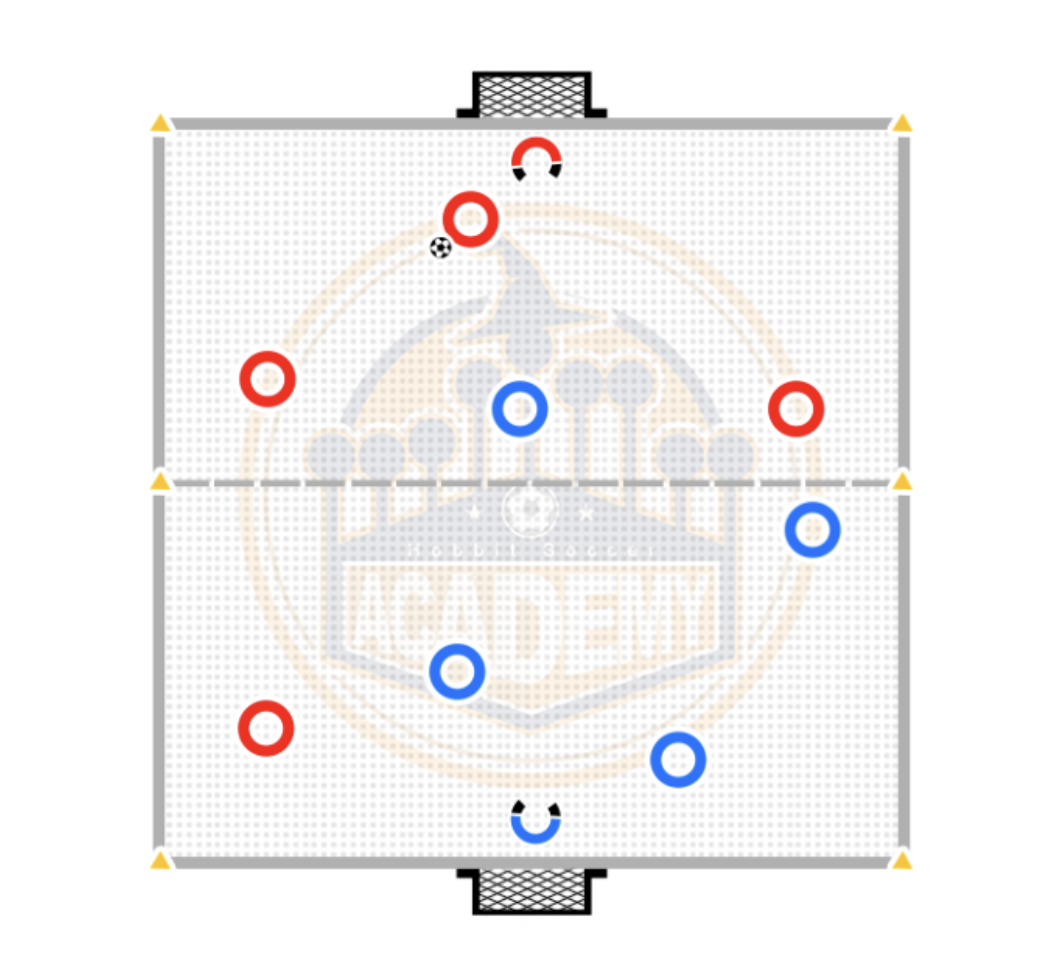
In various "conditional matches," the way to score always has different requirements.
For example, the Red Team scores points for the number of passes completed after crossing the halfway line, while the Blue Team scores one point for each successful dribble past an opponent anywhere on the field.
Or the Red Team earns one point for successfully passing to a designated forward, while the Blue Team earns one point for each successful tackle in the opponent's half.
Or the Red Team earns one point for winning a corner kick, while the Blue Team earns one point for winning a throw-in in the attacking half...
Conditional matches are inherently very tactically intentional and entertaining team competitions, but they can cause players to become "top-heavy", focusing on accumulating points while forgetting that the ultimate goal is to shoot and beat the opponent!
The "Cash Out" format serves as a corrective, helping players perform more in line with real match behavior and meet the coach's expectations.
In a "conditional match," all team points are merely virtual points. Your points only become "cashed out", only become valid, after you score in the opponent's goal.
This is the "Cash Out" competition mechanism.
So maybe your team has 20 virtual points and the other team only has 8, but if they score in the goal before the match ends and you don't, the final score is 8-0 in their favor.
Therefore, all players will, guided by the conditional match rules, seriously think about how these rules can effectively help them break through the opponent's goal, and that's when the conditional match truly becomes effective.
2. The "Streak" Format
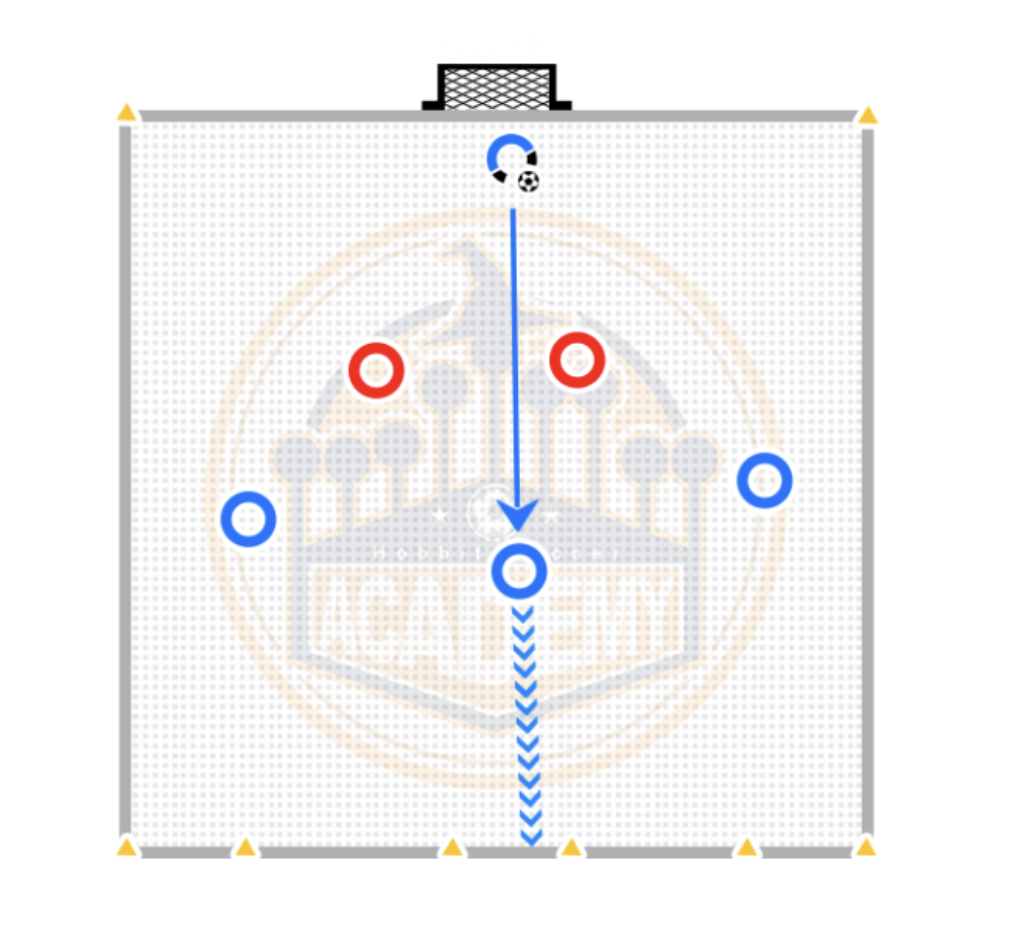
In certain training exercises, there are frequently situations where attacking and defending teams have fixed roles and tasks.
For example, in this segment, the Blue and Red teams each have 5 players who freely choose who goes on the field. The Blue Team is always the attacking side, scoring by dribbling through one of three small goals. The Red Team is always the defending side, tasked with defending and even scoring in the goalkeeper-guarded goal. Then both sides rotate.
In segments like this, it's common to see defensive players being passive, or even attacking players being passive.
Players often become passive because the other side scores easily, and regardless of how they perform, rotation happens anyway.
Not only is there rotation with the opponent, but also rotation with teammates, so intrinsic motivation, training intensity, and training outcomes are all suboptimal.
You might even see thinking like: "Since the coach is having us attack/defend continuously, it's normal that our defense/attack gets destroyed."
The "Streak" format works like this: each round is decided by an arbitrary score, say, first to 5 points, and the winning group gets to be the attacking side.
Just that one rule.
If the defending side stays passive, they'll be stuck on defense forever. And the players on the field being passive on defense also drags their teammates on the sideline into having to defend the next round too, so every defender encourages each other to try to beat the attacking side.
If the attacking players are passive, they'll immediately become the defending side. So every round is played at full intensity, and new attackers coming on will also fight hard to protect the results their teammates earned in the previous round.
This single competition mechanism immediately raises the engagement and intrinsic motivation of players on both sides. Training intensity and communication between teams improve instantly, and you even see a wonderful atmosphere of two teams cheering and shouting back and forth across the training ground.
3. The "Knockout" Format
Using the same setup as above, suppose the standard format is: the attacking side scores 1 point for dribbling into the goal, the defending side scores 1 point for winning the ball and passing to the coach, first to 5 points wins.
We've also added the "Streak" format, and everyone's having a great time.
But as training quality improves and coaching outcomes advance, the defending side finds it increasingly difficult to win. That's when we can introduce the "Knockout" mechanism.
Winning the ball and passing to the coach still earns 1 point as before, but if the defending team wins the ball and then scores in the goal, that's an instant win! This is the "Knockout" format.
The defending side's previous disadvantage and the attacking side's previous advantage are instantly reset to the same starting line. Both sides resume a fierce, edge-of-your-seat, high-intensity match, and at the same time it more closely mirrors real football!
I'm sure it's not hard to see that the theme of this segment is most likely something like "building up from the back." And indeed, while steadily pushing forward, there is a significant hidden danger, losing the ball in the defensive zone and facing the goal directly.
Therefore, with the "Streak" and "Knockout" formats combined, this training exercise becomes much closer to a real match scenario, and the training outcomes multiply.
4. The "King of the Hill" Format
In many exercises similar to "Tower Strike," there will inevitably be a large amount of 1v1 head-to-head content, such as individual attacking, individual defending, shielding the ball, turning, dribbling past opponents, and other training themes.
The "Promotion/Relegation" format isn't ideal here because the physical intensity would be too high, players would probably be exhausted after just three or four consecutive head-to-head matches.
So for these higher-intensity individual head-to-head themes, the "King of the Hill" format is more suitable.
After regular training, only one head-to-head stage remains, this is our arena. Players can volunteer to step up, or they can go in order.
This gives most players rest time after high-intensity head-to-head matches, while they also focus on "learning from" the players on the stage.
While weaker players get more opportunities to observe and learn, stronger players who last longer on the stage face challenges of stamina and mental fortitude.
There are two ways to determine the winner.
If you want to better encourage stronger players to compete for victory, then the person who defends the stage the longest wins. If you want to give more encouragement to weaker players, then the person who happens to be on the stage when the randomized timer ends wins.
Practical Significance in Training
If you think game formats in training are only about "motivation" and "replayability," it goes far beyond that!
Experienced coaches have surely already noticed the clues from my earlier examples.
Now let me walk everyone through what role diverse competition mechanisms play in our youth football training, and indeed in football training for all age groups and all levels.
1. Improving Concentration
What could be more engaging than a match! Matches are what players look forward to the most! The ultimate form of a match is the regular game at the end of training, where everyone splits into two teams to see who scores more.
What seems like an unremarkable game actually contains the most sophisticated combination of rules and competition mechanisms in human culture, and this is one of the reasons football has become the world's number one sport.
Other forms of competition are also matches! As long as we use competition mechanisms effectively, we can create activities that players can't resist, making them an important tool for improving player concentration.
2. Stimulating Intrinsic Motivation
Across all of Hobbit Soccer's content, intrinsic motivation has always been a frequently used term.
Diverse competition mechanisms happen to be a simple method for stimulating intrinsic motivation.
Different competition mechanisms can give players different challenges, creating the desire to break through their own limits.
Imagine if our training had no diverse competition mechanisms, only monotonous drills and crude, simplistic matches. Our stronger players might easily complete the training content and win matches, while weaker players might go an entire session unable to complete the training content and lose every match. Neither group would experience a sense of challenge, so intrinsic motivation cannot be stimulated, and training attitudes may remain persistently low.
But with the diverse competition mechanisms described above, stronger players can get opportunities to defeat opponents consecutively, defeat everyone, and even defeat the coach. Weaker players can get opportunities to beat someone of similar ability, or beat their own score from the previous round.
Guided by the challenge experience, every player will try to push beyond their own limits. Without needing excessive encouragement from the coach, they'll give their all to complete the training content on their own.
3. More Winning Opportunities
I'm sure all coaches are aware that no matter what, your squad will always have so-called "stronger players" and "weaker players."
As training continues over time, the halo effect and the Matthew effect become increasingly pronounced, stronger players keep getting stronger while weaker players keep getting weaker. Along with this comes a growing disparity in mentality and confidence between the two groups. Without question, this is a situation nobody wants to see.
One reason for the loss of ability and confidence in weaker players is that they rarely experience victory.
When our competition mechanisms are lacking or too uniform, there may be only one way to win in our training, and only a small number of people who can win. Players who haven't tasted victory in a long time will undoubtedly become increasingly marginalized.
Diverse competition mechanisms create numerous winning opportunities.
Maybe normally only one or two people win during training, but now perhaps every person within a week has won a different type of competition.
Never forget: weaker players need to experience the joy of winning even more than stronger players do! (We will discuss this in depth in the "Smile Rule" chapter.)
So, give careful thought to how you can incorporate more competition mechanisms into your training sessions.
4. Evaluating Training Outcomes
If the first three points were about the psychological effects of diverse competition mechanisms on players, now it's time to properly discuss their enormous help with training outcomes themselves.
When you finish a segment and progress to the next level of increased difficulty, you may find that everyone can't keep up. The most likely reason is that the training outcomes of the previous segment weren't properly achieved.
So my recommendation is: at the end of every segment, hold a competition, this is the best way to evaluate that segment's training outcomes!
If the previous segment was four-player continuous passing and receiving, and the next segment is a 1v4 rondo, then at the end of the previous segment, hold a one-touch passing competition to see which group of four has the most error-free passes in 2 minutes.
If the previous segment was dribbling with direction changes through various small gates, and the next segment is dribbling with direction changes through a defensive line, then at the end of the previous segment, hold a timed race through the small gates...
These are all very simple competition mechanisms, but with this competition in place, the coach can better discover things like: "Oh, it turns out their four-player group has quite a high error rate in continuous one-touch passing under high pressure," or "It seems their speed and accuracy in dribbling direction changes are quite good."
Then you'll know whether you can progress to the next step, or whether the previous segment needs more reinforcement.
5. Increasing Training Intensity
Following naturally from point 4, diverse competition mechanisms can also be used to adjust training intensity, and the primary focus is on increasing intensity.
It's not just the warm-up that needs to reach a certain level of physical activity. All subsequent segments actually need progressively higher intensity to achieve at minimum a "physical fitness" effect and the secondary benefit of improving "stamina" alongside the training.
Put simply: relay races are more intense than regular running; rondos are more intense than regular passing; timed competitions and scoring competitions are more intense than having no competition... The highest-intensity activities in training all occur during match segments.
So adding a competition at the end of each segment both evaluates training outcomes and increases training intensity, it's practically a standard, essential part of training.
Besides increasing training intensity, diverse competition mechanisms can also be used to decrease training intensity. For example, the "King of the Hill" format mentioned above is a great example. (We will discuss this in depth in the "Social Tools" chapter.)
6. Driving Training Progression
I won't elaborate further here. I believe the two training sessions "Tower Strike" and "Double Shot" described above have already demonstrated very well how competition mechanisms drive the progression of a training session.
The Design Principles Behind It
For most coaches, simply trying to intersperse diverse competition mechanisms throughout training is already a significant challenge. For coaches who are already familiar with diverse competition mechanisms, they can try, like the classic "Tower Strike" and "Double Shot" sessions, to complete an entire training session entirely through various combinations of competition mechanisms.
To achieve this, we first need a basic understanding of the principles behind competition mechanisms.
When designing competition mechanisms, beyond needing a detailed and rich understanding of the rules of various competition mechanisms, another important consideration is the underlying goal behind different formats.
Here we divide them into two types: "offensive goals" and "defensive goals."
Offensive goals are about "winner takes all." We motivate players to compete for victory, faster speed, more accurate passes, more touches, more powerful shots, stronger desire to win, and being more threatening.
Defensive goals are about "staying vigilant in times of safety." We motivate players not to make mistakes, safer ball handling, more comprehensive thinking, reduced risk-taking, and only pushing forward when it's relatively safe to do so.
These two goals correspond exactly to what psychologists call the "speed-accuracy tradeoff," and they also represent the opposing ends of the "speed vs. safety" spectrum in football training.
When we play faster, we often create greater threats for the opponent, but with higher accompanying risk. But playing slowly also has a cost, absolute safety alone cannot help us win, and it often requires extra energy and ability.
Returning to diverse competition mechanisms, which ones fit offensive goals?
Without question: various timed races, scoring competitions, seeing who scores the most, these are all offensive. King of the Hill, where players compete head-to-head to see who wins the most, is also offensive...
No matter the format, if only one champion is crowned in the end, it's offensive.
As for losers being eliminated, that's a standard defensive mechanism. Losing points for mistakes is also defensive. The person in last place at the end loses, that's defensive too...
No matter the format, if there is more than one winning individual (or group), it's defensive.
There are too many competition mechanisms under offensive goals, and I've already given quite a few examples above, so I won't repeat them here.
However, coaches may not yet be as familiar with or sensitive to competition mechanisms under defensive goals, so let me share one more brief example.
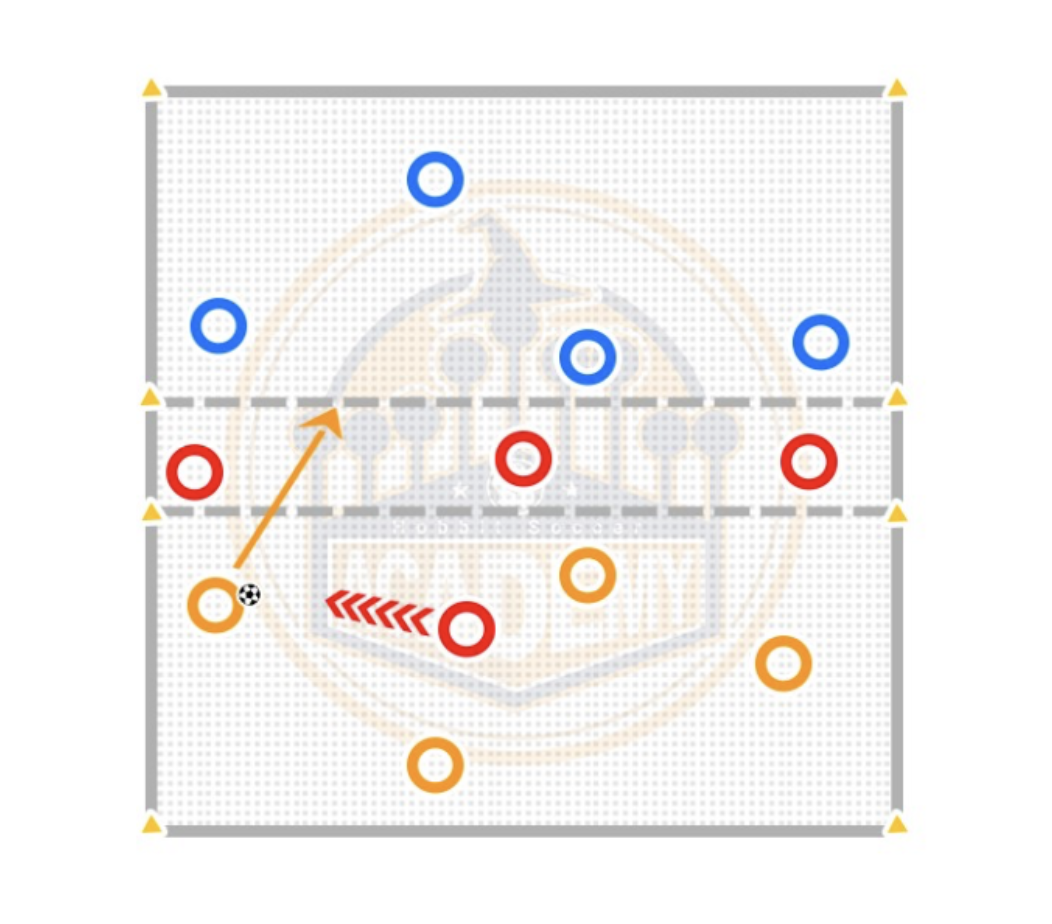
Another classic demonstration session familiar to all Hobbit Academy students, the "Through Pass" themed session's Happy Time (which will be discussed in depth in the Reverse Design Thinking chapter) is when three teams rotate.
The rules at this point are: players on both ends pass the ball through the middle defensive zone to count as safe. After the ball reaches one end, the middle group can send one player into that end zone to press. If the defending group successfully intercepts a pass in the middle or wins the ball in the end zone, it counts as a defensive success, and they immediately swap positions with the group that made the error.
The competition mechanism is: three minutes on the clock, whichever team is in the middle when time runs out loses.
So you can see that there is more than one winning side, this is a defensive competition mechanism.
It can equally demonstrate all six effects of competition mechanisms in a significant way: it improves concentration and intrinsic motivation, evaluates training outcomes and increases intensity, gives everyone more winning opportunities, and drives training progression.
However, the emphasis shifts, it's no longer "we need to be faster and win," but rather "we need to be safer and not lose."
Here's a thought exercise for everyone: among the various competition mechanisms mentioned earlier, which ones are defensive mechanisms?
Additionally, you should know that based on differences in each person's way of thinking, there is a high probability that they will respond very differently to different competition mechanisms.
Some people are easily motivated by offensive mechanisms, while others simply don't respond to them. Some people are naturally more sensitive to defensive mechanisms, no amount of positive incentives seems to work for them.
For example, in a standard offensive mechanism, one player consistently performs at a mediocre level without giving full effort. You realize that the offensive goal isn't giving them challenge or intrinsic motivation.
At that point, you can immediately adjust the rules to: the bottom ten performers will be eliminated. Perhaps their concentration and intrinsic motivation are instantly ignited, and they perform actively throughout the entire session.
Therefore, the mixed use of offensive goals and defensive goals is something coaches need to consider more carefully.
For example, the competition mechanism I use most frequently during warm-ups is a combination of offensive and defensive goals.
Groups of three pass and dribble in free movement. Time: one minute, see which group has the most passes. But if any ball collision or out-of-bounds occurs during the process, their score resets to zero.
An extremely simple little activity that contains both an offensive mechanism and a defensive mechanism. This is what makes each group pursue speed while also maintaining safety. At the same time, everyone's performance more closely mirrors a real match, more observation and decision-making, with quite a few reversals from advantageous positions. Everyone enters the following segments in a lively atmosphere.
All in all, "diverse competition mechanisms" as a commonly used coaching tool in the "coach's toolbox" is perhaps the most fundamental yet visibly effective entry-level tool.
Specific examples are too numerous to list. I believe that as coaches encounter various teaching materials in their daily practice, as long as they maintain sensitivity and awareness of competition mechanisms, they will surely accumulate plenty of game formats, dramatically improving both the enjoyment and training outcomes of their sessions.
Great training starts with designing your competition mechanisms well.