Team Ball Possession: 7 Core Coaching Points
Teaching players the correct approach to team ball possession during their youth development years is critically important. This article uses a classic possession training exercise to explain in detail 7 core coaching points: more threatening passing lanes, body stance and positioning, first touch, the importance of playing forward, angles between teammates, distance between teammates, and creating space for teammates.
Team Ball Possession
In the world of adult football, every team has a distinctly different style, but they can broadly be divided into two types: possession-based and attack-based.
In the world of youth football, there are certainly training exercises with different themes such as possession and attacking as well.
But without question, all teams at the youth level should establish a team possession-based mindset and develop the ability to support it, preparing them for higher levels of football in the future. Whether we look at the Dutch Total Football philosophy that first introduced the concept, or the dominant forces that have ruled world football in recent years, Barcelona, Spain, Germany, and other mainstream footballing powers, the possession philosophy has always been regarded as synonymous with beauty, elegance, and even the key to victory.
How to teach our young players the correct approach to team ball possession during their youth years is of paramount importance. And how to design sessions and explain coaching points so that children can explore and discover the essentials of team possession through repeated thinking and practice in match-realistic environments, that is what truly tests a coach's ability.
Team Possession Training Design Example
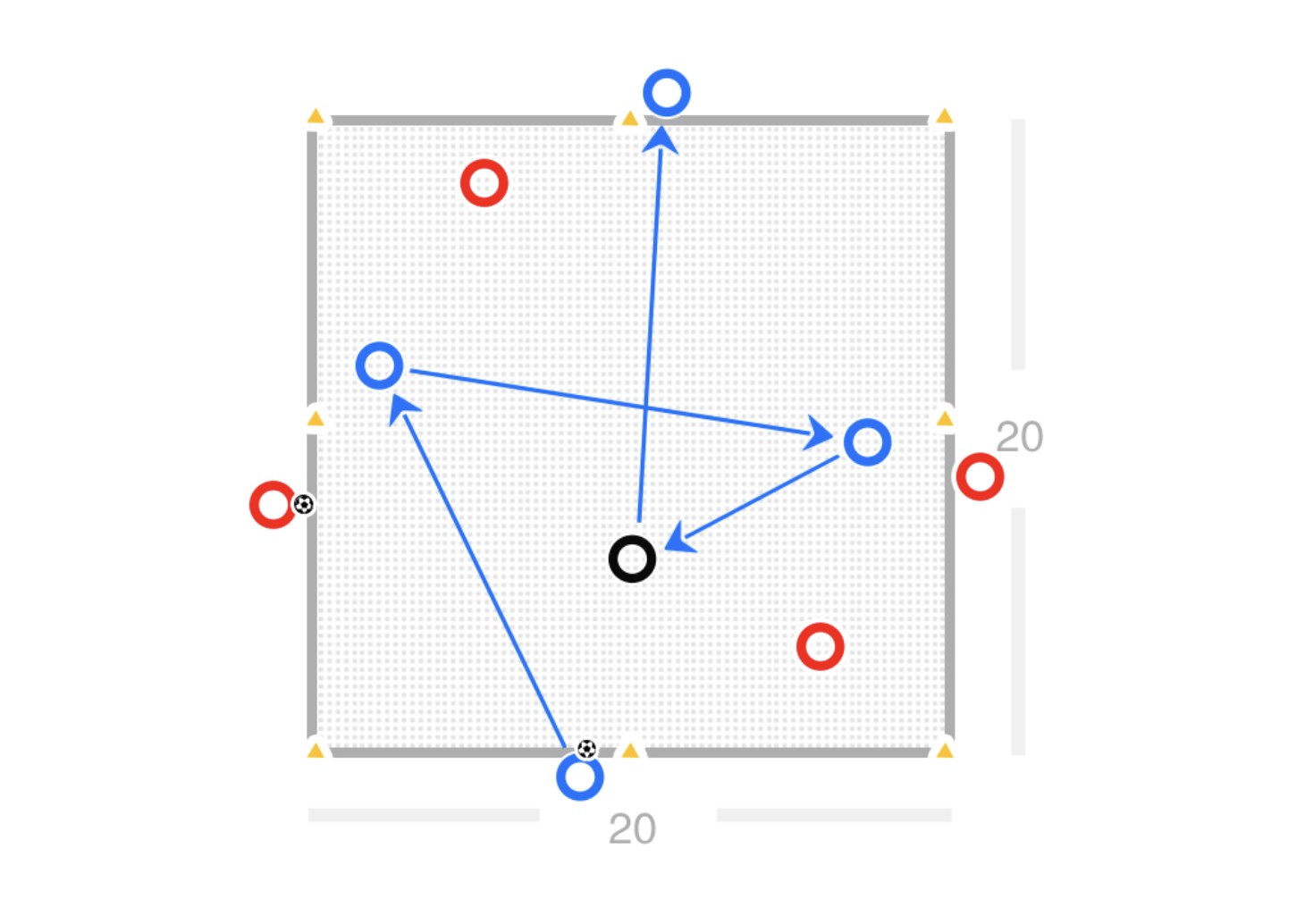
-
The number of central players can be flexibly adjusted based on the total number of participants;
-
Each team has two players standing outside opposite sidelines;
-
The ball is passed from one side to the other, with both channels operating simultaneously, ensuring that the ball moves between players with different balls crossing paths, and every player touches the ball at least once.
1. More Threatening Passing Lanes
The fundamental principle of team possession is to keep the ball within your own team, not to give it away easily, and to maintain firm control of the initiative.
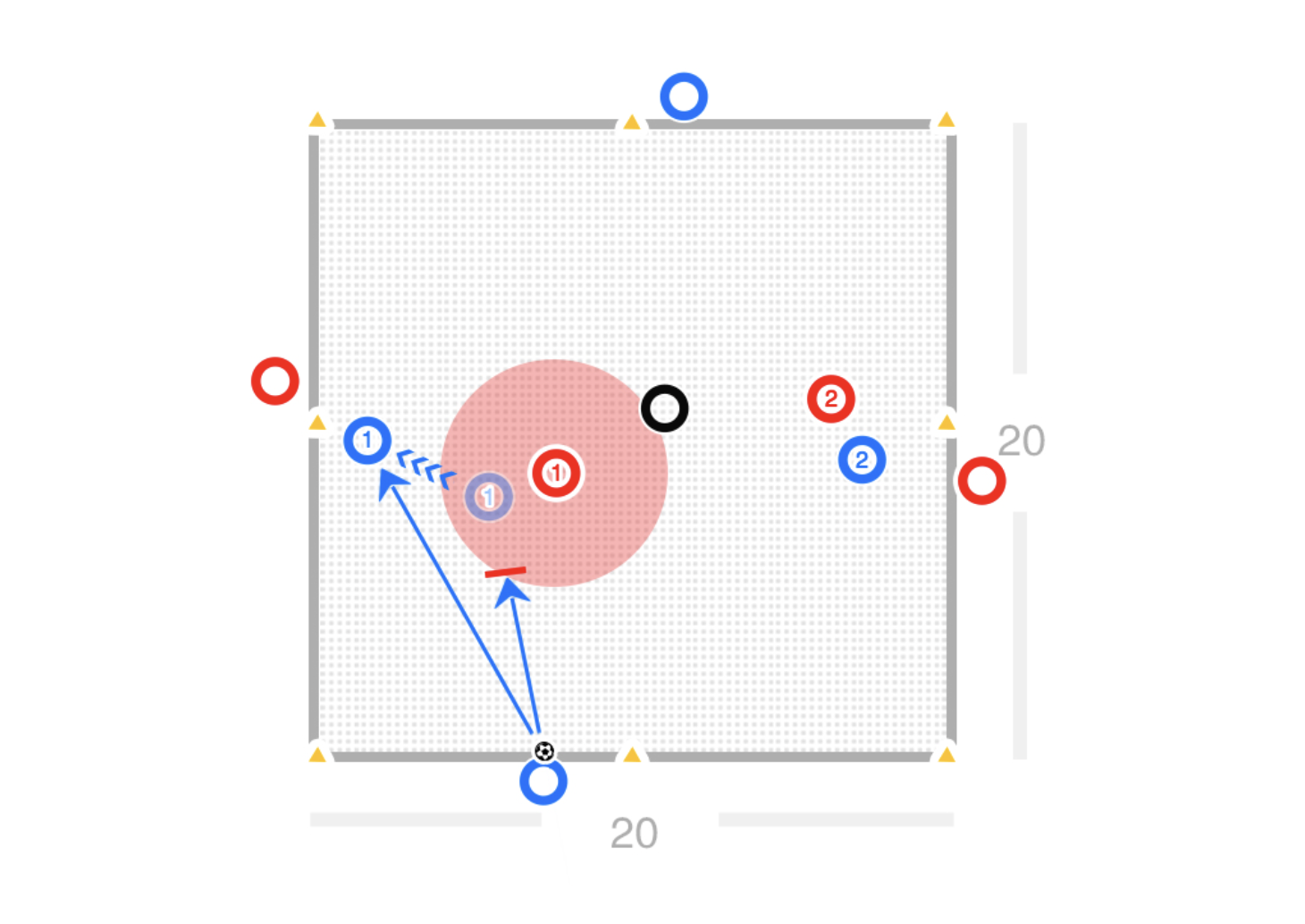
Off-the-ball players in the process of receiving need to consider the receiving situation, their receiving movement, their first touch, the next passing option, the positions of defending players, and many other factors. They need a sufficiently large opening to ensure they can handle the ball comfortably.
Therefore, when the passing lane is not threatening enough, forced passes often lead to unnecessary turnovers. Off-the-ball players should actively find a larger opening through their own movement and observation.
Meanwhile, the player on the ball, when under no or minimal pressure, should scan the field to identify the teammate with the largest opening and the most threatening passing lane, maximizing the fluidity and safety of the team's passing.
2. Personal Body Stance and Positioning
Many players encounter this problem.
During training and friendly matches they can receive the ball comfortably, but in real competitive matches, the moment they get on the ball it gets disrupted, or they get blocked by the opponent, leaving them unable to execute.
This is closely related to personal body stance and positioning in team possession. A closed body position, facing directly toward the passer, prevents the player from properly observing what is behind them, leading to immediate dispossession the moment they turn.
Choosing a side-on stance instead, an open body position that allows them to face the direction of the incoming ball while also seeing the direction of the next pass, gives them a much better field of vision.
Encourage wide players to face away from the sideline as much as possible. On top of maximizing their field of vision, they should use their far foot to receive the ball, allowing them to handle every pass with composure and confidence.
3. First Touch
Once we adopt a side-on stance and an open body position, we gain a better field of vision.
On that foundation, we can calmly choose the direction of our next pass.
The first touch of wide players, when safe to do so, should be encouraged to move the ball forward, and then directly complete the task of passing to the teammate at the opposite end.
Central players should also be encouraged, when safe to do so, to receive and turn in one motion, with a first touch that takes the ball forward, completing the task of passing to the teammate at the opposite end.
4. The Importance of Playing Forward
Excessive pursuit of ball retention devolves into sideways passes and backward recycling. Therefore, what we are discussing here is the importance of actively playing forward, through a progressive touch, a forward carry, or a forward pass, while maintaining possession.
Within a given area, when the team in possession has a clear advantage in the play, it usually means they have earned a better opportunity to advance.
Positively driving forward enables them to convert their advantage into tangible results, such as a shot after a breakthrough, a central penetrating pass, or a cross from the byline. Conversely, excessive pursuit of ball retention without recognizing the right moment to play forward is very likely to create enormous pressure and the risk of losing the ball for the team's own passing game.
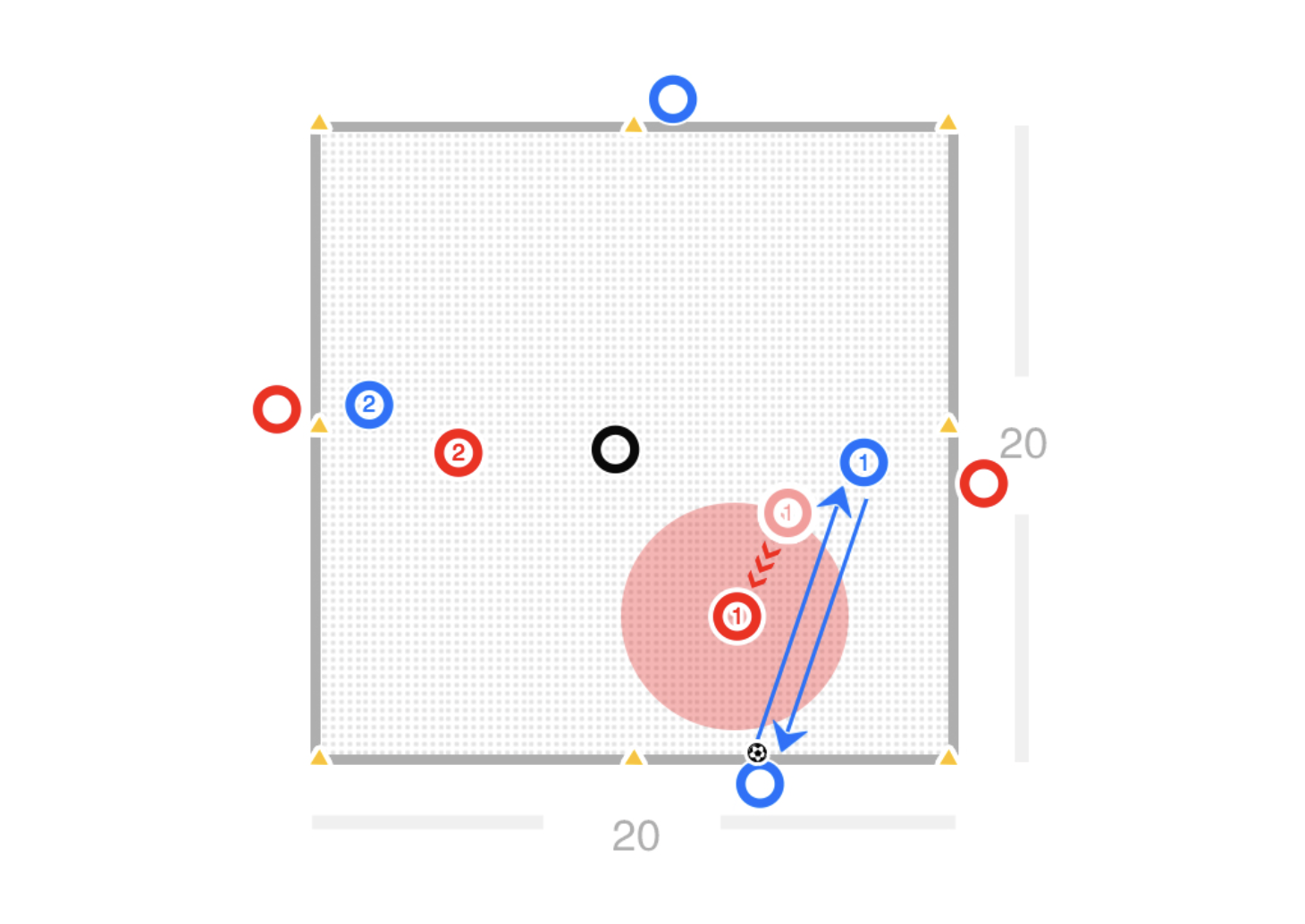
As shown in the diagram, although Blue 1 is closely marked by Red 1 when receiving the ball, he already has the advantage to play forward.
He chose not to take the ball forward, but instead chose to control possession and pass backward.
Red 1 seized the opportunity to press aggressively, cutting off the passing lanes to the blue player below, and to the central player between Blue 1 and Blue 2, all receiving options were completely shut down.
5. Angles Between Teammates
Please make sure your players understand during training the relevance of this exercise to real matches. In a possession exercise like this, the scenario closely mirrors a real game, enabling players to better understand how their judgment and decisions will impact an actual match.
The player on the ball on the outer edge has a relatively safe environment but needs to pass the ball to a teammate 20 to 30 meters away on the opposite side, with different support, passing, and receiving options available on both flanks and through the middle.
At the same time, two defending players are positioned in the center to intercept. You will notice that the players correspond to positional relationships such as center-back to full-back to midfielder to striker, or goalkeeper to full-back to center-back to midfielder.
In a technical exercise like this, the two blue players on the outside will naturally move laterally to offer themselves for the ball. Blue 1 and Blue 2, meanwhile, need to move constantly to maintain a triangular positional relationship with their teammates.
The key teaching focus here is the central player. It is very easy for the wide players and the players at both ends to maintain a triangle, but the triangular positioning among the central player and the two wide players is frequently overlooked.
When all three stand in a straight line, the central player cannot observe what is behind them, and at the same time blocks the passing lane between Blue 1 and Blue 2, allowing a single defender, Red 1, to completely shut down all of the blue team's passing options.
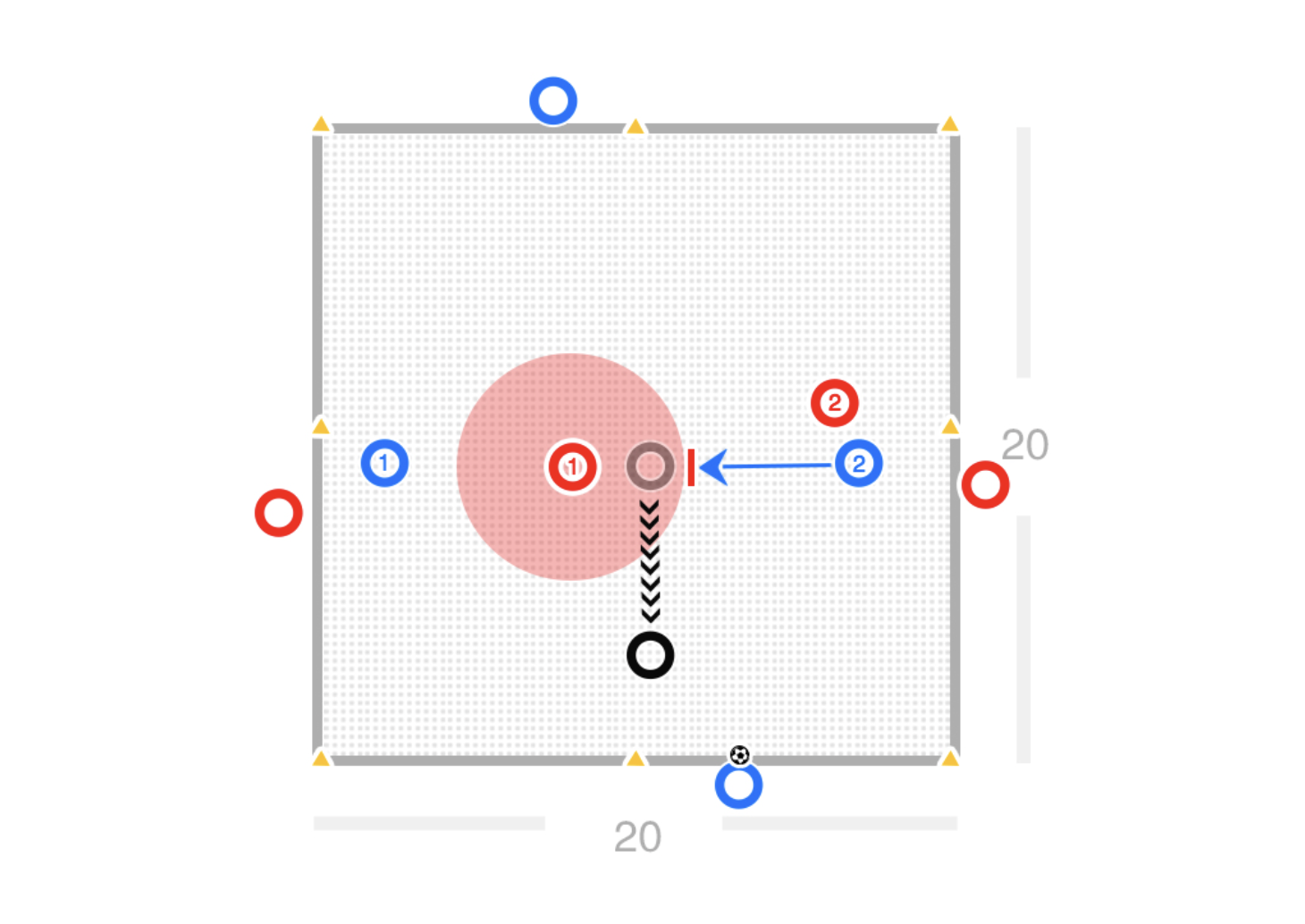
By encouraging and reminding the central player to maintain a triangular position with the wide players, their scanning frequency and awareness of their own running lines will undoubtedly improve significantly.
As a holding midfielder (or central midfielder), good habits of thought when coming to receive the ball will gradually take shape.
6. Distance Between Teammates
Many players have the habit of actively coming forward to support and receive the ball, but this is not always beneficial for possession. When facing opponents who defend tightly, coming too close to the player on the ball attracts opposition defenders to converge, creating a situation where multiple blue players are clustered in a small area, generating enormous pressure and the risk of losing the ball for their own team.
When this happens in training, guide the players to think for themselves and identify the problem. Have them try maintaining an appropriate distance, or even a greater distance, and see what effect it has on their team's possession.
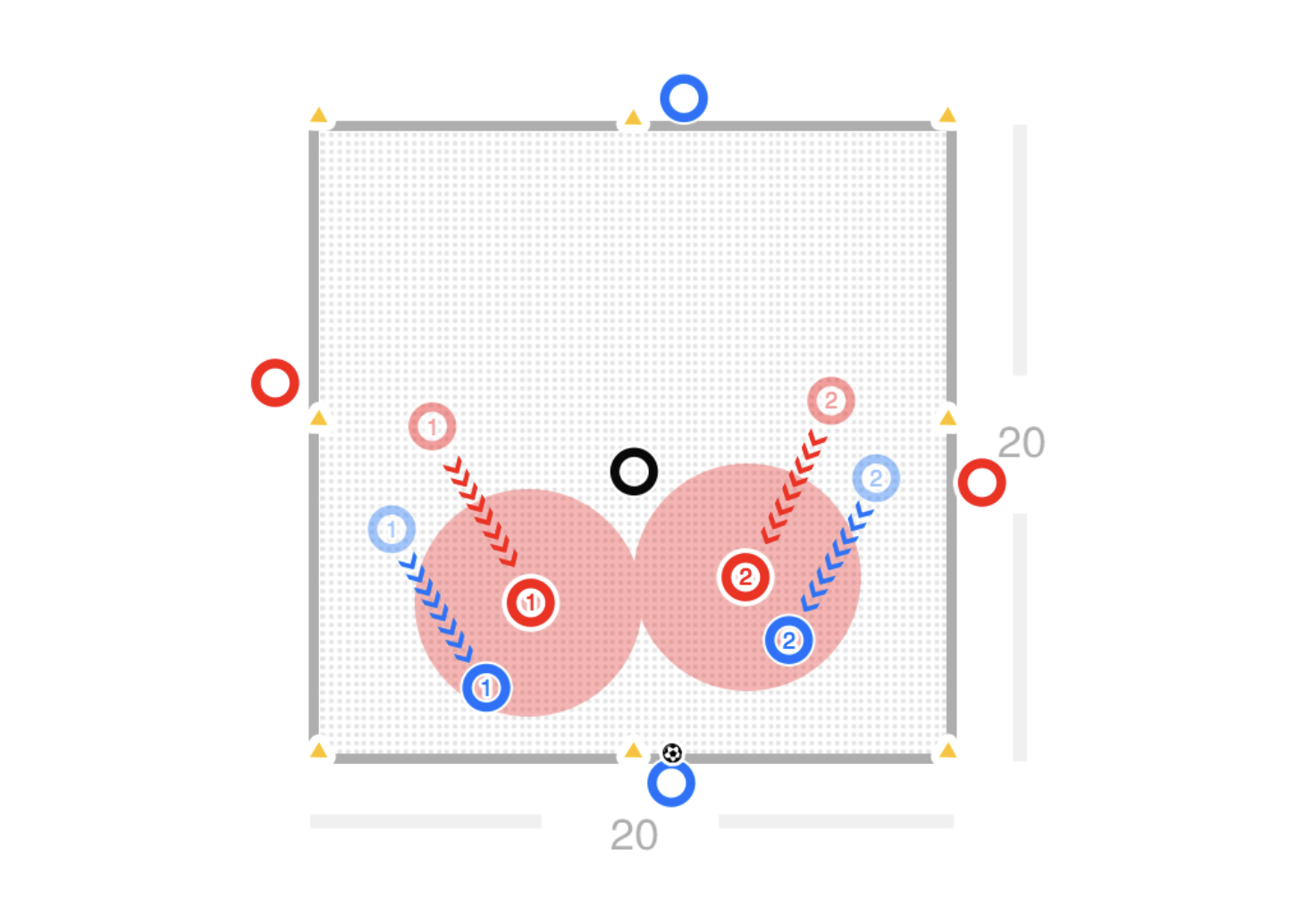
Blue 1 and Blue 2 close down their supporting distance, while Red 1 and Red 2 press tightly. At this point, the defensive coverage of the two defending players already covers all passing lanes. For the player on the ball, playing as a center-back or holding midfielder, handling the ball under such high pressure is undoubtedly the most dangerous situation.
7. Creating Space for Teammates
Good players actively offer support, but excellent players know when to offer support. Good players are constantly trying to "join in" on attacks, wanting to touch the ball more and contribute more. Without question, this is something to be encouraged!
However, as coaches, we should help players understand how to better "join in" on the possession game, rather than continuously making "ineffective" runs. As mentioned above, maintaining distance from the player on the ball can prevent space from being compressed in a small area. So what other benefits does this bring?
When a defender is marking you tightly, by consistently maintaining your distance from the player on the ball, you will find that space for your teammates is being created by your positioning.
Imagine this: if you are in a 3v2 situation and one defender is drawn toward you into a peripheral area, within the same effective playing area the situation becomes 2v1. That undeniably creates the greatest advantage for your teammates, a complex situation is instantly simplified.
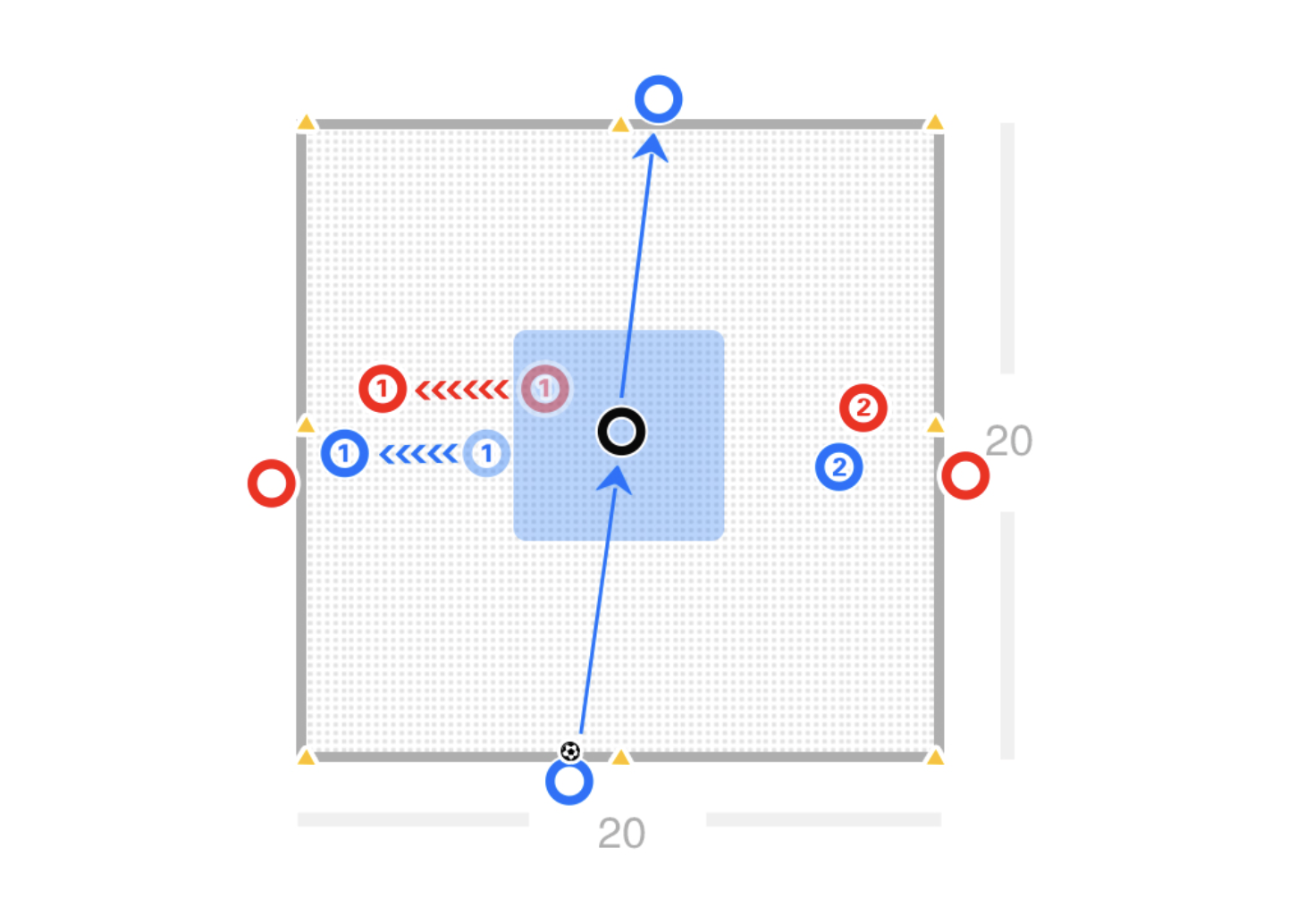
Through the guidance of this coaching point, players will better understand how to truly "join in" on team possession, discover the right timing to make runs and receive the ball, and genuinely learn to "read" the game!