FA FutureFit Explained: Why Every Seven Year Old in England Must Play 3v3
From the 2026/27 season, the FA mandates 3v3 as the entry format at U7: no referees, no goalkeepers, no recorded scores. FutureFit is the biggest reform of English youth formats since 2012. What changes, the evidence behind it, and how a governing body actually forces a change like this through.
Picture a Saturday morning in autumn 2026, somewhere in England.
A pitch 10 metres wide and 15 metres long. Three children on each side, all of them seven years old. No referee. No goalkeeper. No substitutes' bench.
Who kicks off? Two kids face each other and play rock paper scissors.
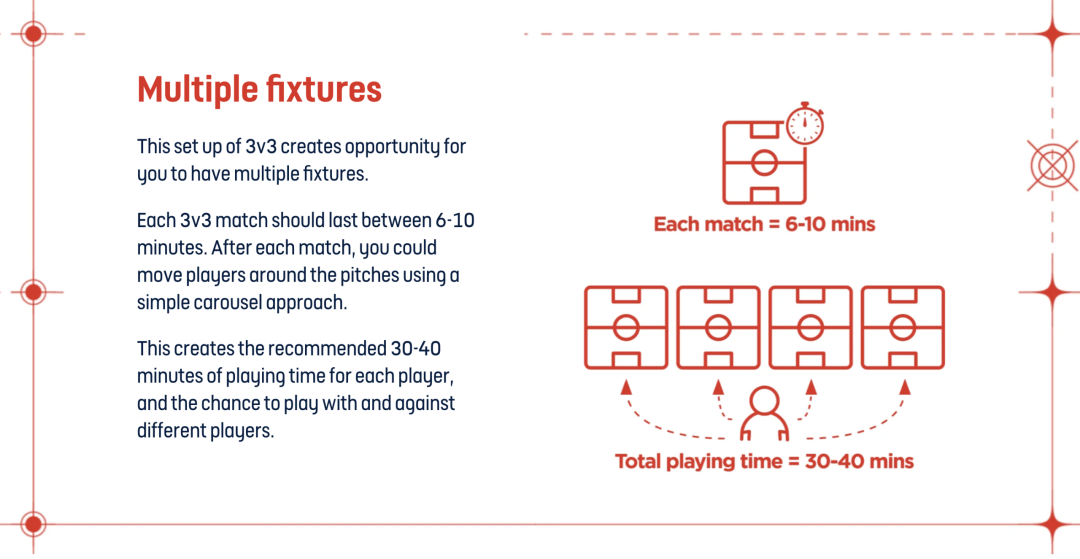
Games last eight minutes. When one ends, the players rotate to a new pitch and a new opponent, like a carousel. An adult stands on the touchline, but he does not blow a whistle. His official title is Pitch Facilitator.
No score is kept. No result is recorded.

This is not one idealistic coach running a private experiment. This is the law of the land: from the 2026/27 season, mandatory across England, by order of the FA.
The programme is called FutureFit. Most coverage of it has focused on what changed. The more interesting question is how a governing body actually forces a change like this through, and what it decided to protect on the way. It is also the direct sequel to the story told in our England DNA deep dive: the 2012 format reform raised the generation now in Premier League dressing rooms, and FutureFit is the second step on the same road.
What actually changes
Three things, from 2026/27.
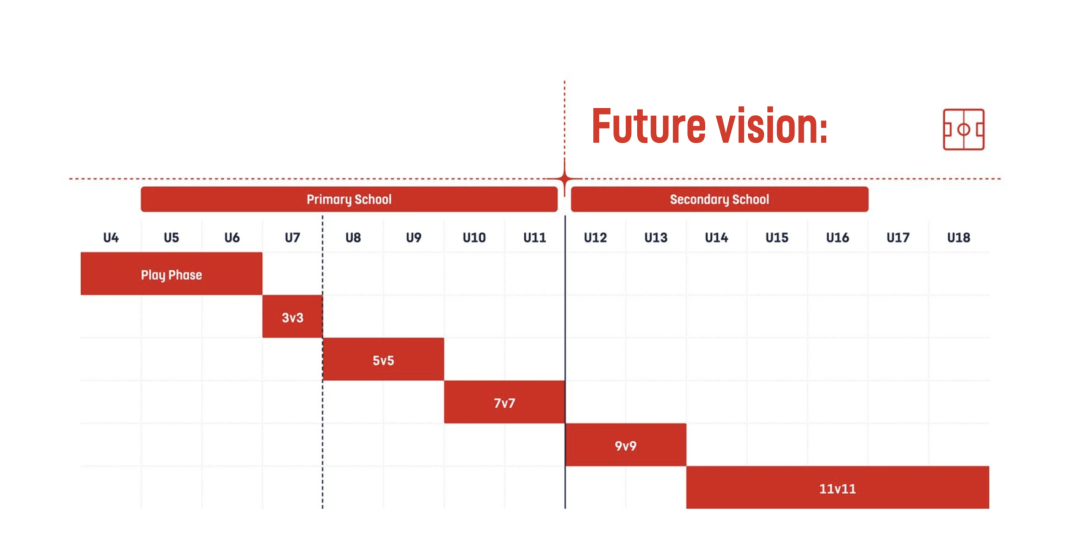
3v3 becomes the entry format at U7. England's youngest players used to start at 5v5. Now their first competitive game is three against three.
Every format is pushed back a year. U8 to U9 play 5v5. U10 to U11 play 7v7. U12 to U13 play 9v9. Eleven a side moves from U13 to U14. Children spend one more year in small formats before they walk onto a full pitch.
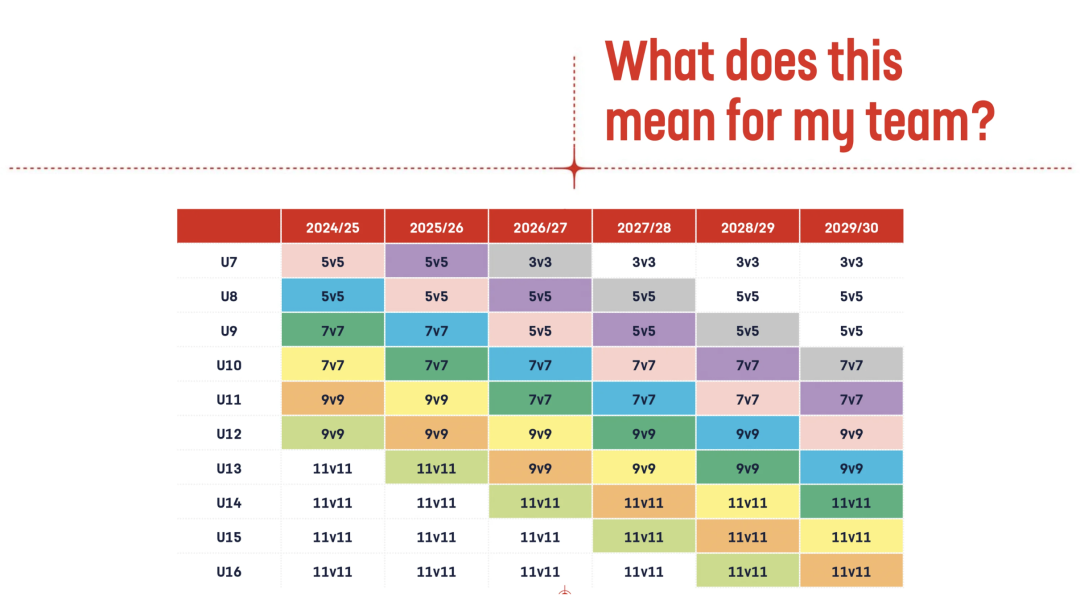
The laws evolve with age. Throw ins are gone at the youngest ages, replaced by passing or dribbling the ball back in. Restarts have been reworked to increase ball in play time. More complex laws arrive later, as children move into secondary school.
One thing worth flagging early, because it is widely missed: this is not a club competition rule. The FA states the changes apply across schools, grassroots and academies. Same formats in a PE lesson, an inter school fixture, and a Sunday league game.
The four principles of 3v3
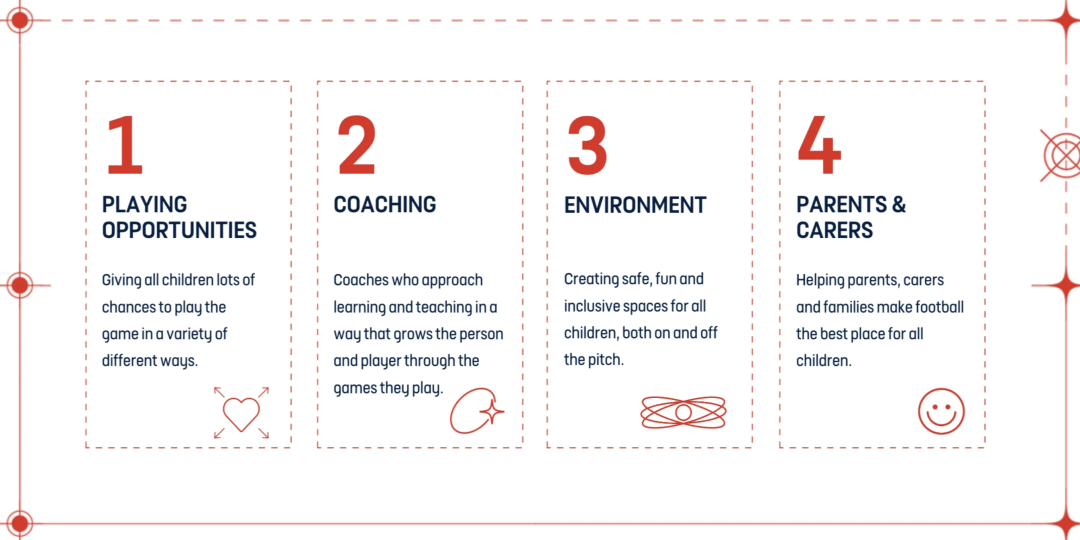
The FA published a standalone guidance document for 3v3. It opens with four principles, and every one of them is aimed at adults rather than children.
No substitutes. Not "try to give everyone a fair go." The bench is abolished as a concept. Every child plays for the maximum time possible.
Think about what that removes. A 5v5 squad of twelve means a handful of children sit out while their parents stand in the cold for an hour to watch ten minutes of football. In 3v3, with multiple pitches running at once, that is structurally impossible.
Every child learns to play as part of a team. All six players are outfield players. Nobody gets parked on a goal line for a season.
Holistic development over outcomes. Games are competitive, but the result is not the point. Scores and league tables are not recorded.
Age appropriate game design that maximises technical involvement.
And then the part that matters most: 3v3 has no referee, because the players officiate themselves. The adult on the touchline is renamed a Pitch Facilitator, and the FA is explicit that the role is not to officiate but to support players in managing their own game, mostly by asking questions.
Stack those four together and you notice the FA has not only changed the rules. It has changed where the adult stands.
The specifications, in case you want to run it tomorrow
- Pitch: 10m x 15m recommended, 15m x 20m maximum
- Goals: 120cm x 75cm recommended, 150cm x 90cm maximum
- Ball: size 3
- Match length: 6 to 10 minutes
- Format: carousel, rotate opponents after each game
- Playing time per child: 30 to 40 minutes recommended, 60 minutes maximum
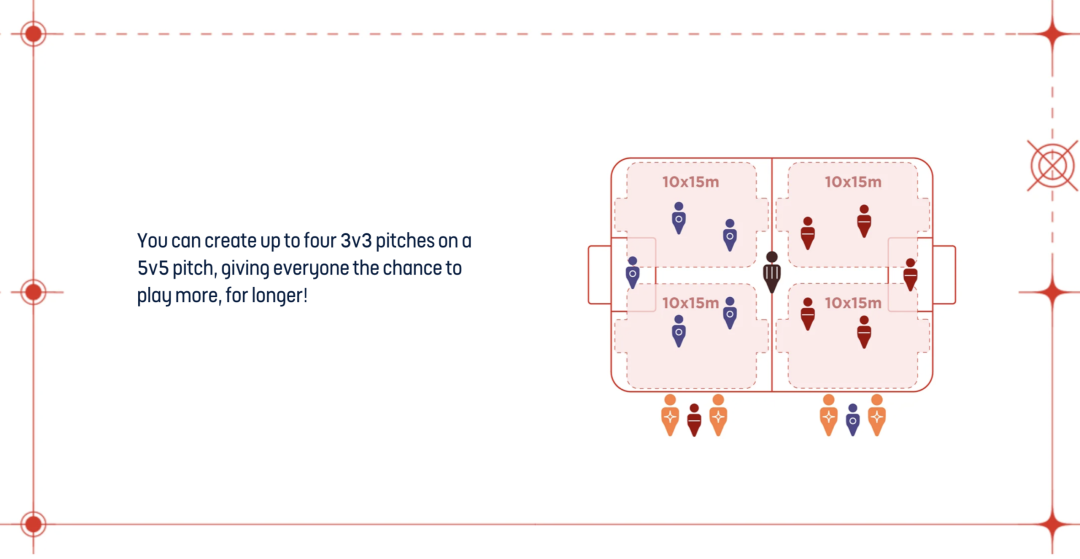
Two of those deserve a second look.
The goal is tiny, roughly a third of the width of a standard 5v5 goal. That is not an accident. Remove the goalkeeper and leave a big goal, and you get a shooting gallery and a lot of hopeful long range efforts. Shrink the goal and a child has to get close, has to combine, has to beat someone. The rules reinforce it: a player must be in the opponent's half for a goal to count.
The playing time has a ceiling as well as a floor. A seven year old plays no more than an hour of football in a day. That is a governing body telling ambitious adults to stop.
They did the work
The part of this story that impresses most is not the format. It is the argument.
Before announcing anything, the FA did three things.
They benchmarked internationally. They studied youth football structures in more than 40 European countries. One finding: over half of the nations they surveyed already use formats smaller than 5v5 at U7. England was behind, not ahead.
They ran an empirical study. In partnership with the Football Exchange at Liverpool John Moores University, led by Professor Allistair McRobert with Dr Jon Foulkes and Dr Ed Hope, they collected data from more than 400 grassroots matches at U6 to U14 level across the country. They measured time on the ball, decision making frequency, and the technical and physical returns of different formats.
They consulted for two years with grassroots football before finalising anything.
Benchmark against 40 countries, instrument 400 real matches, then argue about it for two years. Whatever you think of the outcome, that is how a format decision should be made.
Worth adding: 3v3 was not invented for this. It was already in use in England's elite male and female talent pathways. The reform takes a format that had been validated at the top and gives it to everyone else.
No scores does not mean no competition
This is the point most likely to be misread, so it is worth being precise.
See "no scores, no league tables" and a lot of people conclude the FA has gone soft, that this is participation trophy football.
Read their own words and that reading collapses. FutureFit rests on two themes. The first is Championing Children's Rights. The second is Promoting the Spirit of the Game, and the FA defines that spirit as two teams competing respectfully, each trying to stop the other scoring while trying to score themselves. They add that the emotions felt and the lessons learned are a shared experience.
There is not a word in there that dilutes competition. The 3v3 guidance says the same thing plainly: the games are competitive, the result is simply not the focus.
The distinction is this. Children will try to win regardless. That instinct does not need a league table to survive. But the moment a score is recorded, ranked, and used to judge coaches and clubs, it stops belonging to the children and starts belonging to the adults.
The FA is protecting the first thing and deleting the second.
Rights, not kindness
The wording of the first theme repays a close read. The FA says all children have rights, and that it is the responsibility of adults to keep honouring those rights for every child who plays.
Not "we would like to give children a better experience." That framing makes a good experience a gift, which adults may grant or withhold. The FA's framing makes it something children are owed.
That is a different distribution of power, and it shows up in the small print. When squads do not divide by three and teams need to mix players from opposing clubs, the FA's condition is that this happens if the players are OK with it.
They also asked the children whether they enjoy 3v3. The answer, per the FA's own FAQ, is that U7 players told them they do.
Which lines up with the sharpest line written about this whole reform, from Sky Sports: the resistance is not coming from the children.
FutureFit in schools
The FA built a dedicated schools strand, and it is the part of the reform that decides whether any of this works: most of a child's football happens at school, not at a club.
The formats apply to every football opportunity in a school, from PE lessons to inter school festivals. Ages 4 to 6 get their own named stage, the Play Phase, which is not early competition but an explicit acknowledgement that children this young are not ready for formal matches at all. 3v3 arrives at Key Stage 1, a size 3 ball is used throughout primary school, 9v9 arrives at Key Stage 3, and eleven a side waits for Year 9, roughly U14.
The delivery partners run through the English Schools FA, the Independent Schools FA, the Youth Sport Trust and the School Games programme, with Football Foundation funding available to eligible schools.
How you actually force a change like this through
Here is the section to send to anyone trying to reform anything, in any sport, in any country.
A good idea that never reaches Saturday morning is worth nothing. So how does a governing body push a new format onto tens of thousands of volunteer run teams?
It is mandatory. Not encouraged, not recommended. Leagues could opt in early during 2025/26 through an Early Adopter programme, and 20 of them did. From 2026/27 there is no opting out. An idea that depends on coaches volunteering to agree with it will only ever reach the coaches who already agree with it.
Leagues first, clubs second, coaches last. The three official conferences run in that order: leagues in November 2025, clubs in March 2026, coaches in May 2026. That sequence is the whole strategy in miniature. Leagues control fixtures, registration and competition rules. If the league does not change, the club cannot. If the club does not change, a coach alone on a training pitch cannot either.
Do it the other way round and you know exactly what happens. You win over the coaches, they go home inspired, and they find the league has scheduled 5v5 anyway. The enthusiasm dies in a month. Most reform movements die precisely this way, by starting with the layer that holds the least power.
County FAs are the delivery arm. The FA does not deliver this itself. The county associations run the 3v3 festivals, the in person CPD workshops, the regional events. The FA has also created a new County Coach Developer network specifically to land the new formats.
Money smooths the path. New goals cost real money, so the Football Foundation is providing a bespoke 3v3 Goal Support Package for eligible leagues and clubs. Note "eligible." The money is not sprayed around, it is steering behaviour.
Coach education follows the format, not the other way round. The Introduction to Coaching Football and UEFA C qualifications are being updated to reflect the changes, and three new 3v3 modules are being delivered as county level CPD. The sequencing is the interesting bit. They changed the game first and then retrained the coaches, rather than waiting until every coach was ready.
And they went after the parents. This is the piece almost everyone forgets. The FA has produced a Parents and Carers Gameplan, distributed through clubs, setting out the role parents play.
Ask why that matters. The person shouting "shoot" from the touchline is a parent. The person asking "did you win?" in the car home is a parent. You can delete the score from the record sheet, but you cannot delete it from a parent's mouth. A reform that stops at the coach gets quietly repealed on the touchline.
One honest caveat: the FA's public material does not say what happens to a league that refuses. How much bite "mandatory" really has, no one can tell you yet.
The objections, and the FA's answers
England's grassroots are not unanimously delighted. To the FA's credit, it has put the hard questions in its own FAQ and answered them.
"We will need more teams, more coaches, more admin." The FA says no. A matchday squad of six to twelve players runs multiple simultaneous games, and teams can be remixed between games. Two adults are enough. They must be DBS checked and safeguarding trained, so the headcount is low but the bar is not.
"With rotation, each child actually plays less." The FA says no, because there are no substitutes: 30 to 40 minutes each, 60 maximum. The honest arithmetic is that a benched child in the 5v5 era played zero.
"Goalkeepers lose their apprenticeship." Here the FA offers no comfort. There are no goalkeepers in 3v3, all six players are active outfield players. This is a genuine trade off rather than a misunderstanding. You may disagree with it, but they know what they are giving up.
"Who pays for the goals?" The Football Foundation package, details due March 2026.
"Will my team be demoted to a smaller format?" No team goes backwards. Some age groups will spend three seasons in their current format instead of two. The path only stretches, it never reverses.
A bonus, rarely discussed: boys and girls may play in the same U7 games. The FA's stated basis is research showing no need for different formats by gender at that age.
Worth stating plainly: the criticism above comes largely from community blogs and club commentary, which is opinion. The answers come from the FA, which is an interested party. No independent evaluation of FutureFit's effects exists yet, and none can until the 2026/27 season has been played.
What to take from it
Three things, none of which require you to be English.
Changing the game beats changing the coach. The FA did not write a thicker coaching manual. It changed the competition. A curriculum requires coaches to volunteer to learn. A format is compulsory, and once the format changes, training follows on its own. The game your players play on Saturday is the ceiling on what you can plausibly coach on Wednesday.
Small pitches and more touches is now an evidenced claim, not a preference. There are 400 matches of data behind it. That does not end the argument, but it changes what the argument is made of. If you coach the youngest ages yourself, the principle travels without the format: one ball each, small numbers, nobody standing still.
Adults can say less. Pitch Facilitator is the best definition of a youth coach in years. Do not officiate. Do not instruct. Ask questions.
England last rebuilt its youth formats in 2012. The children who grew up on those small pitches are in Premier League and England dressing rooms now.
This time they have reached down to the seven year olds.
A country spent two years consulting and 400 matches collecting data, so that a seven year old could touch the ball more often, stand around less, and not have to carry a scoreline. That is the part worth looking at, more than 3v3 itself.
They wrote one sentence into the rules: the adult moves off centre stage, and the game is handed back to the children.
Sources
The FA's FutureFit hub (englandfootball.com/futurefit) and content hub, including the Approach, Roadmap, Schools and FAQ pages; the FA's 3v3 guidance document; the FA's announcement of 21 February 2025; Liverpool John Moores University's research announcement of 19 May 2026; and Sky Sports' reporting. Grassroots criticism cited above comes from community blogs and club commentary and is opinion rather than verified research.