For youth coachesThe week in youth football, picked for coaches
Issue02
28 Sept to 4 Oct 2026
Fútbol 7 50%
Sharing minutes fairly by age group
U7 to U9
Long 1v1s build the chase back
30 second talks
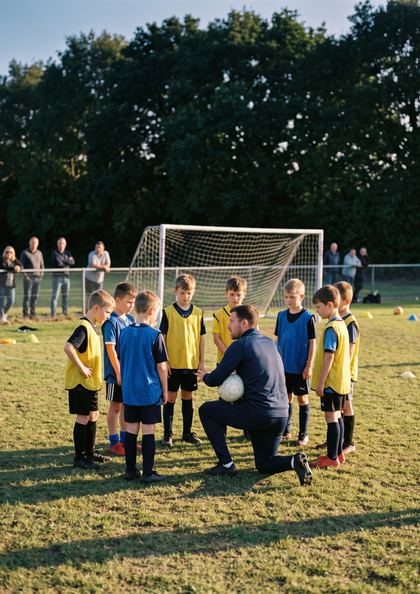
Micro messages instead of one huddle
Cover storyCoaching · ジュニアサッカーカレッジ
Watch first, then plan
Kazu's note: let repeated moments pick your session
7 languages · read online · free PDF
hobbit.football/news
PriceFree
HW 2026 · 02
Editor's note
More Ball, Fewer Lectures
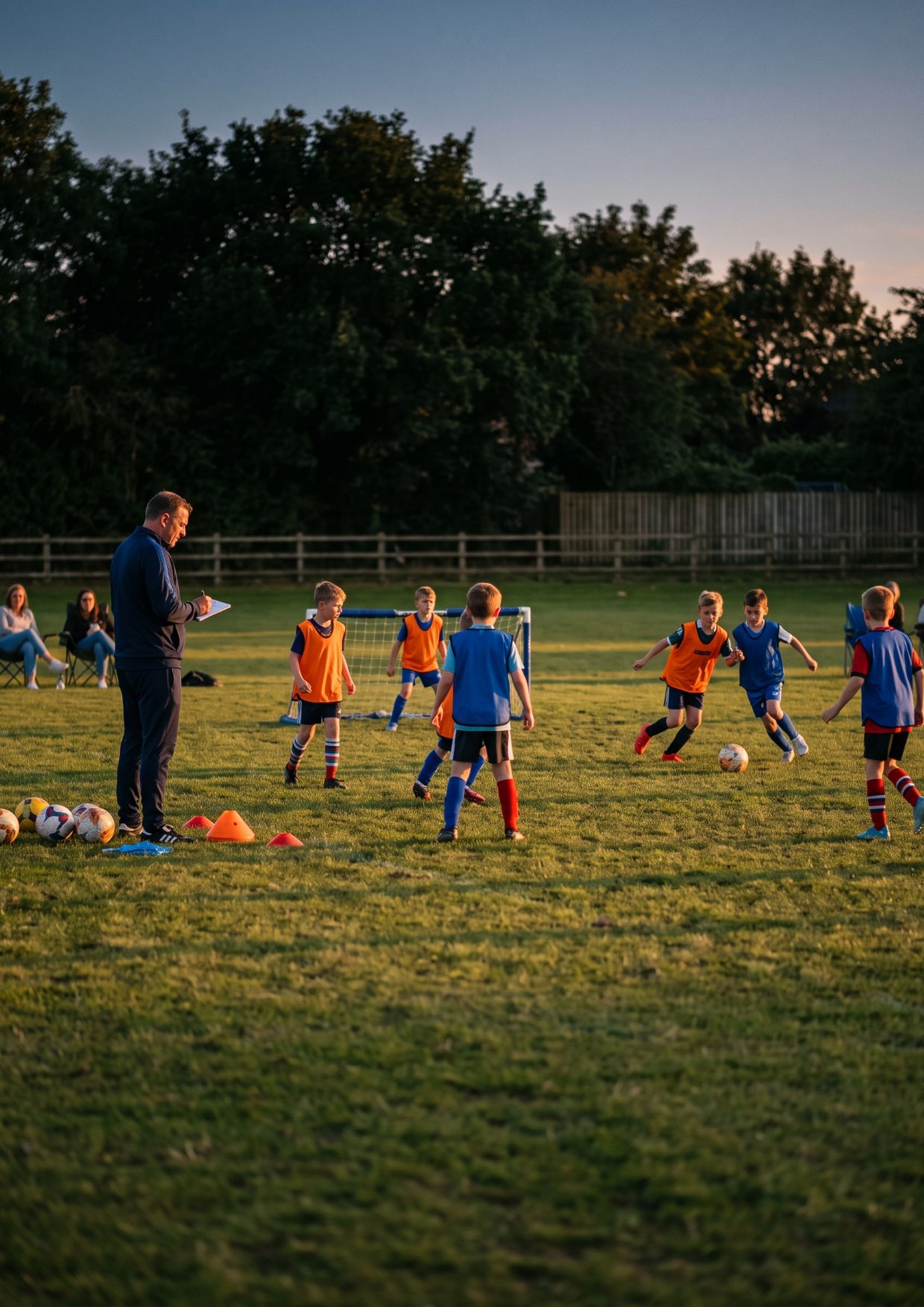
Picture the end of a session: a long line of players waiting for a turn, while the coach explains for the fifth time.
We see this across the issue. Design tasks with ball, teammates, opponents, space and direction. Keep talks to thirty seconds. For defending, build the will to chase back before tactics. Fair minutes matter from Fútbol 7 upward.
“You can change one thing this week.
At your next session, could your players get five more minutes with the ball instead of five minutes of listening?
The Hobbit editors
22
stories
11
sources
5
coaching discussions
226
replies read
8
languages
HOBBIT WEEKLYIssue02
For coaches
Before your next search for drills, watch your team's repeated moments and let what you see decide the session, not the other way round.
Cover storyCoaching · ジュニアサッカーカレッジ
01How to decide on training menu items [youth soccer]: You cannot decide on training without analysis
For coachesBefore your next search for drills, watch your team's repeated moments and let what you see decide the session, not the other way round.
Hello, I'm Kazu, an instructor.
In youth soccer coaching, you end up thinking about "what to do for today's practice" every single time. That said, I think many people feel that no matter how much they search for or create training menus, they just can't quite find something that clicks.
For example, some of you may feel as follows.
You're searching for a menu every time, thinking "What should I do for today's practice?"
This week
02CoachingU8 to U18
Minute management in youth soccer: a practical guide to distributing playing time
For coachesPlan your substitutions and minute blocks before kick-off so the scoreline does not decide who plays; explain your policy to parents at the start of the season.
The most serious mistake I see every weekend on the fields is treating the bench as a place of punishment. If you are looking for a guide to managing minutes in youth soccer that can be applied starting this very Saturday, you need to understand this from the first second: you are not playing for your life on the sideline. When you leave a ten-year-old kid playing three minutes at the end of the match, you are not teaching him character or a culture of effort; you are teaching him to hate this sport. In this article I show you the exact system I use to organize call-ups, balance playing time and keep the locker room motivated without giving away competitiveness.
Why playing time defines player development
Training is learned by training, but playing is only learned by playing. Training gives you the context, the habit and the technique, but real decision-making arises under the pressure of the opponent, the referee and the scoreboard. If you take competition minutes away from a player, you are cutting off the tap of learning.
Moreover, in formative stages a player's self-esteem depends directly on the time he spends on the grass. An unfair distribution destroys the team on two different fronts:
From the coaching community
05Coaching
Tips for coaching your child when he’s not talented
For coachesLet him have fun, and give instructions for the next action rather than pointing out past mistakes.
Any tips from coaches who have been successful coaching a team where their child is not doing great with the ball (love him to bits but he’s bottom 20% of the team).
I see he’s taking any of my advice as criticism, and feel this is getting in the way of my relationship with him. I try leading with positive reinforcement but that doesn’t seem to help (maybe because he feels the praise isn’t deserved or maybe I unconsciously do).
It certainly doesn’t help that he’s not listening either (diagnosed with ADHD) and I struggle to lead with authority. It might be that soccer is not for him too although he enjoys playing with me when it’s just the both of us.
Top replies, most upvoted first
(+17) If he having fun? Let him have fun. If he’s not having fun then maybe he needs a break from soccer. Past that, he’ll ask when he wants your advice.
(+6) I tell my kid he's my helper when we train with their team so the pressure is off. I usually "train" with him at home: one touch passes with both feet to try to go over our record, passes with a bouncing ball, 1v1 and fut volley which he doesn't see as training. For technical stuff I have a dashboard with pieces and ask him what he would do on certain scenarios he had during games without he knowing, we also watch soccer highlights from games and talk about them.
On the pitch
10Coaching
Let's learn "How to Build a High Press That Can't Be Broken Down"! 8 Points That Will Dramatically Change Your Defending From the Front
For coachesCheck your forwards' starting positions before shouting to press: if they are goal-side and patient, the second and third attacks come naturally.
This time's theme is "How to Build a High Press That Doesn't Get Broken Down! 8 Points That Dramatically Change Defending from the Front Line." The instructor is Itaru Kato, who started his coaching career as a high school teacher and currently serves as head coach of SC Toyohashi Azalea in the Aichi Prefecture adult league.
Kato is a coach active in many fields, including serving as an advisor at Nihon Fukushi University Affiliated High School and as head coach of the Japan national minifootball (6-a-side) team.
This time's theme is how to instill in a team the high press, which is considered the most difficult part of defending. In the first part, he introduced the structure of the high press and 4 points: "intermediate," "containment," "decision," and "coordination." (Text by Tomoyuki Suzuki)
Organizing Defending into 8 Cycles
Kato defines defending in the area closest to the opponent's goal, when the pitch is divided into 3 parts, as "defending from a high position," and speaks of its difficulty as follows.
"The space to defend is the largest, and the opponent has a goalkeeper, so you end up defending at a numerical disadvantage. That is why the high press is difficult."
Research and data
20Research
Boys Sports Participation Is Falling, and a New Aspen Report Points to Coaching and Access
For coachesThe report shows boys quit or never start over bad coaching and injury fear, so check how your sessions handle mistakes and how you talk about injury risk with parents.
Regular sports participation among boys ages 6 to 17 slid from 50% in 2013 to 42% in 2024, according to SFIA data cited in the report.
Nearly half of boys who never played organized sports (49.5%) told the 2025 Youth Athlete Survey that fear of injury kept them out.
Current male athletes named bad coaching as their top complaint at 22%, ahead of cost at 17%, per the survey.
The report identifies the Meta state settlement, data center agreements, and sports betting revenue as potential funding sources for new programs.
The Aspen Institute’s Project Play and the American Institute for Boys and Men (AIBM) released “Boys in Sports” in September 2026. The report examines why boys sports participation is declining while girls’ participation has grown. Citing Sports & Fitness Industry Association (SFIA) data, the report says the share of boys ages 6 to 17 who play sports regularly fell from 50% in 2013 to 42% in 2024.
The research draws on four sources:
the 2025 Youth Athlete Survey of 3,827 youth ages 10 to 17
the 2022 National Coach Survey of 10,485 coaches
Views and the game
21Policy and clubs
Midpoint update of our 2024-28 Grassroots Strategy
For coachesFutureFit, which shapes how much time young players spend on the ball and on the pitch, is now part of the national framework, so it is worth checking what it asks of your sessions.
A progress update on our Grassroots Strategy: A Thriving Grassroots Game
A midpoint update of our 2024-28 Grassroots Strategy: A Thriving Grassroots Game
We have today published a midpoint update of our 2024-28 Grassroots Strategy: A Thriving Grassroots Game.
The report highlights the progress that we have made during the first half of our four-year strategic period, including setting record participation numbers, creating equal access to football for girls in PE in 90% of schools, and delivering over 10,000 quality grass and 390 new 3G pitches across England.
Over the past two seasons, we have continued to drive strong growth in player participation, with a 4% increase taking our number of affiliated players to 1.6 million, and we now have more than 124,500 affiliated teams, representing a 10% increase since the end of the 2023-24 season.
We have also created significant growth in female participation, with an increase of 15% to 255,000 players, and we have provided 20,000 opportunities for women and girls to play football in their communities. In addition, we have delivered substantial growth in Disability Football participation, with an increase of 25% to 26,000 players.
HOBBIT WEEKLY
Ideas you read,
used in your next session.
Tell Hobbit your team's age and what you want to work on this week, and it writes a complete session from one sentence, with a diagram for every drill.
hobbit.footballTranslations by AI; every piece links to its original
FA 2025-26 grassroots report shows 90.5% of matches rated good
The FA's new behaviour report covers grassroots fixtures and found serious misconduct in under 0.09% of matches, with discrimination reports rising. Coach guidance this week covers analysing your team before picking training, and fair playing time from Futbol 7 to Juvenil.
Every piece appears in full, translated by AI where the original is in another language. Copyright stays with each author and original publisher; every piece links to its original.
You don't know what training menu suits older or younger age groups
Even when you try a training menu, something just doesn't work
I myself used to search for training menus in the same way. Even now, as a coach, when I think about new training menus, I sometimes flip through books looking for something structurally similar.
I'll write about how to prioritize what players can't do, the "reproducibility" I value in game analysis, and concrete examples of translating analysis into training menus, all based on what happens at my own sessions. If you read this article, I think it will become clear what you should think about before searching for a training menu, so please read to the end.
① "What should I do for today's practice?" and "Isn't there a good training?"
I think there are broadly two worries coaches have about training menus. One is the worry, "What should I do for today's practice?" The other is the worry, "I'm searching for training menus, but isn't there some good training out there?"
I think many people search things like "What should I do for the older age group's training menu?" or "What kind of training menu is good for the younger age group?" I myself was like that in the past. Training menus are something you can't create at first.
② Even now, I sometimes flip through books
Even now, as a coach, when I think about a new training menu, I sometimes look at books thinking, "I have this kind of image, but isn't there something structurally close?" From there, I sometimes adapt things well, and of course, I sometimes create things from zero.
In other words, searching itself is not a bad thing. However, whether you search or create it yourself, there is something you must decide before that.
③ What to decide before searching
Something you must think about before searching for a training menu. What that is, is "analysis."
Depending on what you must do as a result of analysis, the training menu gets decided. I think this is a very simple matter.
Incidentally, at the stage where you're unsure about a training menu, there is a flow that depends on the coach's experience.
① What is the background of "an exciting shooting drill"?
Let me go at it paradoxically. For example, when you think "I want a shooting drill menu that gets the older age group excited," what is the background of that?
Probably, I don't think it's "because there's a really important relegation playoff this weekend."
The same goes for thinking about "an icebreaker training menu": why is there a need to do an icebreaker? Doing that training menu should rest on an analysis of what state the team is in right now.
② The result of analysis decides what you should do
Conversely, without analysis, a training menu cannot be decided. This is something I want you to remember.
Whether it's kindergarteners, the younger age group, or the older age group. Whether it's the start of the season or the final stretch. In all cases, "because the team and players are in this state right now, let's do this" is, I think, the most basic way of thinking in analysis.
It is possible, for the time being, to assemble a training menu without analysis. There is also a method where you try a training menu first and then apply analysis afterward. Even so, the basic order is: analyze and think about the training menu, then decide the training menu.
③ At first, it's only natural to be off
However, at first, you can't do it. That's only natural. There's no way you look at the team and players, analyze on the spot, and sharply decide "this is what's needed, so this is the training."
In most cases, a discrepancy arises, and I think many people worry, "something just isn't working," and I'm sure it will always turn out that way. That is a matter of the resolution of your analysis, and I think it's a world where how deeply you analyze, how much you think, and your amount of experience make all the difference.
① With the younger age group, there are naturally many things they can't do
So, how should you do analysis? At the first stage, when you watch play, I think you can vaguely see the places where "something here isn't good."
For example, with the younger age group, it's things like "when the ball comes, they just kick it forward randomly" or "everyone swarms toward the ball." This is something I often say, but when you watch elementary schoolers, there are more things they can't do.
If you watch a younger age group match: they bunch up, they don't communicate verbally, they can't support, they can't make movements to lose their marker, they can't overlap.
They can't do control-oriented play (control in the direction that leads to the next play), they can't create body orientation from a back step, they can't communicate, they don't understand tactics. That's only natural, right?
There are more things they can't do.
② Even if there are 100, you can't solve 100
You list everything you cannot do, and even if there are 100, it is impossible to solve all 100. That is exactly why, within that, you have to think with priority about "what should I do right now, first." This becomes extremely important.
This is the same whether it is soccer tactics, technique, or team management: first, when you look at the situation, you think "let's start from here" and "next, like this."
Only here does the talk finally turn to planning. Even when it comes to planning, it is difficult if you do not understand the current state to a certain degree.
For example, looking at the team and thinking "practice doesn't look fun every time, so I want to put in a practice menu that gets them excited" is, I think, not wrong at all.
With the older age group, if you see "after winning the ball, they try to play vertically too quickly and immediately lose it," then it becomes visible that "maybe we need practice where, after winning it, they rebuild once." Only then does it become "how can we do that kind of practice?"
It is a single process: analyze, then decide the menu to do.
③ Even if you have little experience, try doing planning
Especially for people with little experience, I think they cannot do planning. Without experience, they cannot picture what state they want to bring the team to one year later.
Even so, I think you have to do it. Try making one for the time being. Try making it, and it not going according to plan at all is fine too, I think.
In my case, I do a one-year planning, and from there I roughly cut it into about 3 turns in cycles of 3 to 4 months, and create an image of "bringing them to here."
For that, I decide what to do now. While putting in the annual planning, at the field level problems different from the annual plan also come up, so I proceed with daily training in a way that balances those out.
In any case, it is analysis. It is not a difficult talk like game analysis: first analyze the team and properly look at things like "they get beaten immediately in 1v1" and "they don't compete in 1v1 at all." Whether you make a practice menu or search for one, that becomes the starting point.
As you repeat it, the resolution of your analysis gradually rises. Roughly speaking, this is the coach's basic cycle.
① Pick up what is happening repeatedly
Let me dig a little deeper into game analysis. Analysis of your own team, analysis of the opponent team, and long ago I used to do one analysis of an overseas professional team every week for my own training. Professional analysis is interesting, and it becomes your own skill.
If you have time, analyzing one match you are interested in per week and putting it together into a report, I think, makes good training.
What is important when analyzing is repeatability.
While watching the game flatly, you also look at the formation and the matchups, but within that you pick up "things that are happening repeatedly." These are things with repeatability, like "this repeatedly goes well" and "this repeatedly does not go well."
Even if you pick up things that happen incidentally, it was "just by chance," so it is hard to analyze. That is exactly why you grasp phenomena that happen repeatedly. Sometimes you mistake something and think "did this just happen by chance?" but basically it is that.
② Cut by phases
Things that happen repeatedly are picked up by cutting them into phases.
At first, I think it is fine to cut them into 4 phases: attack, defense, and transition (switching). If you look in more detail, you can also cut them into the 11 sub-phases I talk about, for example within attack: salida de balón (the way the ball comes out), progression and ball retention, and finishing.
Within those detailed phases, you pick up what is happening repeatedly.
③ Phenomena that go well are traces of intentional training
What does it mean that something happens repeatedly and has repeatability? If it is something going well, there is a high possibility that it has been trained beforehand. In short, it is being done intentionally.
You can see traces of intentional training, such as "the volante who pulls into that space is coming in."
On the other hand, for things that are not going well, you look at "why does that repeatedly not go well?" These are structural things, such as "against the opponent's two in midfield, we are dealing with them with one volante, and the slide is not working, so they are always creating a numerical advantage there."
Then, how to respond also becomes visible, and the possibility that when you respond, a disadvantage appears somewhere else also becomes visible.
"We are always being attacked on the wings, so let's change how we defend. But if we do that, a risk appears here. Which do we take?" At that point, it becomes a question of whether to change the play model.
Conversely, if you analyze by referring to the opponent's games or professional games, you look at the positive parts that happen repeatedly as "highly likely to be intentionally designed," and you investigate "with what structure is that happening?" and "what are the play principles?"
I have not asked the coach, so this is only a prediction, but when I think "this movement is good," I try to come up with a practice menu on my own that makes that play principle work. In that way, my own repertoire increases by one.
1. Make the vertical relationship between the side back and side half diagonal
Let me give one example. This is about when I used a 3-3-1, but in junior 3-3-1, the side back and side half often form a vertical relationship.
Depending on the play model, some teams adopt as a pattern the movement where the half and side back open up wide, and the side half comes inside to create numerical superiority. I often see this in my area too.
In my case, rather than doing it as a pattern, I use a method that encourages self-organization.
When I do that, I think, "I want to make it possible for the vertical relationship between the side back and side half to become a diagonal relationship." To put it extremely, I think it would be good if mobility emerged where the side back opens up, the side half comes inside, and the forward flows into that space.
2. In a 3 v 2 rondo, "outside or inside, either is fine"
So what kind of training can make it so that the two players do not both stay completely inside or both open completely outside, but can always maintain a diagonal relationship? When I think about it including the midfield, in my case I do it in a form like a 3 v 2 rondo, with the image that the supporting players use the outside or the inside, come from outside to inside, or go from inside to outside.
With a rondo of three players, I say, "Outside or inside, either is fine," "Come from outside to inside," "Open from inside to outside."
Then, in the game too, I do the same thing: "Open outside, cut off the passing course, and come inside." So that the side back and side half do not form a vertical relationship during the game either, I connect it by saying, "Either one can be inside. We did it in the 3-player rondo, right?"
As the easiest and simplest example, it feels something like that.
In any case, whether it is game analysis or a thought like "I want to make it possible to play this way," it is fine whether it is correcting mistakes or adding options, but there is something like "I want to be able to play this way," and against that, I create a practice menu.
3. Whether it is the phase that is needed right now, and whether it is feasible
That is exactly why, I repeat, even if I think "I want them to play this way," whether that is the phase that is needed right now and whether it is feasible become extremely important themes in analysis.
Doing what should not be done right now. Trying to make them do what they absolutely cannot do. Or, the analysis itself is off.
For example, if I want to "attack on the sides" and do crossing practice again and again, but they cannot break down the side in the first place, or cannot create an origin on the side, then it becomes "this is the stage before doing crosses."
If there is this kind of discrepancy in analysis, I think it becomes "even if we practice, it does not go well." First of all, what is important is to analyze the situation and context properly. As for analysis, there may be parts that are hard to understand without watching games, but I think this is probably where to start.
Summary
Whether you look for a practice menu or create one, before that there is "analysis." Without analysis, the practice menu cannot be decided
There are 100 things they cannot do. You cannot solve 100, so first decide the priorities of what to do now
Even if you are inexperienced, try planning. It is fine if things do not go according to the plan
What is important in game analysis is reproducibility. Cut it at phases and pick up what is happening repeatedly
Phenomena that are going well are traces of intentional training. From there, probe the play principles and incorporate them into the practice menu
Look at whether "I want them to play this way" is the phase needed now and whether it is feasible
In this article, I explained how to decide a practice menu, with a way of thinking that starts from analysis. At first, it is natural that the resolution of your analysis is not high, and I think it rises as you do it repeatedly. Please try it at your own coaching site too!
Also, if you keep the practice menu you decided through analysis together with the board, then in the next analysis you can look back and say, "Last time we started from here."
The player who never plays: He loses confidence in himself, trains without intensity, plays with panic of making a mistake when he comes on and ends up leaving the club midway through the season.
The undisputed starter: He creates an unfounded feeling of privilege. He knows he will play no matter what he does during the week, he gives up in training and he collapses emotionally when he reaches categories where the competition is real.
Sharing minutes logically is not giving anything away. It is building a deep squad, raising the level of daily training and protecting the mental health of your players.
Distribution criteria by age group: from Benjamín to Juvenil
You cannot apply the same criterion with eight-year-old children as with seventeen-year-old lads. The competition changes and your management of the bench must evolve with the age group.
7-a-side soccer (Prebenjamín, Benjamín and Alevín)
In 7-a-side soccer the priority is overall motor and tactical development. All children must play a minimum of 50% of the minutes in each match. No exceptions for the result.
Golden rule: Every player called up plays at least two full parts (or their equivalent in blocks of time).
Versatility: Rotate positions. An Alevín needs to go through defense, midfield and forward to understand the overall game.
Call-ups: If the squad is very large, rotate rests in the call-ups, but whoever is called up, plays.
Formative 11-a-side soccer (Infantil)
Infantil is the big leap. The large field appears, structural offside and real physical wear. Here we introduce the culture of performance without losing the pedagogical objective.
Minimum time: At least 30-35 minutes per match for each player called up.
Structure: Plan the substitutions before leaving the locker room. Avoid improvising on the fly conditioned by the scoreboard.
Competitive 11-a-side soccer (Cadete and Juvenil)
In Cadete and Juvenil the tactical and physical demands are maximum. Here minutes are earned during the week, but the management must still be transparent and professional.
Clear criterion: Effort in training, attendance, tactical commitment and form determine the starting spot.
Respect for the player: Forbidden to put a player on in the 89th minute just to «fulfill». If you are only going to give him one minute, it is preferable to talk to him at halftime and explain the tactical reading of the match.
The block system: how to plan rotations on the bench
The worst way to manage a bench is to decide substitutions according to what your body asks you for during the match. Your heart rate is high and the scoreboard makes you make short-term decisions.
Use the structure of blocks of time to be in control before the starting whistle sounds.
Practical example for 7-a-side soccer (4 quarters of 12 minutes)
Divide the match into four defined periods:
Quarter 1: Block A (Starters from the initial plan).
Quarter 2: Block B (Players with fewer minutes from the previous match come on).
Quarter 3: Strategic mix maintaining balance in each line.
Quarter 4: Adjustment according to the tactical development of the match.
Practical example for 11-a-side soccer (2 parts of 40 minutes)
Establish three fixed substitution windows so as not to break the team's rhythm or leave anyone without room to make an impact:
Minute 40 (Halftime): Planned double substitution to refresh key lines.
Minute 55-60: Second window to bring fresh legs into high-wear areas (wide areas, central midfield).
Minute 70: Last window for specific tactical adjustments.
How to manage call-ups and talk with parents
The biggest source of conflict at a youth soccer club is not on the tactics board, it is in the stands. Parents suffer when they see their children warm up for 40 minutes and not get on.
The solution is simple: radical transparency from the preseason.
Initial meeting: At the first meeting with the families, explain your policy on minutes. Tell them clearly how you are going to rotate and what is required at each stage.
Objective disciplinary rules: If a player does not train due to an unjustified absence, he loses his starting spot or is left out of the squad that week. If the rule is applied to everyone equally (whether he is the top scorer or a substitute), nobody will be able to complain to you about anything.
Individual feedback: Talk with the kid on Monday after the match. If he has played little, tell him exactly what you expect from him in the week's training sessions to change that situation. Do not leave him hanging.
The 3 fatal mistakes you must eradicate from your bench
If you identify any of these three behaviors in your coaching staff, correct it immediately:
The garbage-time substitution: Bringing on a player with 60 seconds left when you are winning 4-0 just to say he "has taken part." It is humiliating for the footballer and conveys a lack of empathy.
Punishing individual error with substitution: If a center back makes a mistake playing out from the back and you sub him off two minutes later, you have destroyed him for the rest of the season. You are singling the boy out in front of the stands and in front of his teammates.
Promising minutes you are not going to give: Never tell a kid "you are definitely playing in the second half" if you know that the context of the match may make you change your mind. The frustration of a broken promise destroys trust in the coach.
Practical summary to apply this weekend
Before you get in the car to go to the match, go over this quick list:
Take the planned substitutions written in your notebook before kickoff.
Assign your assistant coach or an injured player the task of tracking each player's actual minutes on the stopwatch.
Make sure that all the players called up in the early stages play a significant amount of time in positions where they feel comfortable.
Talk with the substitutes during halftime; keep them involved in the match by explaining what they are going to contribute when they come on.
Managing minutes well is the ultimate test of your level as a coach. Anyone can put out the best 11 and forget about the rest. Building a united group where all 16 or 18 players feel valued and progress week after week is what really makes you a reliable coach.
For coachesWorth knowing before your next parent or player briefing: from this season a first discrimination offence means at least 10 matches out, plus a fine and education, so the behaviour you set in training is now backed by a clearer sanction.
The FA's 2025-26 Grassroots Behaviour and Discipline Report has been published
Our 2025-26 season Annual Grassroots Behaviour and Discipline Report has been published today. The report provides an overview of serious misconduct cases and demonstrates how targeted interventions are delivering measurable improvement across the game.
Serious misconduct includes cases of discrimination, serious offences against match officials and assaults committed by participants.
This comprehensive report covers Step 5 and below of the men's game and Tier 3 and below of the women's game, and analyses serious misconduct cases across both adult and youth grassroots football.
The vast majority of grassroots football continues to be played in a positive environment, with an average respect mark of "good" in 90.5% of matches from more than 1.3 million scores. Serious misconduct cases continue to occur in less than 0.09% of all grassroots fixtures. However, we recognise that even relatively rare incidents of this type can have a significant impact on individuals, clubs and communities, and we remain committed to addressing poor behaviour consistently, robustly and fairly.
During the 2025-26 season, there was an increase of 0.40 reports per 1000 fixtures relating specifically to discrimination. The average ban for participants who were found guilty of discrimination offences was seven matches. This will be increased in the 2026-27 season, with a standard suspension of at least 10 matches introduced for first-time offenders, alongside mandatory fines and education.
Refereeing numbers have reached a record high, with 41,500 match officials registered at the end of the 2025-26 season and a retention rate of 82%. We recognise the impact serious offences against match officials can have on the refereeing community and we are encouraged that serious offence allegations against match officials reduced in the 2025-26 season by 0.28 per 1000 fixtures.
We continue to take strong action for offences towards match officials, and participants found guilty of serious misconduct face significant suspensions and financial penalties. All proven offenders must also complete a mandatory education programme before returning to the game.
Ahead of the 2026-27 season, we introduced a series of behavioural measures aimed at driving a positive culture across grassroots football and to act as a clear deterrent against unacceptable behaviours. This includes our 'Positivity Champions' initiative, the national rollout of 'cooling off' periods, and the monthly publishing of disciplinary sanctions that we have issued.
Tim Foster, Head of Operations, Grassroots Football Division, said: "Our data suggests that participants have greater trust and improved confidence in our processes to take action when they report incidents of serious misconduct. We continue to make strong progress in addressing unacceptable behaviour across the grassroots game, and our commitment to tackling discrimination and other incidents of serious misconduct remains unwavering. Everyone deserves to play, coach, and officiate in a safe and respectful environment, and the improved and enhanced measures that we've introduced will help instil this throughout the game.
"This is a collective effort, and we're grateful to the leagues, clubs, referees, and volunteers who share our commitment to raising standards and ensuring grassroots football provides a positive experience for all."
Alan Darfi, FA Senior Behaviours & Discipline Manager (Grassroots), said: "Publishing this annual review shows our ongoing commitment to openness and accountability across the grassroots game. We recognise the impact that poor behaviour can have on players, referees, and volunteers, and we're determined to address it head-on. With better reporting processes in place, and increased trust and confidence in them, it's natural that we're seeing more allegations come through. We see this as a sign that our systems are working as intended. Alongside our valued County FA network, we are issuing stronger sanctions, championing and celebrating respect and positive conduct, and we are encouraging all participants to play their part in ensuring football remains a safe, welcoming and enjoyable experience for everyone involved."
Study Finds Moderate Screen Time May Speed Recovery in Youth with Concussion
For coachesWhen a concussed player returns to the squad, share with parents that the study points to a middle ground on screens, not total avoidance, and that a care team should still set the plan.
Keywords: concussion recovery, screen time, pediatric concussion
Researchers at Nationwide Children’s Hospital have found that moderate screen time might be better for concussion recovery than no screen time at all. In a study published today in British Journal of Sports Medicine, researchers found that about 141 minutes of screen time each day for the first three days following concussion was associated with quicker recovery.
“These findings support that moderate screen time, not too little or too much, may support concussion recovery,” said lead author Jingzhen Ginger Yang, PhD, MPH, principal investigator in the Center for Injury Research and Policy of the Abigail Wexner Research Institute at Nationwide Children’s. “A median of 141 minutes of screen time each day was associated with a 35% faster recovery, compared to 260 minutes of screen time each day. Youth who use screens for more than four hours per day or less than two hours per day may be at risk for slower concussion symptom resolution.”
This new study, conducted by experts in Nationwide Children’s Center for Injury Research and Policy and division of Sports Medicine evaluated screen time and type in the first week after a concussion and explored the associations between screen time (duration and type) and concussion recovery in youth.
While some research on pediatric concussion has relied on self-reported screen time, this study used a wearable device to objectively measure out-of-school screen time, measured in minutes per day. Screen time use was classified as smartphone, TV, computer/tablet, or gaming during the first week post-injury among youth aged 11-17 years with a physician-diagnosed concussion.
The type of screen time mattered, too. Around two hours per day of smartphone and TV use were associated with quicker recovery, while computer/tablet and gaming were not significantly related to faster symptom resolution. “This study showed that youth with concussion may benefit from some smartphone or TV use, rather than avoiding screen time completely or overusing screens in the days following a concussion,” said Thomas Pommering, DO, chief of sports medicine at Nationwide Children’s and co-author of the study. “While clinical trials are needed to keep moving forward, this study shows a potential development in concussion treatment practices, contrary to previous guidance that recommended total avoidance of screens.”
This study has several important clinical implications:
Moderate screen time, neither too much or too little, during the first week after concussion may help accelerate recovery.
Pediatricians may consider recommending a balanced level of screen time among youth immediately after concussion.
Different types of screen activity may also affect recovery differently. Youth with concussion may benefit from monitoring both quantity and type screen use after injury, potentially with support of wearable technology, to aid in recovery.
Clinical trials are necessary to determine the optimal screen time and specific types of screen activities that may support concussion recovery among youth.
Families should collaborate with their child’s care team to develop an individualised care plan that is tailored to injury severity, symptom progressing and recovery milestones, with adjustments made throughout recovery.
The Center for Injury Research and Policy (CIRP) of the Abigail Wexner Research Institute at Nationwide Children’s Hospital works globally to reduce injury-related pediatric death and disabilities. With innovative research at its core, CIRP works to continually improve the scientific understanding of the epidemiology, biomechanics, prevention, acute treatment, and rehabilitation of injuries. CIRP serves as a pioneer by translating cutting edge injury research into education, policy, and advances in clinical care.
Desai N, Alshaikh E, Yeates KO, et al Post-concussion screen time duration and type and its association with symptom resolution in youth aged 11 to 17 years British Journal of Sports Medicine Published Online First: 09 June 2026. doi: 10.1136/bjsports-2025-110310
(+5) There’s definitely things that you can do to better the situation but frankly some kids are not best suited to be coached by their parents. It’s a lot of pressure on the kid, the parent, and the relationship when it’s not a natural match. So sadly to say that might be the answer
(+4) Same situation. I learned to send any instruction to him through my assistant. Other than that, pure encouragement. But I do use the situation to talk to him about practice ideas at home and ask him to review how practices went(what was fun, what wasn’t etc.) That helps our relationship within the sport a lot tbh and gets him at least thinking about the game in a positive environment without it feeling like I’m coaching him. It’s a tough spot for sure
(+3) Get an assistant coach and have them handle a lot of coaching your kid. My kid has ADHD (as do I, super fun!) and I’ve found she’s much more responsive to other coaches. No matter what, a kid is not going to b able to compartmentalize “dad” and “coach”. Especially with adhd, where a common symptom/comorbidity is rejection sensitivity. It doesn’t matter that you’re his coach leading with positivity, to him it’s dad pointing out why he sucks. One thing that might help is to take out the past tense of things. More “for this next one, can you try to X?” Instead of “next time, don’t do Y.” It...
(+3) This was my child for many years. He has now worked his way to the middle of the crowd. I always reinforce that attitude and effort over everything else. I put him a position where he can possibly find success. As a coach I've stressed trying your best and I treat him the same after games whether he had a good game (for him) or not. He's always having a good time and likes being on teams.
(+2) My child went from being in the bottom 1-2 on a team I coached at U9 to top 3 at U10. I simply made sure she enjoyed playing and motivated her to practice at home. We would go for an ice cream outing after a 15-day streak of at least 15 minutes of practice each day. I made sure she was the one choosing to do it and that she set her goals. All I did was set out a ball, give reminders during the day about her intention, play with her when she wanted me to, and pay for the incentives. It helped that we started at the end of the Spring season so she had a lot of touches when other kids were...
(+2) Nobody is talented, people should stop using that word as it hides the reality that the opposition started first, had more practice, was more consistent and sustained or had a better mentor. Go here, I made this for my kids. This is the mentor I needed. www.soccr.org (http://www.soccr.org) I don't sell anything, I don't sell any services or products. Reach out to me if want me to point you in the right direction.
(+2) If all he wants to do is play 1v1 that’s ok! Play as much as your body lets you lol. As long as he’s having fun and getting touches on the ball he will improve. If he doesn’t he will lose interest (spoken as an ADHDer) and be on to the next great thing lol
(+2) Out of 13 girls my daughter is 10-13 (9v9) I coach her the same as all the other girls on the field - sometimes I get in her ass, sometimes I praise her. I just go into coach mode on the field. If she’s whining - I tell her to get off my field - just like I’ve done with other girls. When we leave the field I laugh and joke with her. We normally don’t talk about the game or practice after. I’ll rewatch games and show her stuff some good some bad - it’s all in good fun. I’m never critical and she typically takes it in stride. She has fun with her friends on the field it’s what she’s there for.
(+2) I stopped coaching my own kids. For me, it didn’t help our relationship. I’m sure for some it can improve it, but it didn’t for me.
(+1) get someone else to coach your kid. it will do wonders for your father/son relationship. don't mix coach and dad.
For coachesDo not change what worked all season for a tournament. If you shorten anyone's time, explain it to parents and kids beforehand.
I coach a recreational fall ball 10u boys’ kid pitch team. I coach in the spirit of rec ball in that everyone plays and everyone is there to just get better. Everyone sits the bench at some point, even my superstars. No one sits more than one inning a game. We have a winning record with this approach, and I’m super proud of everyone!
HOWEVER! It is the end of season tournament, single elimination. I want to win and am wondering if I’d be an awful person if I took a more competitive approach, which would mean my weaker players will sit more than one inning (not the whole game, and everyone will still bat). On the one hand, it’s rec ball. On the other hand, it is clear who puts in extra work at home and I want them to get a feeling of victory. Any advice on how to approach a year end tournament is welcome!
Top replies, most upvoted first
(+5) One of our sons is 36. He still remembers playing 5 minutes in a rec tournament final ad a u14. They won. He didn't care. He didn't play.
(+2) This is one of the things the league should mandate to keep the onus off of the volunteer coaches. Growing up the rule was that every kid had to play a minimum of three innings of a seven inning game. The kids getting to play was more important than the outcome. Sure, sometimes you lost a game because a kid made a mistake. Sometimes you won a game because that kid made a surprisingly good play. ____________ Don't change what you've been doing all year because it's a tournament. If you do you'll undo a whole year's worth of effort for the kid who doesn't get to play. The competitive leagues...
(+2) This is not awful, it’s not uncommon to have more even playing time during regular season than in playoffs. You can still be a good guy but sitting studs less and sitting your not so great kids more. The key is to communicate this message to the parents and kids
(+1) I am of the personal belief that we should ban "post-season" play for all rec leagues under the age of 12 or 13. Norway has a model where they actually have an athletes bill of rights where it is forbidden to have postseason play or rankings before this age and they have had a TON of sporting success recently. I simply do not remember winning or losing anything before I was in middle school, but I certainly remember riding the bench during games. Those kids won't remember that you won or lost next week. Why change your approach now after having success all season? I would say "winning" is...
(+1) I’m all for everyone playing but I would send a message out to the parents and say. Hey everyone I appreciate your support. During the regular season my stance is to play everyone so they develop into a better player by high school. Since this is a tournament playing times may be reduced as it is single elimination. Thanks for your understanding. Usually in a tournament you play a team that’s not great and that’s when you play those kids the most.
(+1) Talk to the kids and talk to the parents, take an anonymous vote with them and clearly explain what more "competitive coaching" will mean.
(+1) Beginning of the season lots of trying things out. End of the season putting kids where they currently fit the best. No one benefits from having a pitcher that can't throw strikes or a first baseman with a bad glove.
(+1) Yes this would be awful. They are 9 and 10 year olds playing rec ball. Many of your kids are likely brand new or still very new to the sport. The last thing you want to do is tell a kid that he isn't "that guy" and make him sit because he's not good enough. On the flip side, you don't want to put extra pressure on those kids that are "that guy" for the sake of winning a meaningless championship. You are there to help these kids fall in love with the sport in hopes that they stick with it for many years to come. Should they decide to play at a higher level, there will be a time when it is...
(+0) In our rec lacrosse league we do equal playing time during the season. In the season ending tournament we play to win. All age levels. It’s been that way for a decade. Players and families know what to expect. Some coaches will not sub at all. I make a point to get every player at least a few minutes.
(+0) I’m betting the parents would be a lot less upset with a medal around their kids neck.
For coachesAsk your league for divisions, or ratings and blind team building, so beginners play beginners instead of stacked friend groups.
Is this just accepted that they exist?
It seems an easy preventative measure is to disallow a parent to request a specific coach/team.
I stepped up to coach as i bought the, “without parent coaches the games don’t happen”. We are getting slaughtered by teams who’ve kept their rosters year-over-year. Meanwhile, I have several kids who have never played organized soccer.
Top replies, most upvoted first
(+19) Generally yes. It’s rec. kids want to play with their friends. Teams like this are often a bunch of kids who are friends outside of soccer. Busting that up at the rec level just isn’t worth it. That said- coaches who run up scores are jerks. I do all I can to not run a score up once we have an obvious lead.
(+13) It’s a double edged sword, staying together keeps the development and coaching consistent. I get where you’re coming from though, some rec leagues only allow a certain amount of coach requests.
(+12) The best rec leagues I’ve found have divisions. Super teams happen when you have a tight friend group with a knowledgeable coach. That’s good Make them play other teams like that and let the beginners play the begonners
(+8) Our AYSO region tries really, really, REALLY hard to balance teams competitively. No friend requests past the U6 level, and even at those levels, only one buddy or coach request per player. I have been-- all the coaches have been-- in the room when ratings were assigned to players and when teams were assembled blind, based on the assigned ratings. Everyone agreed the process was as close to perfect as was within our power to make it. I gotta tell ya: the teams are still not balanced. I've been on both ends of it over the years. It has really, really driven home that I can't judge my success...
(+5) It's rec soccer. Purpose is fun not good competition. People who work harder for longer generally have more fun.
(+4) I coach a super team. We are u12 and it's the same group of girls since kindergarten and they are all best friends. Would be dumb socially to split them up just because they are good.
(+3) My rec league has always had a 1 friend request and up to 3 coach's pick, and uses grades from other years' coaches make new teams each session.. The drawback really is that there's not much continuity and there's not that level of familiarity with teammates that a more consistent team would have. But it really does make the games mostly close and prevents any one kid from consistently losing and maybe give it up because of that. Posts like this really make me appreciate my local league.
(+2) You coach the kids you have. Learning to lose is a really important part of rec soccer. The dominating teams should be coached to build soccer skills. When one team is up 4-0, their coach should be challenging their players to make passes before their next shot on goal. My third grader has been with the same coach for 3 years. We dominate some games and get totally smoked in others, the skill level is so variable at this age and positions are confusing.
(+2) I'm on season 6 of coaching my son's rec team. We have been consistently losing our best players to our rec club's "super teams". It's a combination of the parents wanting their kid to be on the super team and the coaches wanting to build the super team. They just request it as wanting to play with a specific friend and the club approves. It's not supposed to happen but it does. I don't complain because I don't want those parents with this attitude toward rec soccer involved in my team anyway. We've kept a core set of players over the years. We achieve our goals (having fun, playing hard,...
(+2) I'm confused by what people are calling Rec in this thread. Is rec where you are only playing other kids in your town? That is what I understood as Rec. Those teams should definitely be mixed each season. I guess asking for one friend to be with you maybe but that seems like bad slippery slope policy to me. Town travel always had teams grouped by skill so many times the teams would stay together year over year.
(+2) I am on the board of a rec team. To provide some perspective, kids play rec because they want to play with their friends and don’t want to practice all the time or whatever. We have rec teams who are U11, U13, who will enter tournaments with club teams and win the tournaments or come out runners up. Players of course to leave for club, but sometimes they come back because they want to stay with their friends. It’s fundamentally different from the club player experience though. The “super team” team may be able to hold its own, but the individual players are not as skilled as their...
(+2) I’m with ya man. I’ve been coaching my son’s team for the last 4 years and every season (not year) at least half the team is new and most never played before. We’re in U13 and it still is happening and there are teams that have the same kids every season. I even tried to get my son on to one of them just so he can see how a team should play together when you’re not spending most of the time teaching half the team basics. But apparently those spots are for returning team players and their friends.
For coachesKeep it short, repeat a few positive rules each practice, and get a parent helper so you are not alone with 10 to 14 kids.
This is my second year coaching u7/u8.
My last practice the kids were just out of pocket. And the same thing happened last year where I just had some kids who are actually making it unsafe for practice. Had to talk to a few parents.
Bickering, couldn't stop touching each other, complaining about having to be on defense, etc. I had to tie six shoes, a few kids arrived without water. I usually send the kids to their parents if they need something because I'm one person against anywhere from 10 to 14 kids. But two of my kids got dropped off so now I'm going to send a message that practice is not drop off because I can't leave to take your kid to the bathroom and that they need to arrive with their cleats tied even if that means parents doing it.
I have the same setup to my practices. It's 75min. We scrimmage for 15- 20 minutes. Water break then I set up a speed or tempo acceleration drill. I do fun animal warm-ups, hops, sprints, etc. Water then ONE drill. ONE. Usually based off of what I kind of noticed they needed the most work on and I think would give the most improvement in the next game. Sometimes it's passing sometimes it's scanning sometimes it's timing on shooting, etc. Last year we had to work on throw-ins because the concept just was not clicking. WE go to through that drill for 10 to 15 minutes and then we scrimmage again for 20+.
I had to end practice 15 minutes early because we couldn't get through the drill no one was paying attention the kids that were paying attention were annoyed with the kids that were talking the kids that were talking didn't know what to do and so the drill didn't actually work but this is after a legit hour of of emotional chaos.
Upon reflection I wonder am I doing something wrong or was it just a bad day and if so do you find that your team's especially in this younger age between like 6-10 have these practices where they just go sideways?
Also if anyone has any drills for a wide range of skill and age that require less than 30 seconds to explain that would be great. For example I have 2 siblings that are barely six on my team because their older sibling is on my team but they can't keep up with the bigger kids. Like legit can't complete a pass more than a couple feet. And then I have a third of my team that could probably play the next age range up in both skill and size.
I do plan to pull parents in but the chaos started before we even started doing drills.
-...
Top replies, most upvoted first
(+13) They're 6/7 coming to practice after a long day at school. The parents likely just worked a full workday and are scrambling to get everything ready. There is also a full moon or was very recently a full moon. I'd give everyone a bit of leeway, life is busy. Also, 15 minutes for a drill for these age groups may be too long. Heck, 75 minute practices are too long. Heck, having 10 to 14 kids by yourself is too many. Why don't you see if one of the parents wants to help you out? Having an extra set of hands would be extremely helpful and feel a lot less like chaos.
(+6) In addition to everyone else's excellent advice, three thoughts: 1. For the really young ones, I feel like 75 minutes might be longer than their attention spans are built to tolerate. 2. A reminder than when possible, it's helpful to set positive expectations for the kids ("this is how we behave at practice") rather than negatives ("you can't do x/y/z"), it's just more effective overall at helping manage behavioral stuff. Our broad "rules" are really positive expectations, and we can use them to cover pretty much anything-- be on "team time" (a positive way of framing 'don't goof off'),...
(+5) You’ve got some good comments. But I think it is important not to do too many drastic changes from ONE crazy practice. It happens. However, after I had some troubles with my u6/7 team not listening I introduced three rules witch we repeat at the start of every practice, and during if needed: 1) Have fun, 2) listen to the coaches, 3) be a good teammate. It was a assistant coach who had the idea. I didn’t think it would work. But it really has!
(+4) I'm not a soccer coach and don't have advice I just wanted to say that my kids played soccer throughout HS and some in college and looking back it feels like at least once a season when I asked how practice went they'd tell me that it was chaotic or just kind of a silly practice because people couldn't focus or were in a weird mood. I think this just happens sometimes - too close to finals; sudden, unexpected burst of great weather; mercury in retrograde, who knows?
(+4) Sometimes kids on a team all wake up on the same tempo and decide that today is the day that all hell will break loose. There's almost nothing you can do. I personally love to have my players run approximately a mile at the start of every practice bc it does seem to help with crazy antics and also gets everyone on the same pace. However, there are just those days where it does not matter and the kids feel it in their bones to test every cell of your body. On the positive side, this practice has been completed for the fall season so congrats on making it through.
(+3) Lol! 🤣🤣🤣🤣 My practice yesterday was exactly this! My kids who are usually pretty good, were just not themselves I looked over to my assistant and we're both just as perplexed. I thought about coming here and asking the exact same question you just did! I'd love to know how others deal with it!
(+3) This is my first year coaching Rec U8 , and I am loving it but I quickly found out that they don’t listen, I have to keep it as short and sweet as I can and have a backup plan if something doesn’t go well that you can change to quickly. There are so many things I want to work on , like where to position for corner kicks etc that hopefully I’ll get to one day but getting them comfortable in 1 on 1s and more dribbling is what we are doing because we have a bunch of newer players, but it’s a fun journey!
Norway’s youth sports system is something the United States should emulate
For coachesIf you want the Norway ideas, push for them locally, since no single US organization runs youth sports.
In the Norway sports system, no game scores are recorded and no standings are published until kids turn 11. Everyone knows which team is winning. That’s not the point. The emphasis is on something else entirely.
Over the past three decades, as American youth sports have evolved into a $40 billion industry with parents pushing themselves to the brink of bankruptcy to pay for club fees and private trainers, Norway has gone in an opposite direction, radical in its back-to-the-basics simplicity.
Children here are encouraged to play multiple sports. Scores and standings are withheld when they are young. Participation is heavily subsidized by government and local communities, keeping costs low for families. At tournaments, parents can camp beside the fields instead of paying for hotels, and the emphasis is on giving children a reason to keep playing rather than finding out which of those children might be cut out for the pros.
As for those who might argue this kinder-and-gentler approach somehow produces a lesser caliber of athlete, well, tell that to the country that earned more medals than any other in the 2026 Winter Olympics, and whose elite soccer team just finished in the top eight at the World Cup.
Top replies, most upvoted first
(+4) The United States will NEVER emulate something like this. For 2 reasons...the first is already in the article itself and the 2nd may be controversial Over the past three decades, as American youth sports have evolved into a $40 billion industry (https://www.nj.com/sports-news/2026/05/private-equity-is-making-millions-off-youth-sports-lawmakers-announce-plan-to-stop-it.html) $40B industry? That's almost 10% of Norway's 2025 GDP! No $40B industry is going to go away quietly. Not when politicians can be bought and legislation controlled. The second reason the US will never emulate Norway's...
(+3) Youth sports isn't regulated under one organization. Norway has 5M people. It would be a small state. This post is ridiculous
(+3) Should we? 100% Will we? Not a chance.
(+2) There's an interesting theory that migration to the US in the 1800s from Scandinavia removed the bulk of the people that were hard wired to explore and that those remaining have been more genetically inclined to cooperate. This youth sports approach would fit the theory.
(+1) I think there's certainly a problem with American youth sports. But let's not pretend this is actually a perfect representation of Norwegian sports. Haaland is probably the most famous Norwegian athlete around today and is one of the best footballers in the world. He began playing academy soccer for his local major club at the age of 5. This article, maybe intentionally, sort of implies they aren't doing high level training at those age groups. It's possible the academy didn't keep score of games, but Haaland and plenty of others started specializing specifically to play soccer at a pretty...
(+1) Nothing in this article even comes close to resembling journalism. Just a random writer making a random comparison with zero context. Pretty embarrassing.
(+1) Stop. OMG. Keeping score in youth sports is not the apocalypse or a problem.
(+1) EDP Futures already does this
(+1) All the ‘Uncle Rico’s’ of America would never let this happen.
(+1) Not a chance
(+1) Private equity has taken over youth sports in the US
(+0) Camping next to most of the places my daughter plays lacrosse at would be its own circle of hell. Just spent 10 hours roasting out on a hot turf field complex? You know what would be refreshing? Roasting all night at a campground next to that hot turf complex. Only to report back to the turf the next morning. F that.
The 8 keywords that organize this defending are intermediate, containment, decision, coordination, management, recovery, quick attack, and transition.
Specifically, players take up positions, set their aim, one player makes a decision, and everyone coordinates. They prepare for and recover long balls, and if they win the ball they launch a quick attack, and if they lose it they go to win it back.
"The purpose of the high press is not to win the ball itself, but to score goals. Therefore, it is important to communicate all the way to the attack after winning the ball."
Why the Press Gets Broken Down
One cause of the high press being broken down is positional errors. And another is the problem of decision-making: if one player goes on his own, the players behind him do not coordinate, and even if the bench urges "go now," a delay of a few tenths of a second occurs.
"Before saying 'go to the ball!', I want you to check whether the player is starting from the correct position. For example, is he biting too much on a player and leaving space open, or is he going to defend late from a situation where he cannot protect the goal direction? That kind of checking is necessary."
Also, it is important not to think that you can win the ball with a single press. You want to share the idea that forcing a long ball and recovering it is also one form of success.
"In modern soccer, it is almost never possible to win the ball with one press. I want the players to have the feeling that they keep attacking a second, third, and fourth time, and only then finally win the ball."
Cast a Net, and Everyone Coordinates with One Player's Decision
From here, the 8 points are introduced in 3 phases. They are "cast a net," "reap," and "stab & return."
On that basis, he explains point 1 of the 8, "intermediate," which is the starting point of the press.
"Intermediate" refers to a position at an exquisite distance where both the player and the space can be defended. The basic idea is to defend from the goal direction and eliminate the opponent's shortest route. "Containment" refers to limiting the pass courses with one's eyes, like a tiger stalking its prey, and restricting the opponent's options.
"The image is to make the opponent think, 'If I play it here, I'll be intercepted,' and to restrict and guide their options. I show the players a picture of a tiger, and when I do, the way the front-line players enter their combat stance when going to press changes."
And in "decision," the player who becomes the first defender goes to win the ball with explosive speed, and keeps attacking a second and third time.
"If you eliminate the pass course with your back, the players behind you might as well not be there. This second and third attack becomes the chance to turn a numerical disadvantage into equal numbers or an advantage."
And "coordination" is the synchronization of everyone, including the goalkeeper. Players on the side opposite the ball narrow inside, increasing the numbers in the center. As a result, the players near the ball can go forward with peace of mind. Kato shows footage of a school of sardines and has the players imagine that movement.
"With one player's decision as the signal, everyone moves forward at the same timing, compressing the distance between players and eliminating places for the ball to escape. That is coordination."
In the second part next time, he will introduce the remaining 4 points and training to improve the high press.
[Instructor] Itaru Kato / Born in Nagoya, Aichi Prefecture. After serving as a teacher at a public high school in Aichi Prefecture for 16 years, he switched to becoming a professional soccer coach and individual analyst for professional soccer players. Currently, in addition to serving as head coach of the Japan national minifootball (6-a-side soccer) team, he runs coach development and clinics as representative of "Itaru Football Support." His books include "Introduction to Soccer Training from an Individual Analyst" (Heibonsha) and 2 others. On the field, he serves as head coach and GM of "SC Toyohashi Azalea," and as an advisor (junior and junior youth) for the Nihon Fukushi University Affiliated High School soccer club and for Seagrosso Chita. He has also served as coach of the Aichi Prefecture Boys' National Sports Festival selection (U-16), coach of the U-17 Tokai selection, and coach of the Barcelona Academy Aichi school, and has worked widely both in Japan and abroad, including as director of Uganda's "KOMOREBI FOOTBALL ACADEMY." He holds the JFA-certified A-grade General license.
What are key factors? 【Youth soccer coaching】Words, onomatopoeia, purpose only
For coachesNext session, try naming the objective only and let your players find their own way to pass, then keep the detailed words for the child who needs them.
Hello, I'm Kazu, your instructor.
In soccer training, the term "key factors" is used often. However, when it comes to whether I have properly organized key factors within myself, I think that's actually a surprisingly difficult area.
For example, some of you may feel as follows.
Even when I hear "key factors," I don't know what to organize or how far to go
Even if I explain in detail, plant foot like this, kicking foot like this, the kids don't improve
With the ecological approach, I'm unsure whether it's better not to teach the tricks
To be honest, lately I don't really communicate key factors much.
But that's because I understand key factors well from what I learned in Spain, and I'm choosing to do so deliberately. In this article, I'll explain what key factors are, the difference between what coaches and players are asked for, and three ways of communicating: words, onomatopoeia, and purpose only.
1. In my mind, key factors are "tricks"
In my mind, key factors are, simply put, "tricks." Tricks for playing well.
For example, if it's the key factors of a position training, what are the tricks for moving the ball well in that training?
I write those out as a list. When focusing on technique like in drill training, the key factors of an inside kick = tricks for kicking an inside kick well.
2. In Japan it's "quality of support," in Spain it's "consigna"
In Japan, key factors are often phrased as things like "quality of support" or "accuracy of passes." On the other hand, when I got my license in Spain, they didn't call it key factors, they said "consigna."
When thinking of it as the same thing as Japan's key factors, I remember getting the impression that Spain's were extremely verbalized and made in very fine detail. When they say "quality of pass," it's put into words down to the specifics of what quality of pass actually means.
3. What you communicate within the flow of training
The general flow of training is as follows.
First, there's time to understand the structure of the training
You let them try it, and problems emerge
You communicate the key factors, and let them try again
The way of communicating can be synchro or freeze. I think this is the orthodox way of doing it. And the key factors you communicate at this time are a "linguistic approach" that communicates to the players through words.
1. Can you see an inside kick through its structure?
If it's the key factors of an inside kick, they would be things like "bend your plant leg's knee a little more" or "step in right beside the ball before kicking." This is, in a sense, the coach having the solution.
What about the kicking foot, what about the plant foot, what about the arm swing, what about the upper body, what about the body orientation. Being able to verbalize these things is extremely important for a coach. Even for something as simple as an inside kick, can you see it structurally, can you see it in a verbalized way?
That's why I think coaches should definitely be able to verbalize.
2. Players aren't thinking in words during play
On the other hand, that players are absolutely not like that is something I've been saying for a very long time. When I talked about this right after starting Junior Soccer University, I received the opinion that "players also have to be able to verbalize."
However, I think it's fine if players can't verbalize, as long as their play is going well. During play, especially when on the ball, there's no time to think in language. There are times afterward when you think in words, but during play you're not particularly thinking linguistically.
3. Conventional coaching is about getting closer to the "ideal way of kicking"
Conventional coaching was based on the idea that the coach has an ideal way of kicking or ideal way of playing, and you bring the player closer to that.
It's the form of finding where there's a mistake in the player's form and communicating the key factors. That's exactly why even in Spain, key factors were organized in such extreme verbal detail.
1. The purpose is to get the pass through
Now, ideas like the ecological approach have emerged, and I think the situation is shifting to the idea that there isn't really an ideal way of kicking. It's the idea that rather than the player adjusting to a correct way of kicking or correct way of playing, within setting a purpose, the player can discover the way of kicking and way of playing as a solution.
Kicking an inside kick cleanly is not the purpose. If the purpose is to get the pass through, then whether it's an inside kick or an outside kick, as long as the pass gets through, it's fine. The inside kick is not the purpose, it's a solution for getting the pass through.
2. The way of kicking is different for each person
Moreover, the way each person kicks with the inside of the foot is different. Presenting an ideal way to kick there does not have much relevance. Maybe the ecological approach way of thinking is that any solution is fine.
When that happens, the way of training and the way of coaching also change.
③ Even so, there are children who cannot do it unless taught with words
That said, depending on the player, there are children who cannot do it unless you teach them a few tips with words. This is especially true for elementary school students.
That is precisely why coaches need to properly organize the key factors in words.
If you think, for this child it worked better to say, "Step in properly and kick," then you can use that approach. If saying that did not work, then this time have them train with an awareness of external focus.
I think this kind of choosing how to use different approaches is a very important element for a coach.
4. There are three ways to communicate key factors
The way to communicate key factors is not only a matter of drill training, but can be said of soccer coaching in general. It is the same in global training and in set play training. In my mind, there are broadly three ways.
① Explain in detail with words
The first is the method of communicating key factors in detailed words. For an inside kick, you communicate something verbalized about the structure of the movement, such as "step your standing foot beside the ball." For players who do better when told in words, this method suits them.
② Communicate with onomatopoeia
The second is the method of communicating with onomatopoeic expressions. It is a way of saying things like "pass it with a pata," "kick it sharply," or "kick it with a bash." If I say it feels like the old Manager Nagashima, I think that gets it across.
This kind of non-verbal approach is also surprisingly good. Within the ecological approach too, there is talk that top athletes use onomatopoeic expressions. It is the feeling that if you dare put that sensation into words, it is like this.
By daring to make it abstract and communicating the image of the play, you can leave how to move the body to the player.
③ Communicate only the purpose
The third is the method of communicating only the purpose. You tell them only, "Play a fast pass on the ground," and leave the way of kicking to be anything. It is ecological-style advice that treats key factors as nothing more than a solution and takes the view that as long as the pass gets through, anything is fine.
① Use your own skills differently according to context
None of these ways is anything more than a means. If the players get better and the team's performance improves, then whether it is drill training or communicating key factors, whether the players can verbalize it or not, I think it does not really matter.
However, if it becomes "anything is fine," then you lose your footing.
What I think is very important is using your own skills differently according to context. At this time it is better to do drills, here it is better to communicate key factors, here it is better to stay silent and say nothing, here it is better to praise, better to scold.
On the ground, I think flexibly according to the context.
② If you do not know the essence, means do not become skills
Recently, I do not communicate key factors much. That is because I know well about the key factors I learned in Spain, so I am able to take the means of deliberately not communicating them. There is a difference in meaning between not doing it because you understand and not being able to do it because you do not understand.
The play model is the same.
Some years ago, the play model was too strong, the players' degree of freedom became low, and it became patterned, so now I have raised the play model's degree of freedom to the limit. However, if you are in a state where you do not know what a play model is and have never made one, you cannot take this kind of approach.
It is precisely because you know what key factors are and have organized them once that you can throw key factors away.
It is not that you can coach well because you know knowledge and theoretical background. Even so, if you dig into and understand one by one the words that come up in books and training, the range of your coaching broadens.
I think that broadening the range of your coaching means becoming able to coach flexibly according to context.
Summary
Key factors are the tips for playing well (in Spain, "consigna")
Coaches should be able to verbalize them. Players do not think in words during play, so they do not have to be able to verbalize them
In the ecological approach, an inside kick is not a purpose but a solution
There are three ways to communicate them (in detailed words / onomatopoeia / only the purpose)
There is a difference in meaning between not communicating because you understand and not being able to communicate because you do not understand
In this article, I explained what key factors are and how to communicate them. If you properly organize key factors once, I think you will become able to choose on the ground, "Today I will communicate with words," or "Today I will use only the purpose." Please try it at your own coaching site too!
When organizing key factors, it helps to write them down along with the training menu, so you can look back on them the next time you do the same menu.
Teaching people to teach is teaching people to look
For coachesWhen you mentor a new coach, ask what they noticed in a session and why it mattered, not just what they would copy.
David Hockney (in Hockney (2014), directed by Randall Wright) suggests that “teaching people to draw is teaching people to look”, that is because “most people don’t look that hard” (Hockney and Gayford, 2016, p. 50). These two thoughts have been used by David Powell (2016) in his doctoral work to think differently about how we teach people to learn about teaching.
Powell’s starting point is that we perhaps make too many assumptions about what beginning teachers can see when they observe teaching. By the time someone arrives at university, they have spent close to 13,000 hours watching teachers through their formal schooling. Yet, as Powell argues, they have predominantly experienced teaching as learners, leading to a focus on personal preferences, rather than looking at it through the lens of a teacher. Simply being in the presence of teaching does not mean that we learn to see teaching. This is where Powell draws upon Hockney. Learning to draw involves learning to look more carefully at something that has always been visible. Powell makes a similar argument about teaching. Learning to teach starts with “learning to look” at teaching through the eyes of a teacher, and part of our role is to intentionally and explicitly help students to do that.
This perspective resonates with me and has begun to influence how I think about my own work with undergraduate students learning to teach and coach in physical education and youth sport. These students are at the beginning of learning to see practice from the perspective of a teacher or coach. They have huge amounts of experience of being a pupil or participant, but limited experience of being a teacher or coach. Where they do have experience, they may not yet have thought deeply about why something is done the way it is done. From this position, I’m increasingly thinking about my work with beginning teachers and coaches through three simple maxims:
Teaching people to teach is teaching them how to look at teaching.
Teaching people to teach is teaching them how to reason about teaching.
Teaching people to teach is teaching them how to practise teaching.
Teaching people to teach is teaching them how to look at teaching
The students I work with need opportunities to look at teaching and coaching differently. It isn’t simply about watching exemplar teaching and imitating it, but about learning to notice what happens within that teaching. This starts with developing a shared language that allows us to watch and analyse observable practice, and to begin to understand the purposes and decisions behind it. This means learning to look at teaching as it unfolds, constantly moving between a broad philosophical perspective and the more granular details of practice, and developing the professional language to talk about what is seen at different levels. In doing so, students can begin to notice what might be significant rather than simply watching what happens.
Teaching people to teach is teaching them how to reason about teaching
However, noticing what might be significant and using a shared language to understand it is only the beginning of the work. Students also need opportunities to reason about what they see. Why do you think that question worked? Why did the teacher stop the activity at that moment? What might the learners be learning? What else could the teacher have done? What evidence supports your interpretation? These questions are about moving students beyond describing the sayings, doings and relatings they see in teaching towards interrogating, interpreting, explaining and making judgements about them.
Articulation, by both myself and the students, is an important step here because it makes that developing reasoning visible. By putting our thinking into words, we can begin to explain and justify our interpretations together, and those interpretations can then be shared leading to challenge and refinement. The aim of articulation is not to identify the correct answer, but to develop students’ professional capacity to make increasingly informed judgements about teaching.
Teaching people to teach is teaching them how to practise teaching
In the end, we need to get students teaching because teaching is both a practical and intentional activity. Learning to look at teaching and learning to reason about teaching cannot be ends in themselves. They need to feed into students’ own planning and enactment of practice, alongside ongoing reflection on that practice. Students need to practice and practising teaching at university offers something different from simply gaining more teaching experience. It can provide a relatively safe space where practice can be slowed down, paused, discussed and replayed. Students can make decisions about what they are trying to achieve, put those decisions into practice, see what happens, make an adjustment and try again. If needed, they can practise something over and over again, noticing something different or refining what they do each time.
As they practice they are doing this alongside other aspiring teachers and coaches who are also learning how to look at teaching, reason about what they see and articulate their developing thinking. Their practice becomes something we can look at together, talk about, question, learn from and ultimately emulate or reject. Practising teaching at a university is therefore not simply about doing more teaching. It is about creating the space for students to experiment, make mistakes, try things again and gradually develop a different way of seeing and understanding their own and others’ teaching practice.
Learning to teach is learning to see
For me, this is increasingly what undergraduate teacher and coach education should involve. We need to provide students with practice worth looking at and help them learn how to look at it. We need to create spaces in which they can articulate and interrogate their reasoning about what they see. Then we need to provide ongoing opportunities for them to explore that developing understanding through their own practice supported by a community of professional learners. This brings me back to Hockney and Powell thoughts and words at the beginning of this blog post. Helping students learn to teach begins with helping them to learn to look at teaching through a teacher’s eyes. Over time, what they are able to see should change. They begin to notice things that were previously hidden in plain sight, to look more carefully at teaching and from different perspectives, and to see significance in aspects of practice that they might previously have simply not noticed. Learning to teach is, at least in part, learning to see teaching differently.
Relationship with parents in youth soccer (guide for coaches): How to manage families and avoid fires
For coachesIf you have not yet fixed how parents contact you and how the touchline behaves, doing it before the first friendly saves you a season of Sunday arguments.
A parent shouting at a 16-year-old referee from the stands or a WhatsApp message at eleven at night demanding explanations for being on the bench in the U12 category. If you have been on a bench for two weeks, you have already run into this. Mastering the relationship with parents in youth soccer is the real difference between enjoying your passion or hanging up the whiteboard halfway through the season, worn down by outside pressure.
No one teaches us in coaching courses how to manage frustrated adults, excessive expectations or out-of-control stands. However, the behavior of families has a direct impact on the performance and the mindset of your players. Let's look at how to take control from day one, set unbreakable red lines and turn parents into your best allies.
The coach's fatal mistake: acting reactively
Ninety percent of coaches make the same mistake in youth development soccer: waiting for the fire to break out before looking for the extinguisher. If you wait until a parent corners you after a U13 match to set communication guidelines, you are too late. At that moment any rule sounds like an excuse or a personal attack.
To have a calm season you must be proactive. Leading means defining the field before the ball rolls. Parents are not natural enemies, but they need clear limits. When an adult does not know their place, they tend to invade the technical area.
Your job as a coach is to define three clearly differentiated roles within the team:
The coaching staff: Makes sporting decisions, plans training sessions, decides minutes and manages the group.
The players: Come to learn, to make an effort, to make mistakes and to enjoy the game.
The families: Accompany, provide emotional support, manage logistics and reinforce the club's values.
The start-of-season meeting: your protective shield
The initial meeting is not an annoying formality, it is your key tool. It must be held before the first friendly match and is mandatory for all guardians. If a parent does not attend, find ten minutes before a training session to bring them up to date individually.
Structure of an effective initial meeting
Forget two-hour theoretical speeches. Be direct, professional and clear. Structure the talk in four fundamental blocks:
Philosophy according to the development stage. Make the objective of the category clear. Coaching U9s is not the same as coaching U19s. Explain how you are going to manage playing minutes:
U9 and U12: Absolute priority on development, rotating positions and equal distribution of minutes. Everyone plays.
U13: Transition to 11-a-side soccer. The concept of healthy competition is introduced, maintaining significant minutes for everyone.
U15 and U19: More demanding competition. Minutes are earned day to day through commitment, attitude and performance.
Official communication channel. Define where you will communicate. If you give out your personal phone number without rules, get ready not to rest on Sundays.
Match day rule. Establish how the stands should behave during matches and prohibit giving tactical instructions from the fence.
Short question period. Clarify operational doubts and close the session by reinforcing the idea that we all want the best for the kids.
Managing WhatsApp and the 24-hour rule
The team's WhatsApp group is usually the biggest source of problems in youth soccer. If you do not secure it from the first minute, it will become a forum for debate about lineups, substitutions and refereeing decisions.
Set up the group so that only administrators (coaching staff or team manager) can send messages. Use it exclusively as a bulletin board for call-up times, field locations and club notices. If a parent needs to discuss a personal matter with you, they must request a private meeting.
The 24-hour rule
Apply this rule strictly and make sure the parents know it: a match is never discussed in the 24 hours after the final whistle. In the heat of the moment, with heart rates high and emotions running high, any conversation will end in an argument.
If a parent approaches you at the end of a U15 match demanding to know why their son did not play the second half, the answer must be automatic:
"Today is not the time to talk about the match. Write to me on Monday after five in the afternoon and we will arrange five minutes to talk calmly."
Eighty percent of angry outbursts disappear after 24 hours of cooling off.
The three profiles of difficult parents and how to manage them
In almost every squad you will come across repeated patterns of behavior. Knowing how to identify them will allow you to apply the right strategy in your relationship with the team's parents without losing your cool.
1. The "stands coach"
He is the father who spends the 60 or 80 minutes of the match shouting orders at his son: "Shoot!", "Pass it!", "Get up the wing!". This creates a huge processing conflict in the child, who does not know whether to listen to his coach or his father.
How to act: Talk to the father alone. Do not reprimand his attitude in front of the rest. Explain to him that when he gives contradictory instructions he is blocking the child and harming his decision-making on the field. Make him see that during the match the player should only listen to one technical voice.
2. The "star's agent"
This usually happens in age groups such as U9 or U11. He believes his son is a professional football prospect and measures every second the child spends on the bench as a personal affront.
How to act: Focus the conversation on the process and on the player's mental health. Show him that putting excessive pressure on a 9 or 10 year old child usually ends in early dropout from the sport during adolescence. Demand that he let the child enjoy his formative stage.
3. The "minutes auditor"
He keeps the exact count of the seconds his son plays at U13 or U15 and compares the figure with that of his teammates to demand explanations.
How to act: In the in-person meeting, do not get defensive. Show your objective criteria for your work: attendance at training, attitude with teammates, effort and compliance with tactical guidelines. Make it clear that the distribution of minutes responds to sporting and group criteria, never to personal likes.
What to do when the stands get out of control
There is nothing that disorganizes a youth soccer team more than hearing its own fans insult the referee, confront the opposing stands or reproach the players on its own bench for mistakes.
As a coach, you are the club's highest representative on the field of play. If your team's fans go beyond the limits of good behavior, you must intervene:
Keep the focus on the game: Do not get into shouting matches with the stands from the bench during the match. That only adds to the spectacle.
Use the team delegate: Ask the team delegate to go over to the stands to discreetly remind the parents of the organization's code of conduct.
Take advantage of half-time or the post-match: If the situation is serious, gather the parents when the match is over. Convey to them the shame the kids have felt on the field. Nothing disconcerts an adult more than seeing disappointment on his own child's face.
Family management checklist for the coaching staff
Apply this practical roadmap throughout the year to keep your locker room environment free of outside noise:
Before you start: Call the initial meeting and draft a sheet with the team rules that the guardians must sign.
At training: Greet the families cordially when you arrive or leave, but do not stay to debate tactical matters at the field fence.
At matches: Demand absolute respect toward referees, opponents and teammates. The stands support, the bench directs.
Day to day: Stay consistent between what you say in the meetings and what you do during the weekends. A coach's lack of judgment destroys the parents' trust.
Managing the family environment professionally is not an extra in your job; it is a central part of your work as an educator. When you manage to set limits with respect and firmness, you free your players from pressure and build an atmosphere where the true protagonist is once again soccer.
How to run a football club technical meeting (4-step method)
For coachesIf your club meetings are all fixtures and timings, the 10-minute round of one success and one difficulty is the easiest piece to try at your next one.
You come out of your technical meeting feeling like you have wasted an hour and a half. The coaches listened politely, no one really exchanged ideas, and in three weeks, nothing that was said will have changed on the pitch. If this scene sounds familiar, you are not alone: it is the lot of the majority of technical meetings in amateur football.
The problem almost never comes from the content discussed. It comes from the lack of structure.
A well-run technical meeting can, conversely, become the real engine of progress for a staff, far more effective than an accumulation of documents sent by email.
This article presents a concrete method, in 4 stages, to transform your technical meetings into real drivers of collective training.
Why the technical meeting is an underused tool
In many amateur clubs, the technical meeting has slipped into a purely administrative format: match calendar, reminder of schedules, disciplinary points. These subjects have their place, but they do not, on their own, justify bringing together an entire staff for an hour.
A technical meeting has a different objective: to help coaches progress collectively in their practice. It is the only moment in the week when the whole staff is gathered in the same place, without players, without pitch constraints. Not using this time for pedagogy means depriving yourself of a free continuous training tool that is already scheduled in the club's calendar.
A staff that regularly exchanges views on its practices progresses faster than a staff that only receives top-down instructions. The most experienced coaches pass on their knowledge, the younger ones ask questions, and the club gains in pedagogical consistency from one age group to another.
The frequent mistakes that drain a technical meeting of its value
Before detailing the method, it is useful to identify what makes the majority of meetings fail.
A vague or non-existent agenda.
Without an announced structure, the meeting goes in all directions. Everyone brings up whatever comes to mind, out of order, and time runs out before the essentials have been addressed.
A single person monopolizing the speaking time.
The technical director or the head coach talks for 45 minutes, the others listen. No interaction, no feedback from the field coaches, who are nevertheless best placed to observe what really works with the players.
Too many subjects covered superficially.
Wanting to cover everything in a single meeting: the game project, the weekend results, the tournament organization, a pedagogical point, leads to nothing being explored in depth. One subject well handled is worth more than five subjects skimmed over.
The absence of decisions acted upon.
The meeting ends on a soft consensus: "we all agree," without any precise action being assigned to someone, with a deadline. Result: nothing changes concretely.
A frequent mistake is confusing an information meeting with a technical meeting. The first serves to pass on instructions; the second must serve to help the staff progress on the substance of the coaching profession.
The 4-stage method to structure an effective technical meeting
Here is a simple framework, transferable to any club, whatever the size of the staff.
Stage 1, The quick collective review (about 10 minutes)
Each coach present shares, in one or two sentences, a success and a difficulty encountered in their age group since the last meeting. The objective is not to recount the weekend in detail, but to give everyone a structured space to speak.
Concretely, during your meeting, time this round table: two minutes maximum per person. This prevents a particular subject from taking up all the space, and it makes it possible to identify, by omission, the themes that come up among several coaches; often, that is where the real subject to address next is hidden.
Stage 2, One pedagogical subject explored in depth (about 15 minutes)
Choose a single theme for the meeting, and go deep.
For example: playing out from the back under pressure in U11s, managing defensive transitions in U15s, or communication with parents.
Let us take the example of a group of U13s that systematically loses the ball when playing out from goal under opposition pressure. Rather than listing generalities about playing out from the back, the meeting can serve to dissect precisely: what solutions to offer the players, what reference points to give them, what exercise to set up from the following week. The coach can then observe a real change in their team's play, because the subject was addressed with depth rather than on the surface.
This key moment of the meeting can be based on a video, a tactical diagram, or simply a structured oral exchange around specific questions.
Time 3: The exchange of practices between coaches (about 15 minutes)
This is often the richest time, and the most neglected. One coach presents an exercise or a situation that worked well in their session, and the others question it, challenge it, propose variations.
This horizontal exchange has a value that top-down transmission does not have: it values the field expertise of each coach, including the least experienced, and it creates a culture of sharing within the staff rather than a fixed hierarchy. On the field, this can translate into better pedagogical consistency between age groups: an exercise tested and validated in U11 can be adapted in U9 the following week.
Time 4: The decisions made (about 10 minutes)
This is the time that makes all the difference between a useful meeting and a meeting for nothing. Before closing, concretely list what has been decided: which action, carried by whom, with what deadline.
A meeting without a decision made at the end is a meeting that will change nothing on the field. A simple table, even handwritten, is enough:
Test the build-up exercise under pressure | U13 coach | Tuesday session
Harmonize the tactical vocabulary U9-U11 | Technical lead + U9/U11 coaches | Next meeting
Prepare communication to parents | U15 coach | Before the next match
This table can be shared in writing after the meeting (email or staff WhatsApp group), so that everyone keeps a clear record of their commitments.
Example of a ready-to-use agenda
To concretely visualize this method, here is an example of an agenda for a typical 50-minute meeting, with the timing of each time and a decision-tracking table to fill in.
You can use it as is for your next meeting, or adapt it to the usual format and duration of your staff.
Practical tips to anchor this method over time
Set a total duration and stick to it.
An effective technical meeting lasts between 45 minutes and one hour. Beyond that, the staff's attention drops, whatever the quality of the content.
Rotate who leads.
Entrusting time 2 (pedagogical topic) or time 3 (exchange of practices) to a different coach at each meeting strengthens the commitment of the whole staff, and prevents the meeting from resting only on the technical lead.
Keep a written record.
A simple half-page report, sent after each meeting, makes it possible to track the evolution of decisions from one meeting to the next, and to avoid returning to the same subjects without progress.
Start small if your club does not have this culture.
If your current meetings are only administrative, do not try to apply the 4 times all at once. First introduce time 4 (decisions made): it is the simplest change to put in place, and the one with the most visible impact from the first meeting.
FAQ
How long should a technical meeting last?
Between 45 minutes and one hour is enough when the meeting is structured. A longer duration often reflects a lack of framing rather than a real need for additional time.
How often should a technical meeting be organized?
A monthly frequency is a good starting point for most amateur clubs. Some more structured clubs operate on a twice-monthly meeting, especially during a busy season period.
Who should lead the technical meeting?
Most often the technical lead, but rotating the leading between coaches, at least for certain times of the meeting, strengthens the involvement of the whole staff.
How to manage a coach who does not participate in the exchanges?
The framing of time 1 (timed round table) helps to give everyone an equal chance to speak, including the most discreet coaches, without putting them in difficulty in front of the group.
Should administrative topics be dealt with during the technical meeting?
It is preferable to separate them, for example by sending them in writing before the meeting, to devote the collective time to pedagogy and exchange between coaches.
Conclusion
A technical meeting has value only if it changes something on the field. The 4-time method, collective review, pedagogical topic explored in depth, exchange of practices, decisions made, makes it possible to structure this moment without complexity, and to transform an agenda constraint into a real tool for continuing education for your staff.
【Defending practice for young age groups】What do you teach first? 1v1 over 30m where you chase even after being beaten
For coachesIf your U8s or U9s struggle in 8-a-side, the long 1v1 gives you a simple way to make second-chase habits visible before you touch challenge and cover.
Hello, this is Coach Kazu.
I think there are quite a lot of people who struggle with defensive tactics, or with how to get defense to sink in. Especially with lower grades, around 2nd and 3rd grade, it's easy to get lost on what to teach first.
For example, some of you may feel like this.
I don't know how to teach defense to lower grades
There are players who slack off on defense, players who can't get themselves to go defend
Even if they go for the ball, once they're beaten it's over
In this article, I'll talk about what I do first with lower grade defense, together with the 30 meter 1v1 that I actually use. If you're wondering where to start with lower grade defense, I think this will be helpful, so please watch to the end.
1. There Aren't That Many Elements to Defensive Tactics
When we talk about defensive tactics, what most of you probably come up with is challenge & cover, delay (slowing things down), and sliding. With sliding too, there is lateral sliding and vertical sliding.
Other than that, there's vigilancia, the action of being alert. And the representative one is marking. Marking too has various forms: zone, man-to-man, or mixed.
Surprisingly, defensive tactics don't have that many elements. Once they reach the upper grades, they become able to do it to a certain degree.
2. For Lower Grades, Build the Mentality Before the Technique
But in the case of lower grades, I think you'll get lost on all sorts of things, like whether you should start with challenge & cover. What I want to talk about today is the stage before that.
Players who slack off on defense, players who can't get themselves to go defend. I think this phenomenon happens quite a lot, but in my case, I don't start with talk of challenge & cover, sliding, or pressing. The entry point is 1v1.
The technique of 1v1 defending includes basic ideas like aiming at the moment of control, approaching and then stopping and following, and following while putting your body in. But in the case of lower grades, I think it's the stage before that, and if anything, I place importance on building the mentality.
This is immediately useful in matches, and I think it's a skill you want them to acquire while they're in the lower grades.
1. The Attitude of Going to Win the Ball
Simply put, it's whether or not they can go to win the ball. I think players who can go win it and players who can't are split quite clearly.
First is the attitude of going to win the ball. Not technically how to win it, but first of all going to win it. This is the first one.
2. Even After Being Beaten, Go Win It Again (Second Chase)
The second one is, even after being beaten, going to win it again. In the lower grades, I think there are players for whom being beaten means it's over. During matches too, if they go for the ball and get beaten, it's over.
Whether they can make that second chase is the question.
Only when there's a clinging attachment to winning the ball does "how do I win it next" come about. Without that attachment, some kids mentally can't get themselves to defend, so with lower grades I start from here first.
1. Why 30 Meters
The method is a 1v1 practice. However, it's not about how to win in a 1v1, it's about whether they can run.
The distance is about 30 meters. I set a long distance, one that feels a bit tough for 3rd graders, and do a line goal 1v1.
The reason for taking a long distance is that if it's narrow, the second chase doesn't happen. For example, if you do a 1v1 in a 12 meter by 12 meter area, before the action of chasing one more time after being beaten can happen, the attacking side scores.
But if you take about 30 meters, then if they don't chase after being beaten, it's completely obvious that they aren't chasing.
2. The Aim Is the Habit of Chasing Even After Being Beaten
First, approach and go to win the ball. They got beaten. Even after being beaten, run 20 meters, 25 meters and chase.
Getting them to form this habit is the aim of this practice.
1. Getting Beaten and Ending It Against a Driving Dribbler
When you practice with 2nd and 3rd graders and then go to an 8-a-side match, the pitch is incredibly wide, isn't it. If there's a dribbler with fast legs and driving power, you generally get beaten and that's the end of it. It feels like you just can't catch up anymore.
In the case of lower grades, whether they can sprint dynamically on an 8-a-side pitch becomes whether they can show their individual superiority. If the opposing team has one kid who can carry the ball forward strongly with dribbling, and you get blown past there and it's over. Haven't you quite often had that feeling of "that one kid is on a different level"?
2. The Size of the Playing Area Is a Habit
There's also the fact that they simply aren't used to an 8-a-side pitch, so they can't run. Around 3rd grade, I think there are times when an 8-a-side pitch is too wide. When you do a 3-3-1, the playing area for the side backs, side halves, and midfielders is only a range of about 10 meters.
This is true even now when I watch junior high school students: there are quite a lot of players whose playing area is extremely narrow, who can't sprint dynamically. I think of that as a habit.
So, in the sense of good habits, from the first stage, instead of delegating by saying "the person behind me, please" when you get beaten, you go run 30 meters or 40 meters yourself to win the ball. I think that instilling this awareness is the first stage.
① How do you define tactics?
You sometimes see talk that "teaching tactics to elementary school students is difficult" or "it's not necessary." Tactics are whatever that coach defines them as.
It's not a complicated matter; if it's an intelligent action, it's a kind of tactic. So when we talk about defensive tactics for the lower grades too, it's not challenge & cover or line control; chasing a second time is also a kind of tactical action.
You just need to implement tactics that suit the age. If challenge & cover is difficult for second graders, that's because they're not yet at the stage where they can understand it, so you just do something different. That, I think, is chasing one more time after being beaten, the second chase.
② Don't demand perfection, leave margin
It's the same in attack. If it were me, with second graders, because it turns into swarm soccer, I'd say "get away from the ball" and "get away and try receiving a pass." This is just doing one of the key factors of support.
Everyone demands perfection too much. When you try to teach support, if you think that support means being away, at an angle, and beyond the opponent's line, then second graders can't do it, so you end up unable to teach it.
Instead, for second graders, you should teach them within the range that second graders can understand. Anywhere is fine as a place to move away to; if they move away, for the time being it's OK. Leave margin in the tactical movement and loosen it up.
Even so, in the sense of an intelligent act, it is a tactic.
Defense is the same; when you're unsure what to teach first, first look at what they can understand. With second graders, try challenge & cover, and if you think it's still difficult for them to understand, I think you should drop it down a level and do it.
① This drill too was born from analysis of matches
In the previous podcast, I talked about how the practice menu is decided by analysis. The 30-meter 1v1 was also born from me watching games.
After attacking from the side and losing the ball, they don't get back at all, they can't get back. There were quite a few times when we got broken through there. So, from the analytical thought that even if you get beaten for a moment, an action of running all the way and following is needed, I tried this drill.
Conversely, there may be kids who are incredibly fixated on the ball and go after it anywhere. In that case, conversely, I teach them "don't go to win the ball with two people."
② Marking mistakes happen because they are bound to happen
What people worry about most may be marking. Things like not standing on your own goal side.
I think you can consider this as still not understandable. Even when they become junior high school students, there aren't many cases of "I don't know how to mark," right? Even with fifth and sixth graders, I think there aren't many cases of not understanding "you defend from the goal side."
So for marking mistakes to happen with second or third graders is an age-related issue, and I think it's something that happens because it's bound to happen. It depends on the child's level, but that doesn't mean there's nothing you can do; I think the basis becomes doing what you can do now.
③ In kindergarten, conversely, they drop back
As a digression, I'm currently coaching kindergarteners (older children), and when we do 1v1, there's an interesting phenomenon. Around kindergarten age, this time they drop back. When they lose the ball, instead of going to the ball, they dash straight back to the goal and stand in front of the goal.
This is also an instinctive movement.
So when you say "don't drop back, come out forward; even if you get beaten it's fine, try to go win it," they start coming out forward a little.
What the basics are is difficult, but discerning that because they're at this stage now, let's do this kind of thing. I think coaches need this ability to analyze.
① From the overall design to the details
Once they can do these things and their understanding has increased to a certain degree, then this time you properly teach pressing.
What I've thought from watching the scene in Japan is that there are many clubs in the junior years that don't do much defensive pressing. If anything, it feels like they do it on momentum. Even with juniors, I'm the type who properly does defense.
Building defense tends to start from the details. But regarding defense, I think it's better to implement the details from within the overall, broad design. I think it can be done from around fourth or fifth grade.
By the way, around third grade, I think they can understand delay to a certain extent. In short, it's about what is necessary in a match. If you're always getting hit on the counter, it might be better to start from delay.
If it's the stage before that, I think you should start from going to win the ball and chasing even if you get beaten.
② Instilling defensive awareness in a wide grid
Basically, having a lot of space is advantageous for the attack. However, in the case of the lower grades, if the space is wide, the amount of running increases, so both attack and defense are burdened.
So, in terms of building defensive awareness, I think it is better to use a wide grid rather than a narrow grid. Even for possession work with the older age groups, I do this quite intentionally. On a wide pitch, 6 versus 3, with 3 defenders, the idea is to build the awareness of running a good long distance to apply pressure.
Summary
There are not that many elements to defensive tactics. For the younger age groups, start from the stage before challenge and cover
For the younger age groups, build the mentality before the technique. The attitude of going to win the ball, and the second chase of pursuing again even after being beaten
With a 30 meter line goal 1 versus 1, it becomes obvious when a player does not chase. The aim is the habit of chasing
The 8-a-side pitch is wide for the younger age groups. The size of the playing area is a habit
Tactics are an intellectual action. Match it to the age, do not demand perfection, and leave some margin
Seeing what a player can do first is the coach's power of analysis
Once their understanding has grown, move from the broad design to pressing
In this article, I talked about what I do first with the younger age groups on defense, together with the 30 meter 1 versus 1. If you are not sure what to start with for defense with the younger age groups, please try starting from something like this!
How to Design Effective Youth Soccer Training Tasks: A Methodological Guide
Today's youth soccer suffers from a silent epidemic: the obsession with flashy drills. If you want to learn how to design effective youth soccer training drills, the first thing you should do is put away the agility ladders, hide the multicolored cones and stop copying the latest viral routine from social media. Your kids don't need a circus; they need to learn to play soccer.
I see coaches of U9 or U13 teams every day preparing sessions that look like track and field circuits. The result is devastating: players who execute mechanical passes in single file, but collapse on Saturdays as soon as an opponent pressures them. If your drills don't demand thinking, perceiving and deciding, you are training robots, not footballers.
The trap of the flashy exercise with no tactical content
The main mistake on training fields is designing exercises without looking at the squad. A drill is useless just because it is eye-catching or complex on paper. It works only if it solves the real shortcomings of your kids on the field.
When you apply a drill copied from a club's first team or from an internet video without context, two serious problems occur:
Frustration from excessive complexity: If the tactical or motor demand exceeds the developmental stage of your U11 players, the drill stalls every second, the rhythm is lost and the kids get completely lost.
Disconnection from lack of stimulation: If the exercise is purely analytical (lines to practice a cross and shot without opposition), the kids get bored quickly. You lose useful motor practice time.
The requirement of any serious methodology in developmental stages is representativeness. Every drill must contain real extracts of the game: ball, teammates, opponents, defined spaces and directionality.
The 4 pillars of a representative youth soccer drill
When putting your work down in your notebook before jumping onto the grass, make sure every proposal meets these four essential principles:
1. Perception-action coupling
Eliminate the blind pass. The player must give the pass upon detecting a teammate's run or the gap behind the defense, forgetting the fixed arrows in your drawing. Decision-making is born from the constant reading of the environment.
2. Real opposition and uncertainty
Soccer is an invasion sport. Except in warm-ups or in very early initiation for fixing an isolated technical gesture, the presence of defenders is mandatory. Defensive pressure generates spatial and temporal stress, forcing mental processing to speed up.
3. Clear directionality
Horizontal possession drills with no goals end up corrupting the footballer. Include concrete goals: attacking mini-goals, crossing a dribbling line or filtering passes into finishing zones. The player must understand why and for what purpose they keep possession.
4. Managing spatial density
The dimensions of the space condition the type of learning. A reduced space promotes reaction speed, ball protection and short support. A large space encourages runs into depth, long oriented control and defensive vigilance.
Step by step to structure your training drill
To build effective youth soccer training drills systematically, follow this logical order in your planning:
Step 1: Diagnose the team's need
Analyze your players' behavior in the last match. Did your U15 team struggle to progress after winning the ball back in a deep zone? Did your U9 players all pile up behind the ball? That specific deficit is the origin of your design.
Step 2: Define the desired tactical behavior
Avoid generic concepts. Specify the expected conduct: "pinning the marker to free the wing," "orienting the body before receiving" or "closing the central lane after losing the ball."
Step 3: Choose the number of players and the structure
Adjust the structures according to age. Mini-society situations (2v1, 3v2, 4v3) are ideal in 7-a-side soccer. Full-sector dynamics (modified 7v7 or 8v8 matches) fit better in 11-a-side soccer.
Step 4: Introduce provoking constraints
Use the constraint-based methodology. Don't overwhelm the squad with ten absurd rules. Apply one rule that forces the player to find the answer implicitly. For example: "For the goal to count, all attackers must have stepped into the opponent's half." The rule provokes the behavior without the need to direct it.
Step 5: Design the progression and the regression (Adjustment plan)
If the drill gets stuck, you need an immediate regression: widen the space or add an offensive floater. If the drill is too easy, apply a progression: limit the number of touches or reduce the time to finish.
Methodological adaptation by age group
You cannot coach an eight year old the same way as a seventeen year old. The methodological design must evolve alongside the athlete's cognitive and physical maturation:
U9 (8-9 years)
Prioritize situations of constant contact with the ball, 1v1 and 2v1 duels, and small-sided games in small spaces. Decision making is simple and focused on the child's relationship with the ball and the nearest opponent.
U11 (10-11 years)
Work on small combinations begins. Support play appears, along with the notion of width and depth, and basic occupation of spaces. 3v3 or 4v4 tasks with neutral players are highly educational.
U13 (12-13 years)
Transition phase to 11-a-side soccer. Tasks should focus on switches of play, staggering of lines, and the first notions of defensive vigilance in larger spaces.
U15 (14-15 years) and U17 (16-18 years)
Work on collective tactical behavior, the complex phases of the game (organized attack, block defense, transitions), and direct simulation of real competition situations adjusted to the game model.
Practical example of an educational task: Possession with a third man
This proposal is a clear example of how to move theory onto the field in U11, U13 or U15 age groups:
Structure: A 30x20 meter space divided into two halves. A 4v4 situation + 2 inside neutral players.
Objective: Find the far neutral player through the third man concept to switch the area of play.
Rules: The attacking team must make a minimum of three passes in Zone A. Passing directly to the neutral player in Zone B is not allowed; you must first connect with an intermediate teammate who serves the ball to them facing forward.
Scoring: Each time they connect with the far neutral player through that sequence, the team scores a point and the defense must shift quickly to the other zone.
Why it is effective: It eliminates pointless horizontal play, demands pinning opponents, forces correct body orientation, and encourages the constant search for free passing lanes.
How to intervene during training: The art of asking questions
Designing a perfect task becomes useless if you spend the session shouting the solutions during the exercise. When you tell a U13 player "pass it to the right!", you are taking on the decision making yourself. The kid executes the order, but does not learn the reason behind it.
Change your feedback. Move from commands to reflective questions during hydration breaks or during game freezes:
"Why do you think our last three passes through the middle were intercepted?"
"Before receiving the ball, had you looked at where the defender was positioned?"
"What space was free when the defense shifted to the left?"
When the solution comes out of the player's mouth, tactical learning truly takes hold. Limit yourself to setting up the scenarios so that they discover the answers themselves on the grass; consoles are for directing with a remote control.
Coaching youth soccer requires rigor, study and simplicity. Forget the photo gallery and focus on what is happening inside your players' heads while they train. That is how you make the difference on the weekend.
Don't defend with "just your feet"! Training to improve defending by using your body movement and anticipation to win the ball
For coachesYou can run these partner and two-goal 1v1 games in your next session to teach players to move their feet and body instead of reaching in with a leg.
This time's theme is "using your body and anticipation to neutralize physical differences and recover the ball."
In the youth age group, there are many players who struggle with "I closed him down but got beaten" or "I stretched my leg out but could not reach."
So this time, we had Coach Masaki Arano of M&A Soccer School demonstrate everything from stepping drills where players move in response to the opponent's movement, to a 2-goal 1v1 where players eliminate the pass lane while guiding the opponent. Coach Arano verbalizes how to move the body and how to duel with the opponent, guiding the players so they can defend by thinking for themselves. The session, packed with the basics of defending, is sure to be useful. (Text by Tomoyuki Suzuki)
Change your steps to match the opponent's movement
The theme of the first part is "steps to follow the opponent's movement." The warm-up is done in pairs.
The front player advances at a jog and suddenly stops, and the back player follows at a distance where he can touch. When the front person stops, the back person quickly avoids so that his own stomach does not bump into the opponent's back.
Coach Arano calls out, "The front person should try to stop suddenly without letting it be obvious." Doing it at jogging speed is easy, so the key is to do it at a speed just short of a sprint.
The first thing Coach Arano emphasized was how fine the steps should be. "If you are matching your movement to an opponent who is close, make your steps fine. It is the same even when the speed goes up," he told them, and he also demanded that they "watch the opponent's body and anticipate when he is about to stop."
Next, they progressed to a rule where the front player stops and turns around, and the back player goes around from far away to get past without being touched. If the front player can touch the opponent, he stays in front, and if he is beaten, the front and back players switch.
What Coach Arano pointed out here was that many players stop and stretch out only their arms. "Turn around and move sideways. If you move yourself, the range you can defend changes," he conveyed, using demonstrations as well.
Do not try to win the ball by stretching out only your leg
Furthermore, the front player dribbles the ball and leaves it to turn around. If the opponent wins it there, he immediately launches an attack, and if the player with the ball can protect it, the roles continue, evolving into that format.
Coach Arano explained the importance of continuing to respond by stepping, saying, "If you try to win it by stretching out only your leg, you cannot stop it when it is played into a spot you cannot reach."
Guide the opponent with how you close down, and win the ball through duels
Next is a 2-goal 1v1. Passing through the near goal or dribbling through the far goal counts as a win. The defender presses while eliminating the pass lane with his back, guiding the opponent.
As an example of failure in how to close down, Coach Arano says, "If you just close down at full speed, you get kicked past and that is the end." The key is to watch the opponent's motion, and if he looks like he will kick, eliminate that option while not letting him advance.
He further explained, "If you run to eliminate the pass lane from the start, you will be beaten on the dribble," and when closing down, because "if your head goes forward, you cannot catch up when the positions switch," he conveyed, using demonstrations as well, that you should keep your head in the direction you want to go.
Once they got used to it, he also demanded duels from the defenders. "In defending that is only a reaction of matching the opponent's movement, the opponent has the advantage," he said, and he encouraged duels such as "closing down in a way that makes the opponent want to dribble, and aiming for that to win the ball" and "guiding him into a pass and winning the ball."
In the advanced version, the rule was changed so that passing into either goal was OK. Here, he coached the movement of moving the body sideways to protect the width of the goal, saying, "If you stretch out only your leg, there is a limit to the distance you can reach."
His advice at that time, "In case you are beaten the other way, put your foot on the ground quickly. Do not move too much," is also easy to use in coaching settings.
Coach Arano's careful verbalization and way of conveying key points are sure to be useful for coaching.
【Instructor】Masaki Arano / Born June 5, 1995. Played for 1FC Kawagoe Suijo Park U-12, 1FC Kawagoe Suijo Park U-15, and Kanto Daiichi High School. Started as a coach at J-FOOT Soccer School in Saitama in 2017. Started coaching at FC Sayama Junior Youth in 2019. Established M&A Soccer School in 2021. Currently gives private lessons and school coaching in Saitama, Chiba, Nagano, Aichi, and Osaka.
The Basics of Soccer Defending【Youth Soccer】5 Principles and the Order to Teach Them
For coachesIf your team keeps conceding counters, start from delay and build pressing in pairs, then threes, then the back line rather than drilling every detail at once.
Hello, this is Coach Kazu.
Are you properly teaching defensive pressing? I think many of you end up just saying "Go forward from the front somehow!"
For example, some of you may feel as follows.
You know challenge & cover and sliding, but you do not know how to link them as a team
You do not know what to teach first in defense, or in what order
You have seen articles and training menus on defense, but they are scattered and you cannot grasp the overall picture
In this article, I will organize the basics of defense that I focus on in the junior age group, using 5 principles and the order to teach them. Each principle has a link to a detailed article, so please use this as a summary of defense articles.
1. Main elements of defensive tactics
When we talk about defensive tactics, I think what most of you come up with is the following.
Challenge & cover (covering)
Delay (slowing down)
Slide (horizontal slide and vertical slide)
Vigilance (alertness)
Marking (zone, man-to-man, mixed)
Surprisingly, defensive tactics do not have that many elements. By the upper grades, players can do them to a certain degree.
2. Pressing is an action for the whole team to win the ball
Pressing is an action for the whole team to win the ball. And within the tactic of pressing, basic individual and group defensive tactics are included. The image is that tactical concepts such as covering, sliding, anticipation, and vigilance are involved in the overall movement.
Another important thing is to do it not as a reaction, but as an action that you initiate yourself. Otherwise, pressing will not work well.
1. Why you must not learn by patterns
The opponent's attacking patterns, how they carry the ball, and their formation are different every time. If we do it by patterns, we need countless detailed patterns, and intensity also drops.
If you create detailed patterns for each case, players are moved by the coach's top-down instructions, and they become unable to respond to the opponent's countless movements.
2. Have them understand the basic concepts and let the players play
So I have them understand the basic concepts and let the players play. I instill the core principles, and the rest is handled flexibly. I believe that is where the team's self-organization and emergence are born.
What should be focused on in the junior age group is the following 5. Honestly, I do only about this much.
1. Close the center and make them pass to the side
Approach with the image of forcing them from inside to outside, not from outside (this assumes pressing with zone marking). If the neighboring player bites without closing the inside, a gap opens and the ball goes through.
This is the same for the defensive line. It can be said for any location and any formation, so it can be called a principle.
I wrote in detail about the types of marking (zone and man-to-man) here.
2. Covering and sliding (the relationship of the pair)
The defensive unit is an image of the relationships of pairs being linked together. The player next to the one who approached must aim for both covering and intercepting the pass. The player next to that player slides while keeping the line aligned.
Covering too deep, or only aiming to intercept passes, are both mistakes. This is the same not only in 8-a-side but also in 11-a-side.
3. For the ball holder in the center, the central player goes out
When the opponent has the ball in the center, if a wide player goes out, the wide area gets used. Wide players must not abandon the wide area. When the central player goes out, the players on both sides close the inside and aim for covering and intercepting the pass.
4. Vertical shift (vertical slide)
When the front player has no choice but to jump out, the player behind slides vertically and aims. This is an idea I actually adopted when pressing from the goalkeeper against a team above our level that also uses the goalkeeper.
When you make a vertical shift, vigilance against long balls is also part of it. The trigger condition for when to go is also important.
5. Players on the far side are "vigilant"
Sliding too much to the ball side and leaving the far outer side of the opposite side open. This is a mistake often seen around 4th grade.
Since we defend in a zone, even if 2 opponents come in, we watch both at the same time. Vigilance means that even if you cannot directly aim to intercept the pass, you prepare so you can go when the ball is played there.
6. Supplement: The role of the approaching player changes depending on whether they are the first, second, etc.
Is it as the first defender, or the next defender after guiding the ball outside? The role changes depending on which number player is approaching. This is decided by task setting and team rules.
If you focus on these basic concepts, the team's pressing will function to a certain degree. That is my long-held feeling.
1. Lower grades: Go to win the ball, and chase even if you are beaten
For the lower age groups, we start from the stage before challenge and cover or sliding. Before technique comes building the mentality. The attitude of going to win the ball, and the second chase to go and win it again even after being beaten.
I use a long distance of about 30 meters and do 1v1 to a line goal.
② Around 3rd grade: Delay
Around 3rd grade, I think they can understand delay to a certain extent. If you are always getting caught on the counter, it might be better to start from delay.
③ 4th and 5th grade: From the big-picture design to pressing
From around 4th and 5th grade, I think you can teach pressing. Building defense tends to start from the details, but with defense, I think it is better to fit the details into the big-picture overall design.
In short, it is about what is necessary in matches. We decide not only by age, but by looking at what stage the current team is at.
5. Defensive training menu: pairs → groups of three → DF line
The defensive block is built up in the order of "pairs → groups of three → DF line."
① 4v2 rondo (the pair relationship)
When one player approaches, the adjacent player closes the inside and looks to win the ball played outside. We do not start with details like one-side cut from the beginning, but start from a rough basic image. If you approach and a pass is played, immediately return and close.
This series of movements is encouraged through coaching.
② 5v3 rondo (the group-of-three relationship)
If the opponent has the ball in the center, the central player jumps out. The adjacent player closes the inside and guides the ball outside. Here, the concept of vertical shifting also comes out.
It is an image of building the group-of-three relationship from the pair unit.
③ 4v4 + 4 servers (with direction)
When you do this practice, the players mostly forget the principles. We unravel them one by one. Closing the inside while watching the two at the same time, and not forgetting to be alert to the opposite side.
Once you get to this point, you can mostly instill the basic concepts of 8-a-side pressing.
① Do not start from the details first
Even though the team's overall pressing shape is not shared, doing vertical cut or left cut will not work well.
② After the pass is played, the movement stops
There are many children whose movement stops after the pass is played. The continuity of aiming, stepping out, and returning is important. To the player who approached, I tell them, "You can let the pass be played. Stop the dribble in 1v1."
③ If you do too much defense, the team becomes defensive
After returning to Japan, there was a period when I tried to properly do defensive tactics. It is true that our defense got better, but the team became defensive.
Thinking in terms of development, defense is about 20 to 30 percent. The rest focuses on the attacking side. Just covering the basics is enough. That is my conclusion from my own failed real experience.
Summary
There are not that many elements of defensive tactics. Pressing is an action for the whole team to win the ball
Teach defense not by "shapes (patterns)" but by "principles"
The 5 principles to cover in the junior age group = ① Close the center and send the ball to the side ② Covering and sliding ③ Central to central ④ Vertical shifting ⑤ Be alert to the far side
A guide to the order of teaching = lower age groups go to win the ball and second chase, 3rd grade delay, from 4th and 5th grade pressing
Practice is three stages: 4v2 rondo → 5v3 rondo → 4v4 + 4 servers
Do not start from the details. Defense is 20 to 30 percent, the rest focuses on attack
In defense, I think there are many situations where continuing to think is more important than memorizing the correct answer. Cover the basics, and then please value the fun of attack!
Effective Youth Soccer Talks: Strategies to Capture the Attention of Your Young Footballers
For coachesTry breaking your next session talk into two or three 30 second messages tied to moments in the practice instead of one huddle.
Forget the monotonous ten-minute talks. If your kids switch off after two minutes, rest assured it happens to almost all of us on the benches. You need direct strategies to capture their attention because the reality of youth soccer has changed: nowadays they live surrounded by screens, continuous stimuli and instant rewards.
As coaches, we face a giant challenge. They were born with a screen in their hand, with an incessant flow of information that reaches them in bursts of seconds. What does this mean for us? That traditional talks, long and based only on words, simply no longer work. If you want your messages to sink in, for your players to understand and, above all, to apply what you tell them on the field, you have to adapt. We cannot keep waiting for them to adapt to our style; we are the ones who must evolve.
The Battle for Attention: Why Your Talks Do Not Hook Them
A few years ago you could keep a youth player attentive for almost ten minutes. Today that is much harder. The constant use of the phone, short videos and the speed at which they consume content have completely changed their habits. They are used to receiving stimuli every three seconds and to jumping from one thing to another with their finger, so expecting them to stay still and quiet during a long speech does not make much sense.
Many times we think the kids do not care about anything, but in reality they are used to receiving information at another pace. They have grown up with TikTok, with Instagram reels and with formats that go at full speed. When you ask them to sit in a circle to listen to a long explanation without moving, they switch off right away. Their daily pace is much faster than that of a traditional talk in the middle of the field.
If the talk is not dynamic, visual and short, the disconnection comes instantly. They are not winding you up on purpose: they simply get bored if the message has no rhythm. Instead of getting frustrated remembering how we were coached twenty years ago and how kids are now, we have to adapt. What works is speaking their language and giving explanations in a way that truly reaches them.
Basic Principles for Youth Soccer Talks That Really Hook Them
To give effective talks and capture the kids' attention, you have to focus on a few basic pillars. Less is more, and more interactive is better. Here are the fundamentals:
Extreme Brevity: Think in micro-talks. Concise messages, a single idea per intervention.
Constant Interaction: It is not a monologue. Involve them, ask them questions, get them to participate.
Visual Impact: Use the field, the ball, the whiteboard, short videos. Show, do not just tell.
Close Connection: Make it relevant to them, use examples, humor or short anecdotes.
Variety: Change the format, the place, the tone. Avoid monotony.
Concrete Strategies for Effective Talks on the Field
Now, let's get practical. Here are ideas to transform your talks and adapt them to the mind of your young players:
1. "Micro-Talks": The Golden Rule
Forget sitting them down for 5 minutes. Divide your message into pills of 30 seconds to 1 minute, maximum. You can give a mini-talk before training, another during a hydration break, and a final one at the end. Each one with a single objective. For example: "Today, I want us to focus on pressing after losing the ball" (30 seconds), then a drill, and in a break "Great pressing, but remember, the second one to go is decisive" (30 seconds).
2. The Whiteboard is Your Best Friend (and the Field, Your Canvas)
Do not use the whiteboard to write paragraphs. Draw. Use symbols, arrows, colors. Place cones and balls on the field to represent a tactical situation and move them as if they were the players. Have them manipulate the material themselves. "What would you do here with the ball?" while you move the cones. Direct visualization on the pitch is infinitely more effective than any complex diagram.
3. Ask, Do Not Impose
Instead of telling them "You have to pass the ball earlier," ask them: "What happens if we take too long to pass the ball in this situation?" Or "When the opponent presses us like this, what options do you see?" Encourage them to find the answer themselves. This activates their brain, makes them think and they retain the information much better because they discovered it themselves.
4. Demonstrate, Demonstrate and Demonstrate
The best talk is the one explained with your feet. If you want them to make a specific run, you do it yourself. Or ask one of them to do it correctly. "Look how Pablo does it, that is the movement we are looking for." Imitation and learning by observation are powerful tools, especially in U9 or U10 categories.
5. Short and Specific Videos
If you have a phone or a tablet, record a fragment of their own training session or match (with permission). Then, during a break, show a 15 to 20 second clip with a specific mistake or a good play. "Look here, when Juan Carlos moves up, what space that creates for his teammate." Seeing themselves on screen helps them correct details on the spot and grabs their interest right away.
6. Brief Anecdotes and Real Examples
Use brief, simple anecdotes that connect with the situation. They do not have to be complex stories. "I remember a match where a player did exactly this, and it saved us the match, or it cost us a goal." Relating theory to a small story helps them remember things.
7. Tone and Language: Clear, Direct and Positive
Use language they understand. Avoid excessive technical jargon, especially with the youngest ones. Be clear, direct and keep a positive and energetic tone. Your enthusiasm is contagious. If they see you bored, they will be bored too.
8. Location and Timing: Choose Well
Not all talks have to be in the center of the field. Sometimes, a short talk while they stretch or sitting on the sideline can be very useful. Break the routine. And timing is decisive: right before a specific task, or immediately after a game situation you want to correct.
9. Positive Reinforcement When Speaking
When a player participates, asks a question or answers well, praise them. "Good observation, Marcos!" or "That is exactly what we are looking for, Lara!" This encourages the others to participate and stay connected. Recognition is a great motivator.
10. Hook Them From the First Second
Start the talk with something that grabs their attention right away. A direct question, a firm statement or a demonstration with the ball. "Today we are going to see how we can score 3 more goals per match just by changing one thing." Or "I am going to show you the trick so the rival forward does not beat you even once."
Adapting the Strategy to Each Youth Soccer Category
Although the principles are the same, the intensity and the format vary depending on age:
U9 and U10: Here play and visuals rule. Explanations should almost always rely on demonstrations and movement. "You do it" or "Move here" work better than any speech. Humor and fun cannot be missing.
U12 and U14: You can include more questions and debate, but the interventions still have to be short and very specific. Start using the whiteboard with simple diagrams.
U16 and U18: They are capable of processing more spoken information, but they do not want endless speeches either. They want direct, practical messages that they find useful for competing on the weekend.
Conclusion: Be the Coach Who Evolves
Getting the kids' attention nowadays is hard, but it is not impossible. It demands that we leave behind old-fashioned habits and adapt to how they communicate. By applying these guidelines on the field, you make sure the message arrives clearly and that the group is with you in every session.
Try it in the next training sessions and see how they respond. You will see that not only do they listen more eagerly, but they also understand the tasks better and perform more happily. Our job as coaches is to communicate clearly, connect with them on the field and help them enjoy and improve with the ball.
The authors state that the prevalence and causal importance of the barriers they identify remain uncertain.
How Far Has Boys Sports Participation Dropped?
The decline shows up across multiple national datasets, according to the report. The Youth Risk Behavior Survey shows high school boys playing on at least one team fell from a 2011 peak of 64% to 56% in 2023. University of Michigan’s Monitoring the Future survey, per AIBM’s analysis, shows 12th-grade boys on school teams dropped from 65% in 2013 to roughly 53% to 55% in the post-pandemic years.
Traditional boys sports are losing ground fastest. SFIA data cited in the report shows the following five-year declines:
Baseball: down 19% among ages 6 to 12 and 16% among ages 13 to 17
Tackle football: down 7% and 9% for the same age groups
Boys still participate at higher rates than girls, the report notes, but their trend line is moving in the opposite direction.
Coaching, Injury Fears, and Public Failure Keep Boys Out
The 2025 Youth Athlete Survey found that the barriers differ by segment. Bad coaching was the most cited complaint among current male athletes at 22%, followed by cost at 17%. Among boys who quit, “I’m not good enough” led at 28%. Among boys who never played, the same answer led at 31%, with “my friends don’t play” close behind at 30%.
Injury is a major deterrent. According to the survey, 49.5% of never-players said fear of injury kept them from playing, and football was the sport cited most often.
Coaches report gaps in the areas boys say they need most. Per the 2022 National Coach Survey, baseball coaches felt least confident linking athletes to mental health resources and helping them navigate social media.
Cory Stevens, athletic director at Sandwich High School in Illinois, told researchers that today’s players are “looking for more empathetic coaches.”
The report also flags phone recording and social media as amplifiers of pressure. Focus group participants described skipping tryouts to avoid ridicule if they performed poorly.
The Missing Middle: Low-Stakes Play for High School Boys
None of the 20 focus group participants had ever played intramurals in middle or high school, according to the report. The authors describe unmet demand for low-cost, entry-level options for late starters and late developers. They cite several working models:
John Rogers High School, Spokane, Washington: Athletic director Aaron Brecek added extra teams in high-demand sports that compete in an in-school intramural league. Weekly winners earn the chance to represent the school in official uniforms. Brecek says two peer schools in Spokane have adopted a similar model.
Alexandria City High School, Virginia: The school partnered with the Alexandria Soccer Association to offer free recreational play to students cut at tryouts, in exchange for access to school fields.
San Francisco Youth Soccer: The organization created a “Varsity Division” for high school teens with no experience required.
Gaming also plays a role. Per the survey, 55% of boys who never played organized sports said video games increased their interest in sports. By contrast, 27% of former athletes said gaming reduced their interest.
Meta Settlement Dollars and Betting Revenue Could Fund the Next Intramural League
The report recommends that every school receiving federal support run an annual student interest survey and publish the results. It also calls on federal Title IX guidance to count intramural and club programs as meaningful athletic opportunities.
To pay for expansion, the report points to several existing and proposed funding streams:
Meta state settlement: at least $12.1 billion over ten years, with after-school sports programs listed as a permissible use.
Data center agreements: Google committed $4 million over five years to community projects in Botetourt County, Virginia.
New York sports betting: the state directs $5 million annually from mobile sports betting to underserved youth programs. Pending legislation from State Sen. Jamaal Bailey would dedicate up to 2% of that revenue, capped at $23 million, to youth sports.
Massachusetts sports betting: the state directs 1% of its Sports Wagering Fund to youth development, including athletics.
The report’s clearest proof of concept is local. In Oakland, Stephen and Ayesha Curry’s foundation partnered with middle schools to add more sports, and participation rose from 17% in 2021 to 62% in 2026.
Source: Aspen Institute Project Play and American Institute for Boys and Men, September 2026, https://www.aspeninstitute.org/
Our FutureFit framework, which aims to further improve the experience for young players across the country - giving them more time on the ball, more time on the pitch and increasing their physical activity levels - has been established and was rolled out across the country from the start of the 2026-27 season.
We continue to build more and improve existing high-quality facilities across the country, and through our partnership with the Football Foundation we have delivered 35 Lionesses Future Fund 3G pitch projects via a £35 million investment. Building on the legacy of back-to-back EURO successes for our England women senior team, these pitches will supercharge women and girls' football.
We continue to take tough steps to tackle poor behaviour in our grassroots game and have doubled the number of participants who feel we are doing enough to address this over the past two years.
Our most recent Silent Support Weekend, in March 2026, set a record of over one million participants, leading to more positive touchlines for young players. We are also seeing an increase in reports of discrimination, showing increased trust, understanding and awareness of reporting systems and the sanctions issued to offenders.
Our coaching, volunteering and refereeing networks are stronger than ever, with record numbers across the board including over one million volunteers, and we have achieved our highest-ever referee retention rate of 82%.
Governance at all levels of the grassroots game is of the highest standard, with all 50 County FAs compliant with both our Code of Governance and Safeguarding 365 framework, ensuring football is safe and welcoming for all.
James Kendall, FA Director of Football Development, said: "Our 2024-28 grassroots strategy was created for the game, by the game - and it was part of our commitment to help transform the grassroots football landscape by 2028. I'm delighted with the progress that we have made during the first two years of the strategy, and I'm proud that we have already achieved some of our four-year targets.
"The support of the County FA network, our education partners, and the wider football family has been vital to this progress, and will remain so as we enter the final two years of the strategy.
"Grassroots football makes a significant contribution to society, as demonstrated in our Social Return on Investment report. There is a huge opportunity to build on this impact and grow the game so that players, clubs, leagues, volunteers, coaches and communities can all enjoy the wide range of benefits that football brings.
"Together, we will continue to inspire positive change through football and ensure our grassroots game thrives for years to come."
Girls Youth League completes first Club Standards and Benchmarking Framework assessment cycle
For coachesClub assessment now weighs long term player development far above league results, so the environment you create at training and match day is what gets scored.
Football NSW is proud to release the findings of the 2025 & 2026 Girls Youth League Club Standards cycle.
Girls Youth League Clubs experienced the first cycle of the newly introduced Club Standards & Benchmarking framework during the 2025 & 2026 seasons, changing from the previous Club Championships model that had existed across the Girls Youth & Women’s Senior Competitions.
The Club Standards & Benchmarking framework is the Football NSW benchmarking, quality assurance and club support process to provide better services for our players, coaches and Clubs across the state by empowering improved football environments. At the heart of the Club Standards are three themes that Football NSW strives to deliver; Accountability, delivery of Best Practice and the ongoing Capability Building of Club Technical staff.
Each Club at the conclusion of the 2026 season has received a Club Standards & Benchmarking Assessment score out of 100, based on the publicly available Club Standards & Benchmarking Framework Information Pack. These assessment scores were utilised to determine the composition of the Girls Youth League One and Girls Youth League Two competitions in the 2027 Declaration of Leagues.
Clubs were evaluated across four components; Football Criteria, Technical Qualifications, Progression and Retention, and Club Championships.
Within the Football Criteria component Clubs were evaluated on their off-field Club operations via evidence submitted during the season and its ‘on-field’ Delivery.
The ‘Planning’ aspect of the Football Criteria component outlines the Clubs Youth Development Plan, Football Operations, Player Services and Coach Development. This component on average scored 65%, with the top score reaching 90%.
Arguably the most important aspect of the Clubs impact on its players is the environment at Training & matchday, known as the ‘Delivery’ component. Throughout the two-year period Football NSW Technical Advisors visited the Club five times to evaluate the Clubs environment, their coaches and the programs alignment to their Planning submission as outlined above. On average Clubs scored 61%, with an impressive showing from the top 7 Clubs all scoring above 74%.
“The completion of the first Girls Youth League Club Standards cycle represents an important milestone for both the competition and its clubs. For the first time, clubs have been assessed against a broad range of measures that extend beyond on-field results to evaluate the environments, structures, technical leadership, and processes that support player and coach development,” said Football NSW Club Technical Development Manager, Neil Mann.
“The commitment shown by clubs throughout the process reflects a shared ambition to provide high-quality football environments. The outcomes highlight areas where clubs are performing strongly while also providing valuable insight into where future investment and focus can have the greatest impact.”
“As the first Girls Youth League Club Standards cycle comes to a close, clubs now have a clearer understanding of the strengths within their programs and the opportunities available to further enhance and build upon the experiences and pathways they provide for players and coaches.
A major shift of the introduction of the Club Standards was the change in emphasis of the Club Championships on League positioning year-on-year, with this component reduced to 24% weighting of the overall Club Assessment score. This change aligns with global best practice of youth development environments with the aspiration to change behaviours and mindset by encouraging Clubs to focus less on the short term, immediate performance of its teams, and greater emphasis on the long term, individual development of players.
Pleasingly, Clubs have mirrored their investment and commitment shown in the Girls JDL programs in their appointment of technical staff, with an average rating of 67% and four Clubs achieving 83%+. This prioritisation is the foundation to a safe, development focussed environment within Clubs and Football NSW applauds all Clubs above the average for their commitment to its players.
Within Girls Youth there is a large emphasis on preparing players for the game in the future and as the players progress through Club programs those opportunities materialise in the form of opportunities in the Talent Support Program (TSP), Future Sapphires and the Football NSW State teams. As players enter the Under 15 & Under 16 age group they may be identified for Football NSW talent identification programs with the eventual goal of selection within the Football NSW Emerging Matildas (and Socceroos) Championships. Thess opportunities form part of the National Team talent identification journey, with Football Australia staff directly involved in Football NSW program enhancement to ensure we provide the best chance for NSW based players to be represented in the Under 17 Junior Matildas squads. On average, Clubs scored 50% within the Progression & Retention component, with three Clubs reaching 75%.
“The Girls’ Youth Leagues have experienced the first cycle of our Club Standards framework and we are proud at the reaction of the Clubs and their embrace of the new system of meritocracy. Change is never easy, particularly within sports, when for a long time the metric for success has been a simple ‘win or loss’ scenario. The new merit-based system rewards Clubs for their focus on long term development of their environment through various objective measures that will contribute to players gaining a challenging and enjoyable experience,” said Edward Ferguson, Football NSW Head of Football Development.
“The scores that have been produced are reflective of a committed system and one that is aspirational and competitive. Our aim is to expose more players to better environments across the landscape and through the Framework this is step one of that journey. We have seen the transformation within the Girls JDL environments with a significant improvement across the landscape and anticipate this will be the same in 2028 when our next GYL Report will be due.”
“I’d like to take the opportunity to thank the Club, its committees, its staff and its coaches, for embracing the challenge and without a doubt, delivering an improved experience for its members. With your energy and dedication, Australian football has the ability to reach the potential we all know it has, thank you and well done”.
(+3) I just emailed all the parents on my u13 girls team about this. The disrespect is crazy. I have never had a team like this one. I have 2 assistant coaches. Try to break them into smaller groups. Long lines = attention lost. It's tough, some just dont want to be there. When they are older, the parents don't stick around ro help check the attitudes. Not sure I want to deal with this next year. Good luck!
(+3) Yeah, that happens. Kids, amirite? If a drill isn't hitting, we get water and move onto the next drill. If you need backup drills that are easy -- Rondo, two-in-the-middle Rondo, over the river, using ultimate frisbee rules (passing only, no dribbling), and thunder/lightning Over the river is with 3 teams and a play area solit in 3rds. The teams on either end (the banks) try to pass to each other through the river (the middle strip). If the middle team gets the ball, they replace the team that passed it in. If they get the hang of it, you can change it up by having one player from the middle...
(+2) I just had to have this discussion with my U12 boys team. Most of my players remained from last year, but we did add a few new players. And with that comes some group storming as the honeymoon period ends and kids start being themselves. What I do to help with this is set up practice before anyone gets there. Which eliminates the down time between drills, I limit the distractions and standing around. If there are lines, the activity is fast paced.
(+2) I always keep the scrimmage option in my back pocket just in case it gets too chaotic.
(+2) Haven't seen it mentioned yet but get 1 or 2 assistant coaches. Smaller groups mean more individual attention and easier to handle 5 or 6 kids vs twice that.