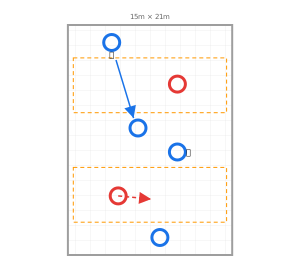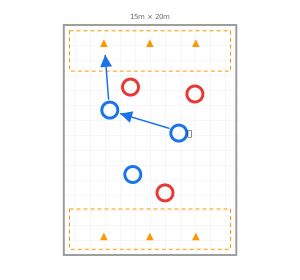
How to set it up
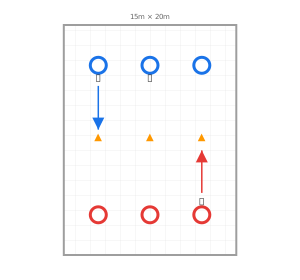
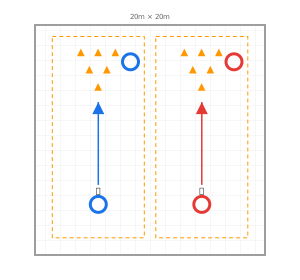
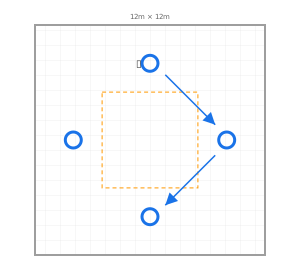
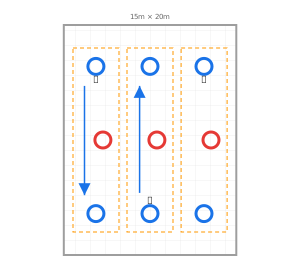
- In a 20 by 20 metre area set out five or six small gates, two cones about 1.5 to 2 metres apart.
- Players work in pairs with one ball per pair.
- Pick one or two pairs as hunters, in a different colour.
How to play
- A pair scores a point by passing the ball through any gate, one player on each side.
- They then move on to a different gate; the same gate twice in a row does not count.
- The hunters score a point each time they intercept a pass or win a ball.
- Play two-minute rounds, then swap the hunters.
Why it works
Before the hunters come in, the gates are just targets. Once they arrive, every pass becomes a choice: this gate or the free one, now or after a dribble.
Children also have to move without the ball. A partner standing still on the far side of a gate is easy to read, so pairs learn to arrive at the gate together, call, and leave.
What to coach
- Look for the free gate, not the nearest one.
- Pass to your partner's front foot so they can keep moving.
- Talk before the pass: where are we going next?
- After the pass, move straight away to the next gate.
Questions to ask
- "How did you choose the next gate?"
- "When the hunters were close, what did you do differently?"
- "How did you tell your partner where to go?"
Make it easier, make it harder
- Easier: practise with hand passes first (rolled, bounced), wider gates, only one hunter pair, or the coach as the hunter.
- Harder: two hunter pairs; the receiver must take their first touch through the gate; a gate only counts once per round.
How to adapt it by age
- U6 to U7: rolled hand passes first, then feet; the coach is the hunter.
- U8 to U10: one hunter pair, the scoring above, two-minute rounds.
- U11 to U12: two hunter pairs, two-touch limit, and gates closer together to make it crowded.
Put it in a session
Hobbit plans the whole practice around this game for your age group, numbers and space, with a diagram for every block.