
Ten soccer passing drills for youth players from U6 to U14, each with a diagram. Every drill has a target to hit, a teammate to find or a defender who can intercept, so children practise passing the way it happens in a match.
10 drills
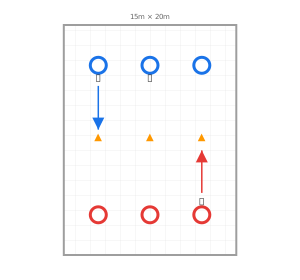
U6 to U14 · 2 to 16
Pairs knock a cone tower over from seven metres; the harder the technique, the more it scores.
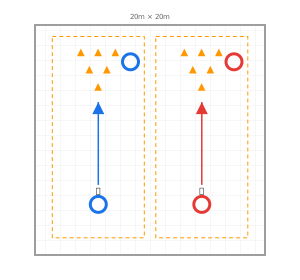
U6 to U10 · 2 to 12
Pass at six cone pins; a strike in one roll scores 100.
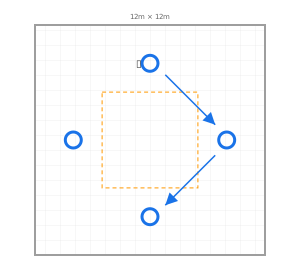
U6 to U10 · 4 to 16
Four players pass across a small square; one mistake and the streak resets.
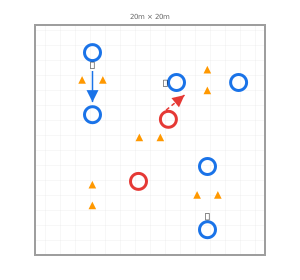
U6 to U12 · 6 to 16
Pairs pass through cone gates while hunters try to cut the passes out.
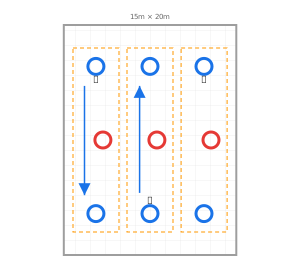
U8 to U14 · 3 to 15
Two end players pass past a blocker in the middle before a five-second count runs out.
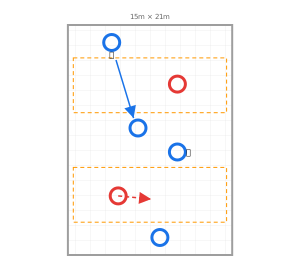
U8 to U14 · 6 to 12
Pairs pass across a channel while an interceptor inside tries to cut the ball out.
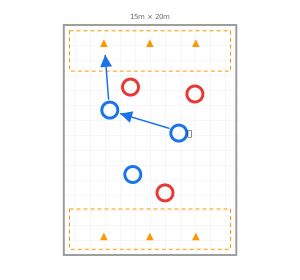
U8 to U14 · 6 to 8
3v3 or 4v4 where a goal is a cone tower knocked down from outside the zone.
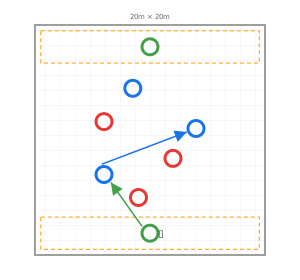
U8 to U14 · 6 to 10
Two teams score by getting the ball from one end-zone neutral to the other.
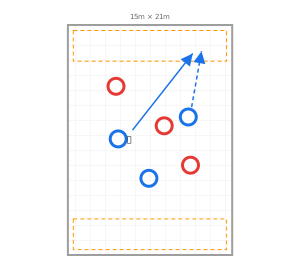
U8 to U14 · 6 to 8
A pass received in the end zone scores three; a dribble in scores one.
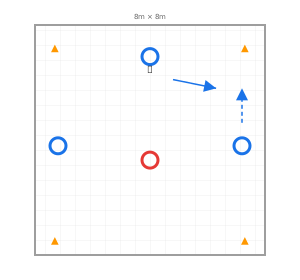
U9 to U14 · 4 to 16
3v1 in a small square, with receivers always moving to the passer's side cones.
A good passing drill gives the player a reason to pass: a target to hit, a teammate who has to move, or a defender who can intercept. It keeps every child on the ball with no queue, and it asks the questions a match asks: where to pass, when, and how hard.
Two children ten metres apart, passing back and forth, look like they are learning to pass. The ball rarely goes astray. But nobody chose anything: the partner is always in the same place, nobody is trying to stop the ball, and the pass never has to be early or late.
That is what we call "football calisthenics": the movement of the game without the game. The drills on this page add one of three things, a target, a choice or an opponent, and usually all three by the end.
Under 8, use target games where passing is about aim and weight; from 8 to 10, add passing on the move and defenders who hunt the ball; from 10 up, use rondos, end zones and games where the run before the pass decides the outcome.
Give every pair or small group its own ball and its own space, explain the rule in under 30 seconds, and change the game instead of stopping it. One ball between two keeps every child touching it every few seconds; a queue of six cuts that to one touch a minute.
When something is not working, change one of the game's variables rather than giving a speech: the number of touches, the size of the space, the distance, or the number of defenders. If nobody plays the long pass, make it worth double.
The common mistakes are long queues behind a cone, passing without opponents for the whole session, stopping play to correct every pass, distances copied from adult football, and passing only with the stronger foot. Each one makes a session look tidy while the children make fewer decisions.
Most passing drills work best in rounds of one to three minutes, for ten to fifteen minutes in total. Short rounds keep the intensity up and give natural breaks to ask a question, change the rule or swap the roles.
Target games are best at six: knocking a cone tower over or bowling at a set of cones. They teach aim and weight with the inside of the foot, every child gets a turn every few seconds, and a hit is instant feedback.
Do not take the dribbling away; make the pass worth something. In a game where a pass into an end zone scores three and a dribble scores one, children start to look for the pass on their own, because it pays.
Four is enough: three attackers keep the ball from one defender in a small square, about 8 by 8 metres for U10. Bigger groups can run several squares side by side, so nobody waits.
Yes, from about eight. The easiest way is to score it: a pass with the weaker foot is worth more points than one with the stronger foot, so children choose to try it.