
Ten soccer dribbling drills for youth players from U5 to U16, each with a diagram. Every drill gives the dribbler a decision, an escape route or a defender to beat, so children practise dribbling the way they use it in a match.
10 drills
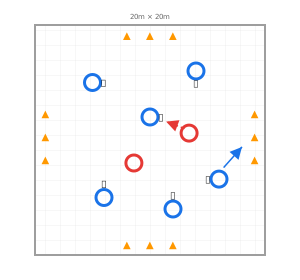
U5 to U10 · 8 to 16
Dribble from side to side to score while the bib throwers try to hit your ball.
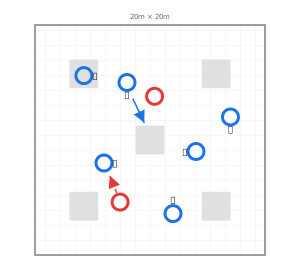
U5 to U10 · 8 to 16
Dribble between safe zones for points; three in a row pays a bonus, a hit resets you.
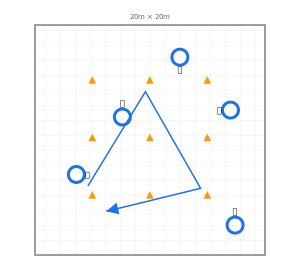
U5 to U10 · 6 to 16
The coach calls a shape or a letter; players dribble a route around the cones that draws it.
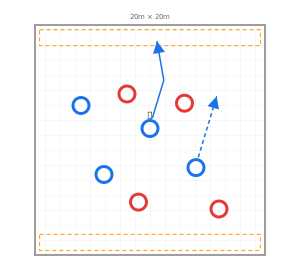
U5 to U10 · 6 to 16
4v4 where you score by stopping the ball on the other team's end line.
U6 to U10 · 6 to 16
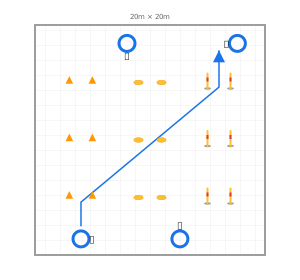
Cross three rows of gates without repeating a colour; every crossing scores a point.
U6 to U10 · 6 to 12
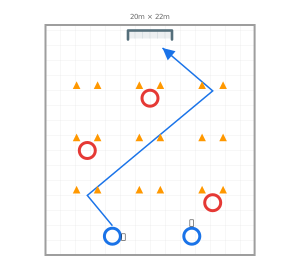
Cross three rows of gates past a guard in each row, then shoot.
U6 to U14 · 6 to 12
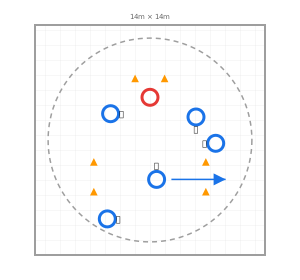
Dribble through empty gates in a circle; beat a gate guard with a feint for three points.
U6 to U12 · 6 to 12
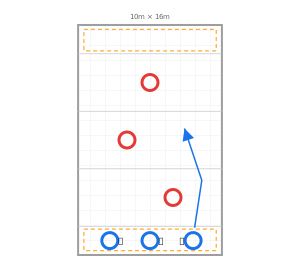
Dribble through three zones, past one defender in each.
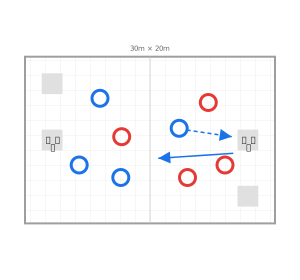
U8 to U16 · 8 to 16
Raid the other half, steal a ball from the treasury and dribble it home without being caught.
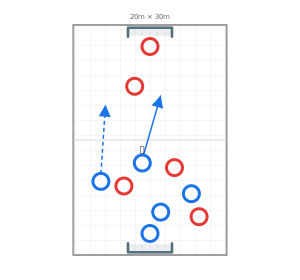
U8 to U16 · 10 to 12
Defenders caught upfield cannot recover until an attacker crosses halfway: run into the space.
A good dribbling drill makes the player decide where to go, when to speed up and how to beat or escape an opponent. Cones can mark the space, but they should not be the opponent: a cone never moves, so a slalom teaches a route, not a decision.
Watch a child weave smoothly through a line of cones and it looks like dribbling. Put a real defender in front of the same child and the smoothness often disappears, because the cones never stepped in, never showed a side, never took the ball.
So in every drill on this page there is something that moves and decides: a tagger, a guard, a defender, or at least another dribbler in the way. That is where dribbling is learned.
From U5 to U7, use games with a ball each, safe zones and taggers; from U8 to U10, add gates, routes and 1v1 breakouts; from U11 up, use team games where running with the ball into open space decides the result.
Both, and choosing between them is the real skill. Close control keeps the ball near the feet in tight spaces and near defenders; running with the ball uses long touches to cover open space quickly. Games with safe zones and halfway rules make children switch between the two.
A child who only ever dribbles close loses the ball to a recovering defender in open space; a child who only knocks it long and runs loses it in traffic. The drills here put both situations in the same game, so the child has to read which one they are in.
The common mistakes are cone slaloms as the main activity, telling children which move to use, punishing every lost ball, big groups sharing one ball, and correcting a technique that works. Each one makes dribbling look tidier and makes children less brave.
At five, the best dribbling drills are tag games with a ball each and safe zones, like Four Sides Escape. Every child dribbles all the time, the taggers make them look up, and the safe zones give them a target to run to.
Give them something worth looking up for: a safe zone that is only safe when it is empty, a gate that is free, a tagger coming. Telling children to look up rarely works; a game that punishes not looking does.
Show moves as options, not as answers. Children learn a feint fastest when they need it to beat a defender in a game, and the same situation can be solved in several ways: a feint, a change of speed or a turn.
Do not take dribbling away from the child; change the scoring. In Stop It on the Line, a point needs the ball stopped on the end line, and a pass that reaches a teammate in space gets there faster than a dribble through three players.
Most dribbling games work in rounds of one to two minutes, for eight to fifteen minutes in total. Dribbling with a defender is intense, so short rounds keep the quality high and give breaks for one question.