
Ten soccer defending drills for youth players from U6 to U14, each with a diagram. They start with 1v1 body shape and when to press, and build to pressure, cover and balance in small groups, always against real attackers who are trying to score.
10 drills
U6 to U14 · 6 to 12
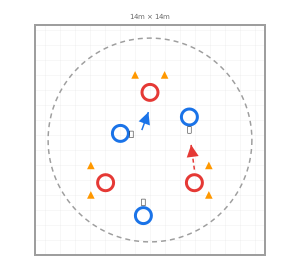
Defenders guard gates in a circle and choose when to step out and win the ball.
U8 to U14 · 3 to 12
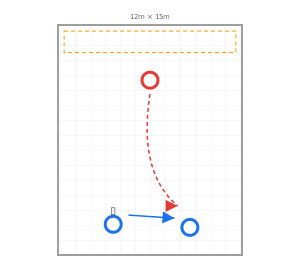
One defender against two: close down while the ball travels, then show the attacker away from help.
U8 to U14 · 6 to 12
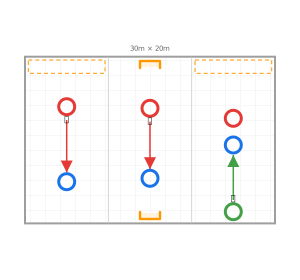
Three lanes, three 1v1 problems: an end line, a goal, an attacker who must turn.
U8 to U14 · 8 to 10
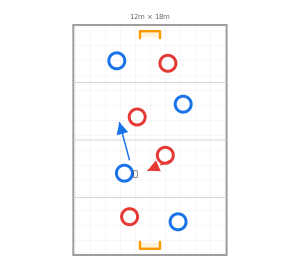
4v4 with one player from each team in each zone; only the dribbler may leave.
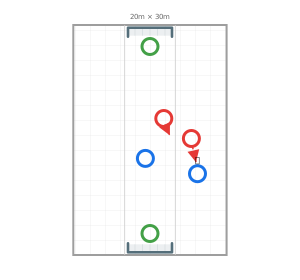
U9 to U14 · 8 to 14
Two against two: one defender presses, the other covers, and the roles swap with every pass.
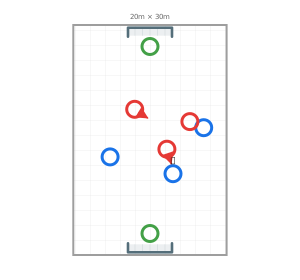
U10 to U14 · 9 to 14
Three defenders, three roles: pressure, cover and balance, swapping as the ball moves.
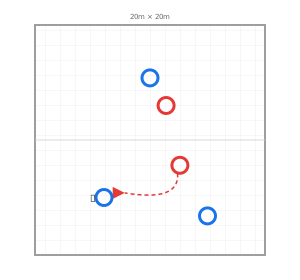
U10 to U14 · 5 to 10
Press on a curved run so your body blocks the pass behind you.
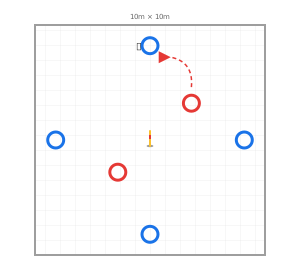
U10 to U14 · 6 to 12
Two defenders protect a central cone by closing the passing lanes through the middle.
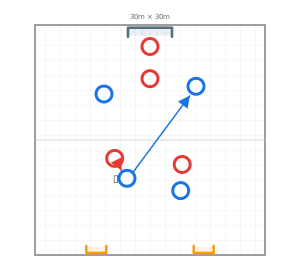
U10 to U14 · 8 to 10
Three defenders and a keeper against four attackers, with a counter into two small goals.
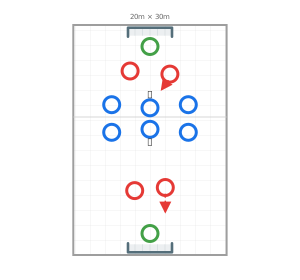
U11 to U14 · 10 to 14
Two 3v2 games at once: delay in the big zone, block in the small one.
A good defending drill has real attackers trying to score, a target the defender is protecting, and a reward for winning the ball and attacking straight away. It teaches the defender to read the attacker and decide when to press, when to wait and how to work with a teammate.
Defending is the part of the game children are most often shouted at about: "get in there", "tackle". But the hardest defending decisions are about when not to: wait for help, show the attacker the wrong way, stand where the pass would go.
So none of the drills here have a passive attacker or a walk-through of positions. Somebody is always trying to get past, and the defender always has a reason to win the ball: a goal to counter into.
From U6 to U8, start with protecting a gate and 1v1 body shape; from U8 to U10, use 1v1 and 2v1 games with clear end lines; from U10 up, use 2v2 and 3v3 games that teach pressure, cover and balance, then shadow covering and defending outnumbered.
Pressure is the defender nearest the ball closing the attacker down; cover is a second defender behind and to the side, ready if the first is beaten; balance is a third defender further away, protecting the space and the far attacker. The roles change every time the ball moves.
Children do not need the words first. In a 2v2 they discover quickly that two defenders running at the ball leave the other attacker free, and the question "who went to the ball, and where was the other one?" does the rest.
The common mistakes are diving in, standing square to the attacker, practising shape without attackers, shouting "tackle" instead of letting the defender decide, and giving no reward for winning the ball. Each one teaches defending as a reaction instead of a decision.
Teach the approach and the stance through a game: close the space quickly while the ball travels, slow down at two or three metres, turn side-on and show the attacker one way. A 1v1 to an end line, where the defender can score too, gives all of that in one activity.
Around 10. Before that, 1v1 and 2v1 defending is enough; from U10 a 2v2 game shows the need for a covering defender, and from U11 or U12 a 3v3 adds balance.
Shadow covering is pressing the ball carrier on a curved run so that your body blocks the pass to the nearest attacker behind you. One defender covers two players: the one with the ball and the one in their shadow.
Give the defender a reason to wait. In games where a defender who stays on their feet and wins the ball can counter straight into a goal, children learn that a tackle that misses gives the attacker a free run, while patience gives them the ball.
Most defending games work in rounds of one to three minutes, or a set number of attacks, for twelve to fifteen minutes in total. Defending 1v1 is tiring, so rotate the defenders often.