How to set it up
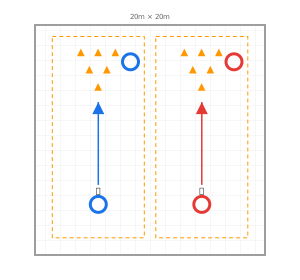
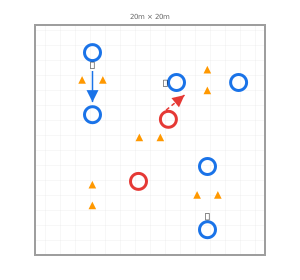
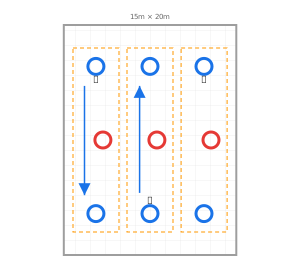
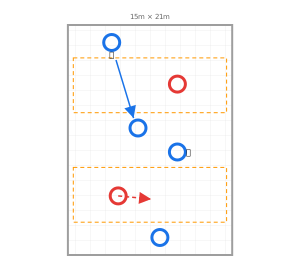
- Mark a 20 by 20 metre area with an end zone about 3 metres deep at each end.
- Put one neutral player in each end zone (a different colour bib). The neutrals play for whichever team has the ball.
- Split the rest into two teams of 3 or 4 in the middle. One ball.
How to play
- Play starts with a neutral passing into the middle.
- A team scores a point when the ball travels from one neutral to the other: in from one end zone, through the team, out to the other end zone.
- After a point the scoring neutral restarts the game, now towards the opposite end.
- The defending team wins the ball and attacks straight away, using the same two neutrals.
- Rotate the neutrals every three minutes so everyone plays in the middle.
Why it works
There is no goal to shoot at, so the only way to score is to find the next pass. Children who would dribble into traffic have to look up, because the point is at the other end of a chain of passes.
The neutrals give the team with the ball an extra player at each end, which makes the first pass forward possible. The defending team learns to block the lane to the far neutral rather than chasing the ball.
What to coach
- Spread out: move to where the passer can see you, away from the defender's shadow.
- Pass to the foot further from the defender.
- Receive with an open body, so you can see the far end zone before the ball arrives.
- Choose between the safe pass and the forward pass; both are allowed.
Questions to ask
- "Before you got the ball, could you see the other neutral?"
- "When you were defending, which pass did you try to stop first?"
- "What did your team do when the middle got crowded?"
Make it easier, make it harder
- Easier: add a third neutral in the middle who plays for the team with the ball, or make the area wider.
- Harder: two touches per player in the middle; the neutrals have one touch; a point only counts if every player in the team touched the ball.
How to adapt it by age
- U8 to U9: 3v3 in the middle with a neutral at each end, a wide area, no touch limit.
- U10 to U12: 4v4, two-touch rounds, a bonus point for a pass that skips a player.
- U13 and up: a narrower area, one-touch neutrals, and a rule that the ball must go back to the start neutral before it can go forward again after a lost ball.
Put it in a session
Hobbit plans the whole practice around this game for your age group, numbers and space, with a diagram for every block.