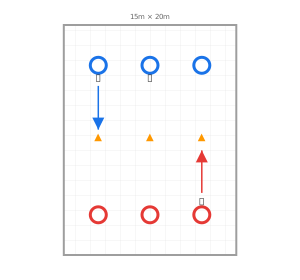
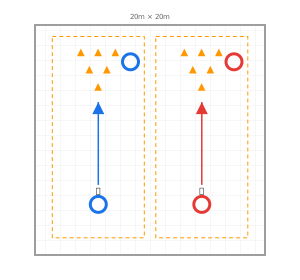
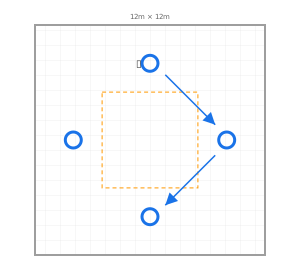
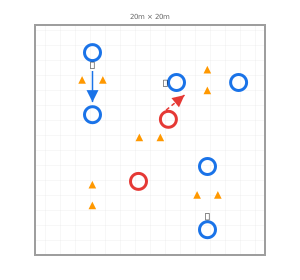
How to set it up
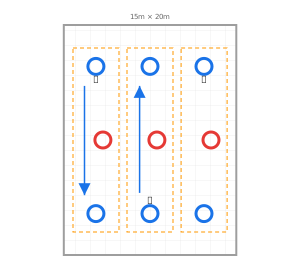
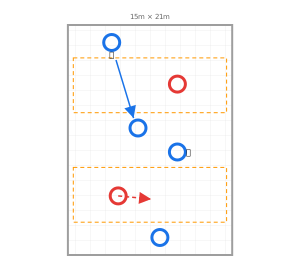
- Mark a 15 by 21 metre area: a 15 by 15 playing area with an end zone 3 metres deep at each end.
- Two teams of three or four. One ball.
- Defenders are not allowed inside their own end zone.
How to play
- A player who receives a pass inside the opponents' end zone scores 3 points.
- A player who dribbles into it scores 1.
- After a point, the other team restarts from their own end.
- No corners; side line restarts with a pass or a dribble.
- Rotate teams or players every few minutes.
Why it works
Three points for a pass, one for a dribble: children work out the sum very quickly. The best attacker is now the one who times a run into the zone, not the one who carries the ball furthest.
Because defenders cannot follow into their zone, the run has to be timed: too early and the receiver waits in the zone with nobody able to reach them; too late and the pass is cut out.
What to coach
- The run starts when the passer can see you and has time to pass.
- Run into the space behind the defenders, not towards the ball.
- Pass into the space in front of the runner, so they receive moving.
- A first touch that carries the ball forward into the zone.
Questions to ask
- "When did you start your run, and how did you know it was the right moment?"
- "Why is a pass into the zone worth more than a dribble?"
- "What did the passer see before playing the ball?"
Make it easier, make it harder
- Easier: deeper end zones, an extra attacker who plays for the team with the ball.
- Harder: two touches in the middle; the receiver must score with one touch in the zone; a narrower area.
How to adapt it by age
- U8 to U9: 3v3, deep end zones, the scoring above.
- U10 to U12: 4v4, a two-touch round, a bonus point for a pass that skips a teammate.
- U13 to U14: a narrower area and offside on the end-zone line, so the run has to be timed exactly.
Put it in a session
Hobbit plans the whole practice around this game for your age group, numbers and space, with a diagram for every block.