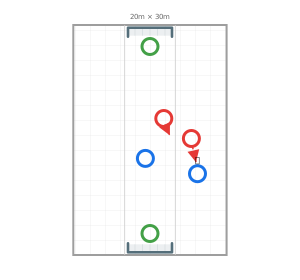
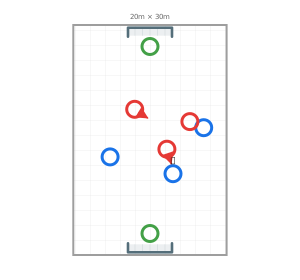
How to set it up
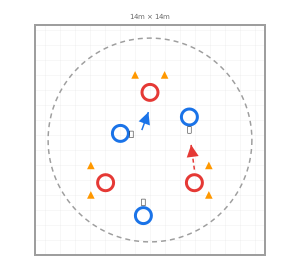
- Mark a 10 by 10 metre square and put a tall cone or a pole in the middle.
- Four attackers, one on each side of the square; two defenders inside. One ball.
How to play
- The attackers keep the ball. Twenty passes in a row, or a pass that hits the central cone, scores a point.
- The defenders try to win the ball. When they do, they swap with two attackers.
- When the attackers score, the defenders stay in for another round.
Why it works
The cone makes the middle the most dangerous place on the pitch, just as the space between defenders is in a match. The two defenders cannot just chase the ball: they have to keep the lanes through the middle closed.
That forces the pair to work out the distance and angle between them: too far apart and a pass goes through; too close and the ball goes round them.
What to coach
- One defender presses the ball, the other covers the lane to the cone.
- Keep the distance between the two of you small enough that no pass goes between.
- Press on a curve to block the pass to the nearest attacker.
- When the ball carrier has no pass, both press hard.
Questions to ask
- "Which pass were you trying to stop first?"
- "How far apart were the two of you when they got the ball through?"
- "When did you decide to both go to the ball?"
Make it easier, make it harder
- Easier: a bigger square; the attackers need two touches; only twenty passes score, not the cone.
- Harder: a smaller square; one-touch attackers; the defenders score a point for every ball won and passed out of the square.
How to adapt it by age
- U10 to U11: a 12 by 12 square, two-touch attackers.
- U12: the full game.
- U13 to U14: 5v2 in a smaller square with one touch.
Put it in a session
Hobbit plans the whole practice around this game for your age group, numbers and space, with a diagram for every block.