How to set it up
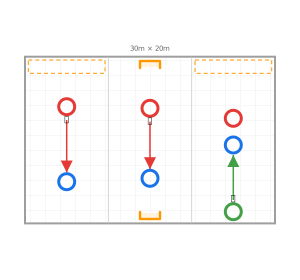
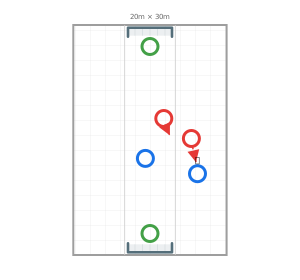
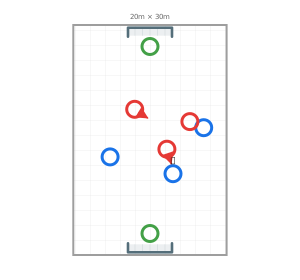
- Mark a pitch about 12 metres wide and 18 metres long (10 by 15 for U8) and divide it into four zones across its width.
- Put a small goal at each end.
- Two teams of four, one player from each team in each zone. One ball.
How to play
- Players stay in their own zone. Only the player with the ball may dribble out of it.
- Score in the opponents' small goal.
- No corners; a ball over the side line restarts with a pass or a dribble.
- Rotate the zones every few minutes so everyone defends near both goals.
Why it works
Each zone is a small 1v1 with clear borders, so a defender always knows who they are responsible for. But a dribbler who leaves their zone arrives in the next one, and the defender there has to decide: step up to meet them, or stay with their own attacker?
That is the first step towards defending as a team: the defender's job changes when the ball comes into their zone.
What to coach
- Choose where to stand in your zone: closer to the ball or back towards your goal?
- Side-on, low, showing the attacker towards the side line.
- When a dribbler comes into your zone, decide early: step up or stay.
- Talk to the defender in the next zone: who has the dribbler?
Questions to ask
- "When the dribbler came into your zone, what did you decide and why?"
- "Which way did you show the attacker?"
- "How did you and your teammate in the next zone help each other?"
Make it easier, make it harder
- Easier: three zones and 3v3; a wider pitch.
- Harder: a narrower pitch; the dribbler may only beat one zone before passing; a goal only counts if the ball has gone through all four zones.
How to adapt it by age
- U8 to U9: 10 by 15 metres, 3v3 in three zones.
- U10 to U12: the full 4v4 in four zones.
- U13 to U14: a narrower pitch and the rule that defenders may help in the next zone but must be back in their own within three seconds.
Put it in a session
Hobbit plans the whole practice around this game for your age group, numbers and space, with a diagram for every block.