How to set it up
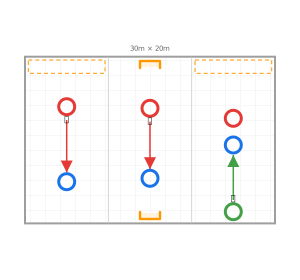
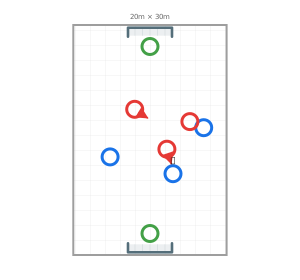
- Mark a lane about 12 metres wide and 15 metres long.
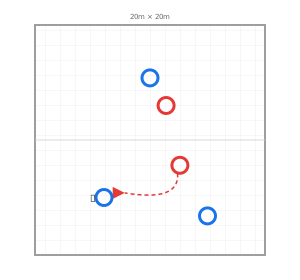
- Groups of three: two attackers start on one end line with a ball, one defender on the other.
- Several lanes side by side for bigger groups.
How to play
- The attackers start with a pass across to each other. The defender may move as soon as the ball is played.
- The attackers score by stopping the ball on the defender's end line.
- The defender scores by winning the ball and kicking it over the attackers' end line.
- When the ball goes out or someone scores, the next group goes.
- Change the defender every two minutes.
Why it works
Two against one is the hardest job a defender has, so every second counts. The defender learns to cover ground while the ball is travelling, the only moment the attackers cannot hurt them.
Then the question changes: can I make this a 1v1? Showing the ball carrier towards the side line, away from their partner, is how.
What to coach
- Sprint to close the space while the pass travels.
- Slow down two or three metres away, so the attacker cannot go past you.
- Side-on, showing the ball carrier towards the side line and away from the other attacker.
- Stay on your feet until the attacker gives you a chance to win it.
Questions to ask
- "When was the best moment to run at the attackers?"
- "Which way did you make the attacker go, and why that way?"
- "What did the attackers do that made it hard for you?"
Make it easier, make it harder
- Easier: a narrower lane; the defender may start closer; the attackers must make the first pass straight across.
- Harder: a wider lane; the attackers can pass back and forward freely; a second defender joins from behind after three seconds, making it 2v2.
How to adapt it by age
- U8 to U9: a narrow lane, the first pass straight across.
- U10 to U12: the full game, with the defender scoring over the end line.
- U13 to U14: the recovering second defender, to start pressure and cover.
Put it in a session
Hobbit plans the whole practice around this game for your age group, numbers and space, with a diagram for every block.