How to set it up
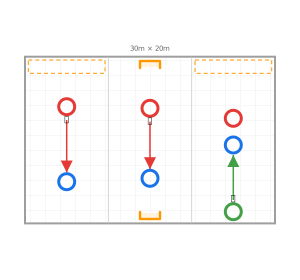
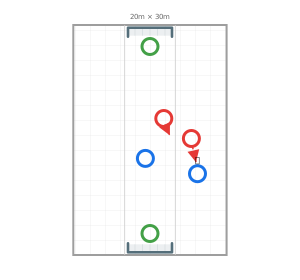
- Mark a 20 by 30 metre area with a goal and goalkeeper at each end.
- Three teams of three or four; two play 3v3 while the third waits one round.
How to play
- The defending team passes to the attacking team and can press once the ball is touched.
- The attackers score in the goal behind the defenders; the defenders counter into the other goal if they win the ball.
- After each goal or ball out, rotate the teams.
- Play twenty attacks; most goals wins.
Why it works
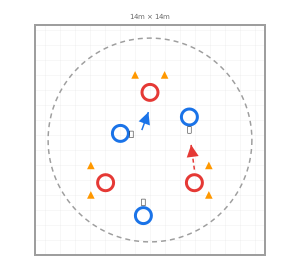
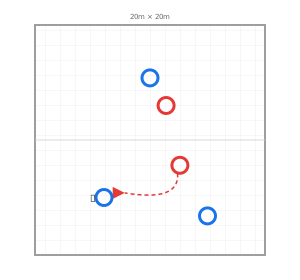
Three defenders against three attackers is the smallest game where all three defending roles appear: one presses the ball, one covers behind them, one balances the space on the far side.
The roles change with every pass, so nobody owns one. The balance defender, who can see the whole picture, also learns to tell the others where to go.
What to coach
- Pressure: the nearest defender closes down fast, then slows, and shows the attacker towards a teammate.
- Cover: behind and to the side of the presser, close enough to help, far enough not to be beaten by the same move.
- Balance: further away, between the far attacker and the goal, watching the space behind.
- When the ball moves, the roles change: talk.
Questions to ask
- "Where were the three of you when you won the ball?"
- "Who was in the best place to see the whole game?"
- "What did the attackers do to pull your shape apart?"
Make it easier, make it harder
- Easier: a narrower area, two touches for the attackers.
- Harder: a wider area; 4v3 for the attackers; a defending team that wins the ball must score within ten seconds.
How to adapt it by age
- U10 to U11: the narrow area, and start with 2v2 before adding the third player.
- U12: the full game.
- U13 to U14: 4v3 and a high pressing trigger: the defenders press as one when the ball goes to a wide player.
Put it in a session
Hobbit plans the whole practice around this game for your age group, numbers and space, with a diagram for every block.