How to set it up
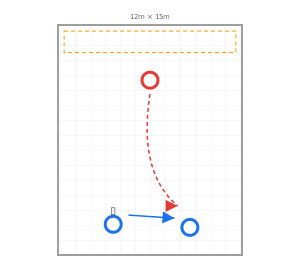
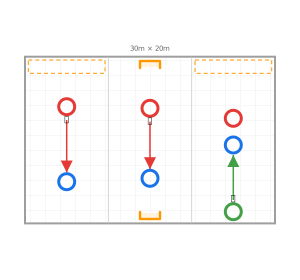
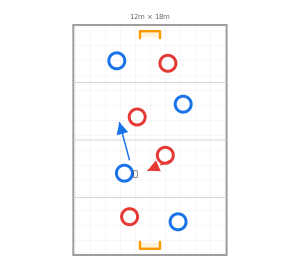
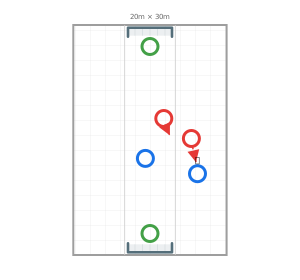
- Mark a circle about 12 metres across with three small gates inside it.
- Split the group into teams of three. One team defends, the others attack with a ball each.
- Each defender starts on a gate line.
How to play
- Attackers dribble through any gate to score a point, then come back into the circle round the side of the gate.
- Defenders protect their gates. They can move along the gate line, or leave it to win the ball from an attacker.
- A defender who wins the ball swaps places with the attacker who lost it.
- Two-minute rounds; the attacker with the most points wins, and every team takes a turn defending.
Why it works
A defender standing on a gate line has a clear job, and a clear risk: step out to win a ball and your gate is open behind you. Every step out is a decision about how dangerous the attackers near the gate are.
The stance comes from the task. To see the attacker and the gate at once, the defender has to turn side-on.
What to coach
- Stand side-on so you can see the attacker and your gate.
- Knees bent, weight low, ready to move both ways and stretch a leg.
- Leave the attacker a big space on one side, then close it when they take it.
- Step out when the attackers near your gate are not a threat; stay when they are.
Questions to ask
- "When did you decide to leave your gate?"
- "Which way did you want the attacker to go, and how did you show them?"
- "Why did standing side-on help?"
Make it easier, make it harder
- Easier: bigger circle, smaller gates, defenders stay on the line.
- Harder: two attackers can combine; a gate beaten with a move scores three; defenders who win the ball can score by dribbling through any gate.
How to adapt it by age
- U6 to U7: defenders stay on the line; attackers score through any gate.
- U8 to U10: defenders may leave the line; swap on a win.
- U11 to U14: the three-point move, and a defender who wins the ball counters straight away.
Put it in a session
Hobbit plans the whole practice around this game for your age group, numbers and space, with a diagram for every block.