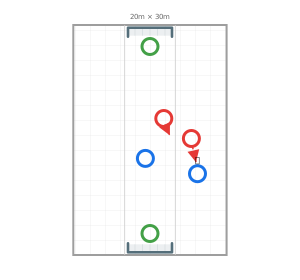
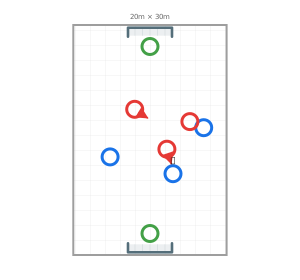
How to set it up
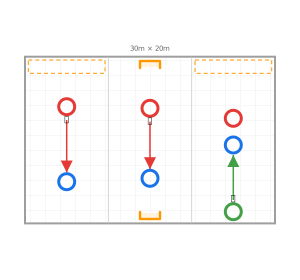
- Mark a 20 by 30 metre area split into a small zone and a large zone, each with a goal and a goalkeeper at its far end.
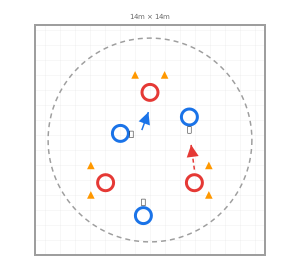
- In each zone, three attackers against two defenders.
How to play
- The attackers start from the line between the zones and attack the goal in their zone.
- The defenders score by winning the ball and passing it to a teammate in the other zone.
- After a goal or the ball going out, the attackers restart from the line.
- Seven-minute rounds; then rotate positions and zones.
Why it works
Outnumbered, the defenders' first job is not to win the ball but to buy time. In the large zone there is room to back off, slowing the attack until it reaches the area where the keeper can help.
In the small zone there is no time to back off: the defenders have to block the shot and close the gap between them at once. Two zones, two answers to the same problem.
What to coach
- Large zone: back off towards goal, side-on, until the attack is close enough for the keeper to help.
- Small zone: the nearest defender blocks the shot; the second closes the gap between them.
- Keep the distance between the two defenders tight enough that no pass goes between.
- Stay between the ball and the goal, moving across as the ball moves.
Questions to ask
- "In the big zone, when did you stop backing off?"
- "What did you do differently in the small zone?"
- "How did the goalkeeper help you?"
Make it easier, make it harder
- Easier: 3v3 in each zone; a narrower area.
- Harder: a neutral player in the middle who can help either attack, making it 4v2; the attackers score double if they keep the ball for six passes first.
How to adapt it by age
- U11 to U12: one zone at a time, then both.
- U13 to U14: the neutral player, and attackers who are told to be patient.
Put it in a session
Hobbit plans the whole practice around this game for your age group, numbers and space, with a diagram for every block.