How to set it up
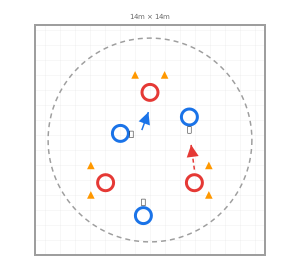
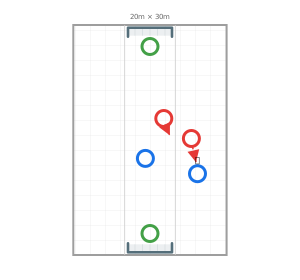
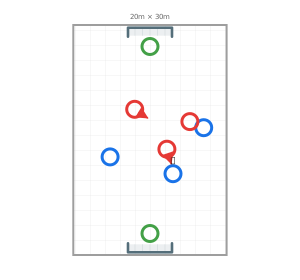
- Mark a 20 by 20 metre area divided into two halves.
- Three attackers and two defenders, one defender in each half. One ball.
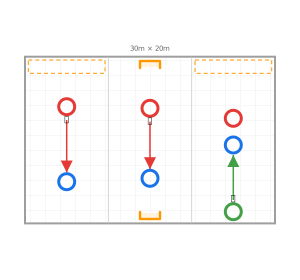
- Run several areas side by side for bigger groups.
How to play
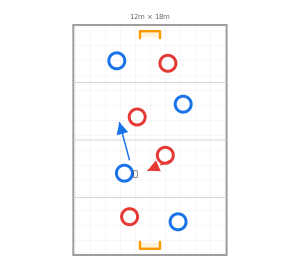
- The attackers keep the ball. The player on the ball stays in their own half, with a teammate on the same side; the third attacker is in the other half and moves across to support when the ball is passed there.
- Each defender stays in their own half.
- A defender who wins the ball swaps with the attacker who lost it.
- Ten passes in a row and the defenders do an extra round.
Why it works
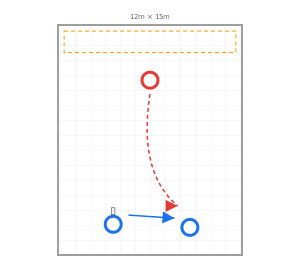
A defender against two attackers on the same side cannot mark both. But by pressing on a curved run, the defender's body hides the pass to the nearer attacker: that is shadow covering, one defender covering two players.
The halves keep it simple. Each defender has one problem in one space, and the attackers' switch to the other half tests the second defender.
What to coach
- Approach on a curve, not in a straight line, so your back blocks the pass behind you.
- Close the pass forward first; leave the sideways pass, which your teammate can attack.
- Slow down at the right distance and stay on your feet.
- When the attacker has no pass left, press hard.
Questions to ask
- "Which pass did your run block?"
- "Why did you come round in a curve and not straight?"
- "When did you know the attacker had no pass left?"
Make it easier, make it harder
- Easier: a bigger area; the attackers must take two touches.
- Harder: a smaller area; four attackers against two; the attackers score a point for a pass that splits the two defenders.
How to adapt it by age
- U10 to U11: walk the curved run without the ball first, then play.
- U12: the full game.
- U13 to U14: four attackers against two, and the split pass scoring.
Put it in a session
Hobbit plans the whole practice around this game for your age group, numbers and space, with a diagram for every block.