How to set it up
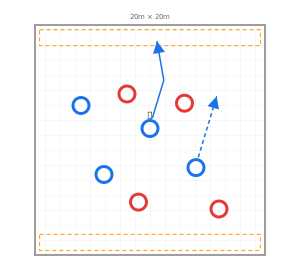
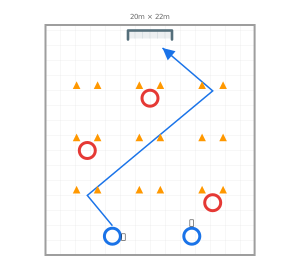
- In a 20 by 20 metre area set nine small gates (two markers about 2 metres apart) in three rows and three columns.
- Give each column its own colour, or its own kind of marker: cones, discs, poles.
- Every player has a ball and starts behind one of the two end lines.
How to play
- Dribble from one end line to the other through one gate in each of the three rows.
- The three gates must be three different colours, so the route has to change direction.
- Each time you start a crossing, use a different gate in the first row.
- A completed crossing scores a point. A ball that goes out, touches a marker or hits another ball, or a collision, resets your score to zero.
- One-minute rounds; players cross in both directions at once, so the middle gets busy.
Why it works
The colour rule turns a straight run into a decision: the gate in front of you is the wrong colour, so which one now? Players coming the other way add a second decision at every row.
Because a mistake resets the score, speed alone does not win. The best routes are planned early and taken with control.
What to coach
- Look up as you start: plan two gates ahead.
- Change direction with different parts of the foot: inside, outside, sole.
- Keep the ball close through the gate, then push it into the next space.
- Speed up after the last row.
Questions to ask
- "Which route did you plan before you started?"
- "What did you do when someone was coming through your gate?"
- "Why did your score go back to zero, and what would you change?"
Make it easier, make it harder
- Easier: wider gates, fewer players at once, colours allowed to repeat.
- Harder: a time limit per crossing; a different turn at every gate; a goal beyond each end line, so a crossing ends with a shot.
How to adapt it by age
- U6 to U7: run the routes without a ball first, then with the ball; call a colour and players go through it.
- U8 to U9: the full rule and the reset; a time limit for the crossing.
- U10: players choose their own start; add the goal and the shot at the end.
Put it in a session
Hobbit plans the whole practice around this game for your age group, numbers and space, with a diagram for every block.