How to set it up
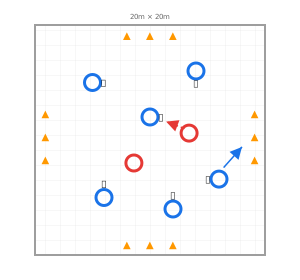
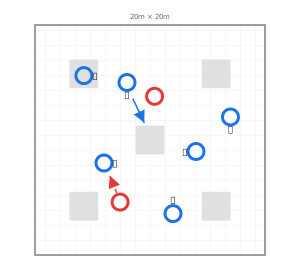
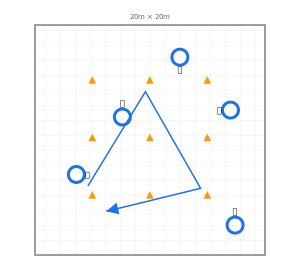
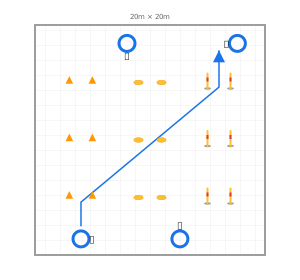
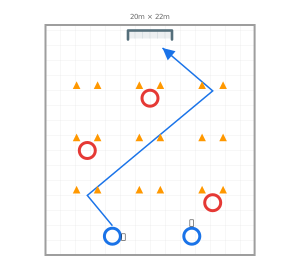
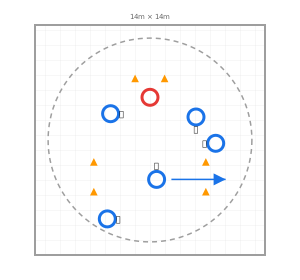
- Mark a 20 by 20 metre area. With more players, set up two or more areas side by side.
- Two teams of four, one ball, no goals and no goalkeepers.
How to play
- A team scores when a player stops the ball under the sole on the opponents' end line.
- After a point, the team that conceded restarts from its own end line, and the scoring team must first drop back to its own half.
- No corners. A ball over the side line comes back in with a pass or a dribble.
- Play short games of three or four minutes.
Why it works
The whole end line is the goal, so a dribbler always has somewhere to go, and there is no keeper to shoot past: the ball has to be carried, or passed to a teammate who can carry it.
Stopping the ball on the line is harder than it looks at speed. It rewards control at the end of a run, not just a fast run.
What to coach
- Head up to see the space and the defenders.
- Ball close when a defender is near; protect it with the body.
- Long touches and speed when the path to the line is open.
- Find a position away from your teammate who has the ball.
Questions to ask
- "Where was the space when you scored?"
- "When was it better to pass than to dribble?"
- "What did you do when two defenders came at you?"
Make it easier, make it harder
- Easier: all four sides score; two balls in the game; 3v3 for more space each.
- Harder: a rectangle that is longer than it is wide; the ball must be stopped inside a narrow end zone; a point only counts if every player touched the ball.
How to adapt it by age
- U5 to U6: any side scores, or two balls at once; very short games.
- U7 to U8: a round robin of four teams on two areas.
- U9 to U10: a longer rectangle, the drop-back rule after each point, and a bonus for beating a player before the line.
Put it in a session
Hobbit plans the whole practice around this game for your age group, numbers and space, with a diagram for every block.