How to set it up
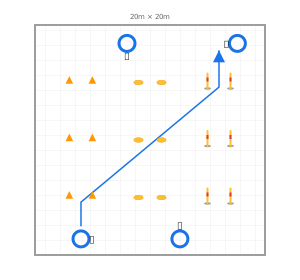
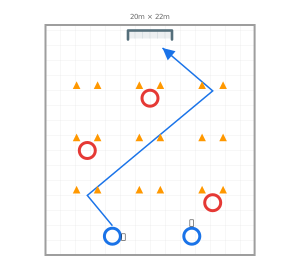
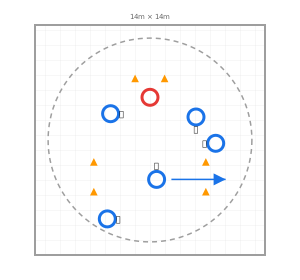
- Mark a 20 by 20 metre square. In the middle of each side put three cones 2 metres apart: these four side zones are safe.
- Every player has a ball.
- Pick two to four bib throwers. Each holds a bib.
How to play
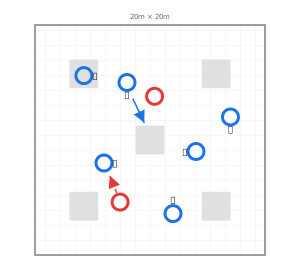
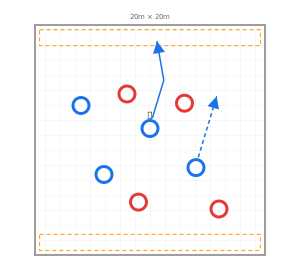
- The dribblers go from side to side. Each time a dribbler reaches a side zone, they score a point, and the next point must come from a different side.
- The throwers try to hit a dribbler's ball with a bib, thrown low along the ground.
- A dribbler whose ball is hit swaps roles with the thrower.
- Side zones are safe, but nobody can stay in one for more than three seconds.
- One-minute rounds; the highest score wins.
Why it works
Every child dribbles all the time, and the throwers turn an empty square into a place full of decisions: which side is free, when to go, when to keep the ball close.
The three-second limit stops anyone hiding. The safe zone is a breather, not a home.
What to coach
- Look up between touches: where are the throwers, which side is free?
- Keep the ball close when a thrower is near, and shield it with your body.
- Change direction away from the thrower, then speed up into the space.
- Keep a sensible distance from the throwers; do not dribble straight past them.
Questions to ask
- "How did you choose which side to go to?"
- "What did you do when a thrower came close?"
- "When did you go fast, and when did you slow down?"
Make it easier, make it harder
- Easier: fewer throwers, a bigger square, throwers can only tap the ball with the bib in their hand.
- Harder: only an empty side counts; at most three players in a side zone; the throwers become normal defenders who can tackle.
How to adapt it by age
- U5 to U6: give the throwers a story: zookeepers, monsters, spiders. A hit ball means the dribbler joins the zookeepers.
- U7 to U8: a hit dribbler becomes a thrower until one dribbler is left: the last one standing wins.
- U9 to U10: the throwers defend normally and can tackle; the score counts only from empty sides.
Put it in a session
Hobbit plans the whole practice around this game for your age group, numbers and space, with a diagram for every block.