How to set it up
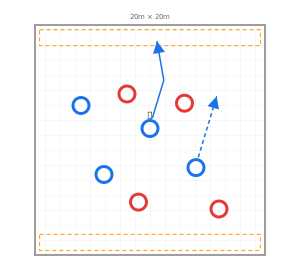
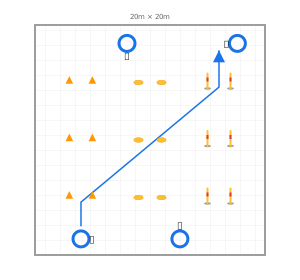
- In a 20 by 20 metre area set nine small gates in three rows of three, and a goal beyond the far end line.
- Put one guard in each row of gates. Guards stay in their own row.
- The attackers each have a ball and start behind the near end line.
How to play
- Attackers dribble through one gate in each row, then shoot at the goal.
- A guard stands in front of the gate an attacker is heading for and blocks it with their body. Guards cannot tackle.
- An attacker may not go through a gate that a guard is blocking: they have to find another.
- A crossing and a goal score a point. A ball that goes out, hits a marker or another ball resets the score.
- After the shot, attackers collect their ball and dribble back down the outside to start again.
- One-minute rounds; change the guards every round.
Why it works
The guard is a defender who cannot take the ball, which makes it the perfect first opponent: the attacker has to read where the guard is going and pick another gate, without the fear of losing the ball.
The earlier the attacker looks, the easier the choice. Children who look up at the first row find the gaps; the ones looking at the ball meet a guard at every gate.
What to coach
- Look at the guard before you reach the row, not when you arrive.
- Feint towards one gate, then go through another.
- Change direction and speed past the guard.
- After the last row, shoot straight away.
Questions to ask
- "When did you see where the guard was going?"
- "How did you trick the guard into the wrong gate?"
- "What made you shoot quickly, or slowly?"
Make it easier, make it harder
- Easier: guards pick their gate at the start of each round and stay there; attackers go one at a time.
- Harder: guards move freely along their row; rows closer together; the shot must come with the first touch after the last gate.
How to adapt it by age
- U6 to U7: guards stand at fixed gates for each round; one attacker at a time.
- U8 to U9: guards may change gate once per attack.
- U10: guards move freely; attackers can go two at a time and pass to each other through a gate.
Put it in a session
Hobbit plans the whole practice around this game for your age group, numbers and space, with a diagram for every block.