How to set it up
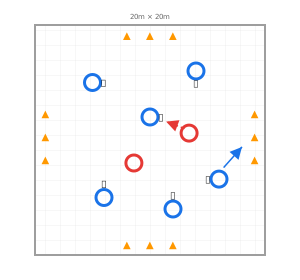
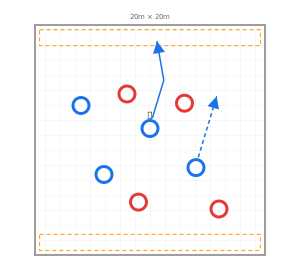
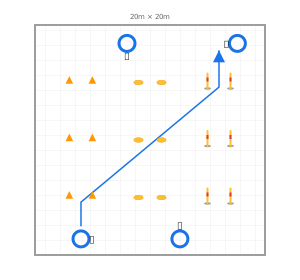
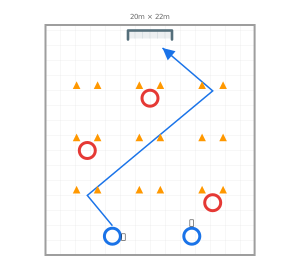
- Mark a 30 by 20 metre area with a halfway line. Each half belongs to one team.
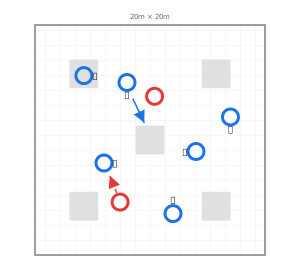
- In each half mark two small squares: a treasury with as many balls as there are players, and a prison.
- Two teams, no balls at the start except the ones in the treasuries.
How to play
- Players are safe in their own half. In the other team's half, a touch from a defender sends you to their prison.
- A prisoner waits there until a teammate reaches the prison safely; each rescue frees one player.
- Reach the other team's treasury safely and you can take one ball and dribble it home. Get it into your own treasury and your team scores.
- While dribbling home in their half, you are caught only if a defender wins the ball and kicks it out. Then the ball goes back to their treasury and you go to their prison.
- A team wins by taking all the treasure or by putting every opponent in prison. Nobody may stand in their own treasury or prison.
Why it works
Every raid is a decision about space: which route is safe, when to go, and whether to go now or wait for a teammate to draw the defenders away.
The ride home is running with the ball in its purest form: open space ahead, a defender closing, and the choice between big touches and keeping it close.
What to coach
- Look up for the safe route before you cross the halfway line.
- Start from a position that gives you space, not from the middle of the defenders.
- With space ahead, push the ball further and sprint; with a defender close, keep it tight.
- Work with teammates: decoy runs, rescues, and who stays home to defend.
Questions to ask
- "How did you find the safe route?"
- "When did you switch from big touches to small touches?"
- "How did your team decide who raids and who defends?"
Make it easier, make it harder
- Easier: start by carrying the ball in the hands instead of dribbling; the first player into the treasury can take two balls.
- Harder: fewer balls in each treasury; a pass to a teammate who then dribbles home also scores; a rescued player can go straight for the treasury.
How to adapt it by age
- U8 to U9: play the hands version first, then dribbling. Too many rules for most children under eight.
- U10 to U12: the dribbling version, with a rescue worth two players.
- U13 to U16: a bigger area, the passing rule, and a limit on how many players can defend inside their own half.
Put it in a session
Hobbit plans the whole practice around this game for your age group, numbers and space, with a diagram for every block.